How Do Bitcoin, Stablecoins, and DeFi Work?
TL;DR
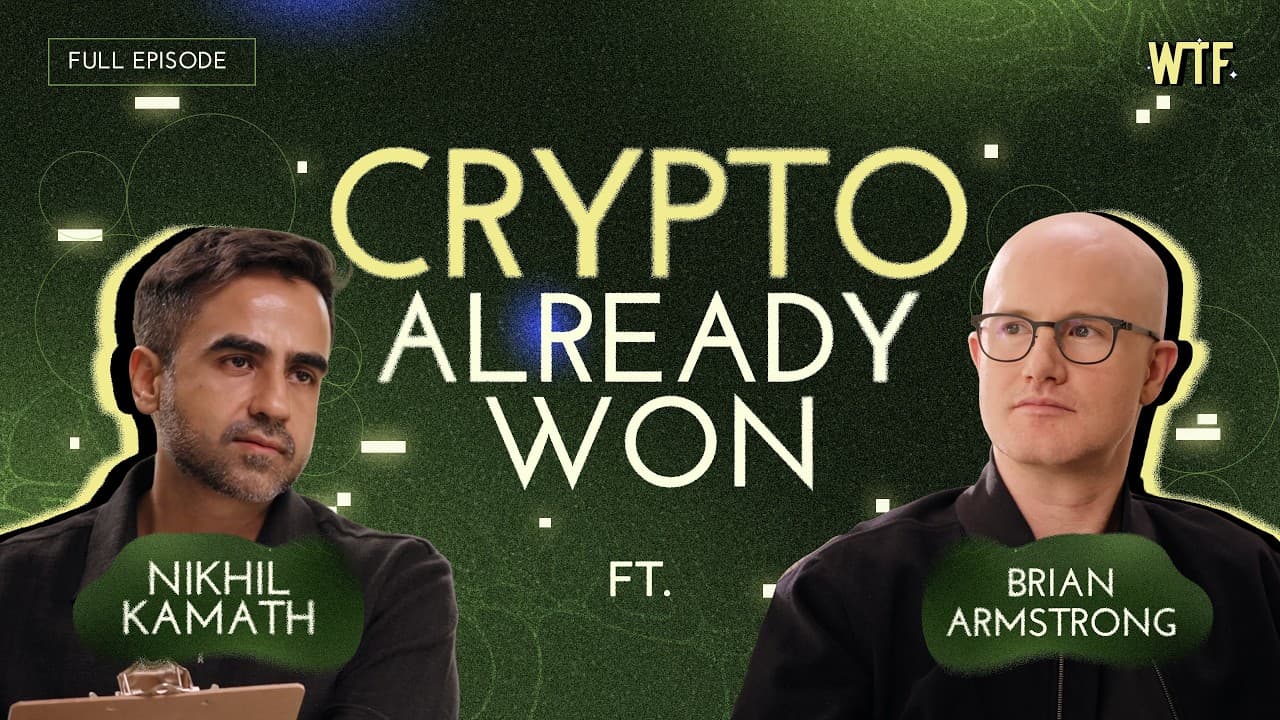
Crypto networks use blockchains, proof of stake, smart contracts, and stablecoins to support digital ownership, payments, and lending without relying entirely on traditional banks. Brian Armstrong argues that these systems could expand access to assets, improve remittances, and serve AI agents, while questions about intermediary profits, financial risk, centralization, and unequal wealth remain unresolved.
Transcript
So crypto is interesting. Everything from Bitcoins, blockchains, Solana, Ethereum... I'm no expert in these, but I've always wondered what... what the nuances of this industry are, and today is probably a good day to find out. I am a critic. I have never bought any of these, ever. I don't know if I'll remain a critic after this, but I suspect I wil... Read More
Key Insights
- Broader asset ownership is presented as a possible response to inequality because wages alone may not keep pace with rising asset values. Armstrong argues that enabling more people to own equities could give them a direct stake in economic growth and make them participants in capitalism.
- Income inequality is not treated as an isolated problem because social frustration also depends on whether ordinary purchasing power and living standards are improving. Armstrong suggests that extreme disparities become especially destabilizing when wages remain flat while a smaller group becomes substantially wealthier.
- Relative wealth affects satisfaction even when material conditions improve. Kamath argues that people compare their position with others, while Armstrong adds that individuals also adapt to better living standards and can lose appreciation for comforts that once felt exceptional.
- Stablecoins are examined as both payment instruments and financial businesses. The conversation questions how issuers generate revenue, where user yield comes from, why an intermediary should retain treasury-related returns, and what risks accompany products designed to maintain stable value.
- AI agents are expected by Armstrong to use stablecoins for payments. This prospective use connects automated software with digital money, suggesting that stablecoins may become useful when machines need to exchange value through internet-based systems without depending on conventional payment workflows.
- Bitcoin and blockchain are explained from first principles for a skeptical audience. The discussion separates the digital asset from the underlying record-keeping network, then considers mining economics and the role of proof of work in securing a blockchain.
- Proof of stake is presented as another method for securing a blockchain network. The conversation contrasts it with proof of work and places the change within a broader explanation of how crypto systems validate activity without using the same institutional foundation as traditional banks.
- Smart contracts enable decentralized finance applications such as lending. The discussion uses DeFi lending to illustrate how programmed rules can support financial transactions, while also raising the larger question of whether modern crypto has recreated intermediaries that conflict with the principles associated with Bitcoin's origin.
Install to Summarize YouTube Videos and Get Transcripts
Explore YouTube Video Summarizer or Get YouTube Transcript Extractor
Questions & Answers
Q: How can wider asset ownership reduce inequality?
Wider asset ownership could reduce dependence on wages by allowing more people to participate in the growth of companies and other assets. Armstrong says roughly four billion people are unbrokered and cannot buy equities. He presents universal access to ownership, including proposals that give children an investment at birth or a share of a sovereign wealth fund, as a way to create economic alignment.
Q: Why does income inequality create social unrest?
Income inequality becomes especially contentious when ordinary wages and purchasing power remain flat while a smaller group becomes much wealthier. Armstrong argues that people may tolerate large differences if their own lives are also improving, but stagnation makes those differences feel unfair. Kamath adds that wealth is experienced relatively, so comparisons with richer people can produce dissatisfaction despite long-term material progress.
Q: What is the difference between Bitcoin and blockchain?
Bitcoin is discussed as a digital asset, while blockchain is the underlying network and record-keeping concept that makes crypto systems possible. The conversation starts from first principles because Kamath has never bought Bitcoin and approaches the subject as a critic. It then connects blockchain security to mining, proof of work, proof of stake, and the economics that encourage network participation.
Q: How do stablecoin issuers make money?
Stablecoin issuers are presented as intermediaries whose economics depend on the assets and treasury-related returns connected to the stablecoins they issue. Kamath presses Armstrong on where the yield originates and why the intermediary should keep those returns rather than passing them to users. The discussion therefore frames issuer revenue, user yield, and financial risk as linked questions rather than treating stablecoins as simple digital cash.
Q: Why might AI agents use stablecoins for payments?
Armstrong believes AI agents will use stablecoins when they need to make payments through digital systems. Stablecoins fit this proposed role because they combine internet-based transfer with a value intended to remain stable. The conversation treats machine payments as an emerging application for crypto infrastructure, although the supplied material presents the prediction without specifying when widespread adoption will occur.
Q: How does proof of stake secure a blockchain network?
Proof of stake is presented as a blockchain security method and as an alternative that replaced proof of work in some contexts discussed during the interview. It belongs to the network's process for validating activity and maintaining trust without relying on a traditional bank. The supplied material identifies its role and comparison with mining, but does not provide a detailed step-by-step validation procedure.
Q: What are smart contracts and DeFi lending?
Smart contracts are programmed rules used to support blockchain-based financial activity, including decentralized lending. The interview uses DeFi lending to explain how financial transactions can operate through crypto infrastructure rather than depending entirely on conventional banks. It also leaves room for skepticism about risk and intermediation, especially when crypto businesses begin to resemble the financial institutions that the technology was intended to challenge.
Q: Has crypto moved away from Bitcoin's original principles?
Kamath raises the possibility that modern crypto has become the opposite of what Satoshi wrote in the Bitcoin white paper. His concern centers on intermediaries, including businesses that hold assets or retain financial returns, and on whether these structures recreate features of traditional finance. The conversation does not settle the issue, but uses it to test whether current crypto products remain consistent with their stated decentralized foundations.
Summary & Key Takeaways
-
Brian Armstrong presents wider asset ownership as one response to inequality. He argues that giving more people access to equities could let them participate in economic growth instead of relying exclusively on wages. The conversation also distinguishes absolute improvements in living standards from dissatisfaction caused by comparing wealth with that of others.
-
The discussion approaches cryptocurrency from first principles, covering Bitcoin, blockchains, mining economics, proof of work, proof of stake, stablecoins, and smart contracts. It also examines how stablecoin issuers earn money, where associated yields originate, and whether crypto intermediaries retain benefits that could otherwise flow directly to users.
-
The conversation connects crypto infrastructure to practical and emerging applications, including remittances, a digital rupee, tokenized gold, DeFi lending, and payments made by AI agents. Armstrong sees entrepreneurial opportunity in these systems, while Kamath questions their risks, centralized intermediaries, relationship with traditional banking, and divergence from Bitcoin's original principles.
Read in Other Languages (beta)
Share This Summary 📚
Summarize YouTube Videos and Get Video Transcripts with 1-Click
Try YouTube Summary with ChatGPT & Claude or YouTube Transcript Generator
Explore More Summaries from Nikhil Kamath 📚





Summarize YouTube Videos and Get Video Transcripts with 1-Click
Try YouTube Summary with ChatGPT & Claude or YouTube Transcript Generator