How to Transition from Prompting to AI Questioning
TL;DR
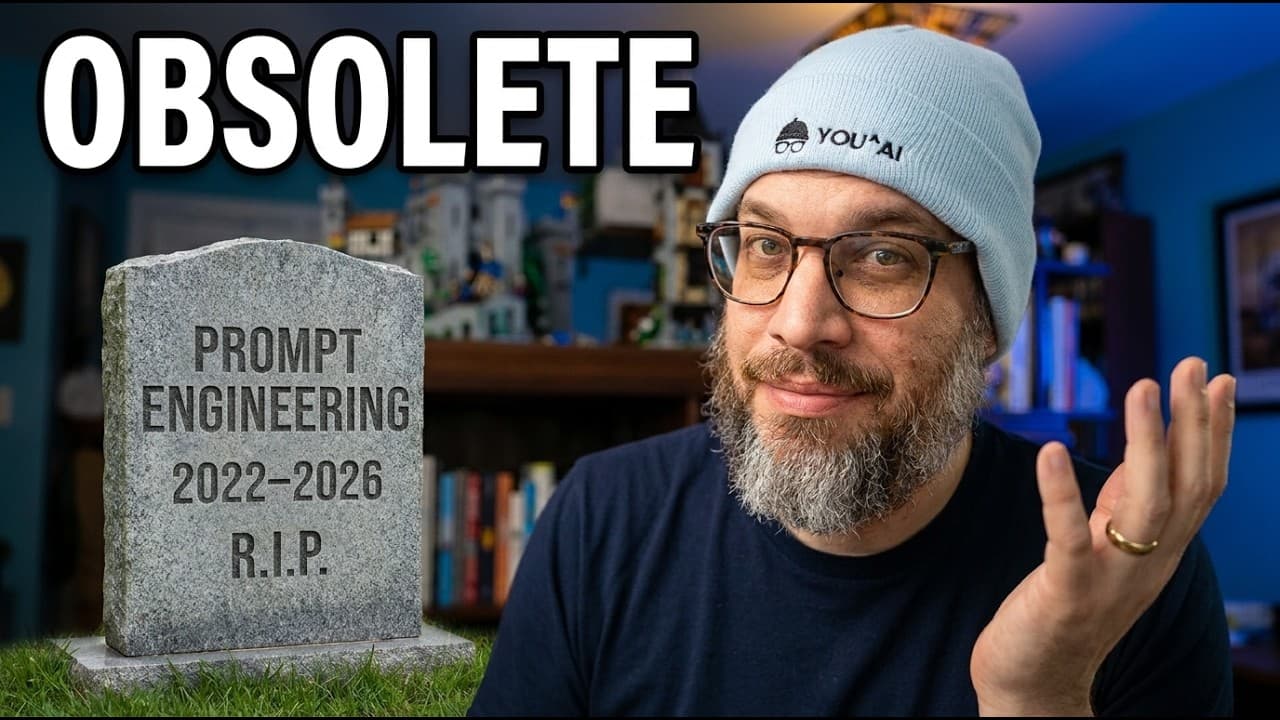
Prompt engineering is now considered basic knowledge, and the focus has shifted to developing questioning techniques that treat AI as a senior partner. This new approach, called the AI Question Method, involves asking layered questions that enable AI to perform complex tasks more effectively, allowing users to harness the full potential of advanced AI models.
Transcript
Prompt engineering is a 2025 conversation. Prompt engineering is dead. Prompt engineering is not what we need to be talking about now. And I say that and people say, "Nate, you told us so much about prompting. You said it would be futurep proofed." Yes, absolutely true. It's table stakes now. It is table stakes now. You got to be good at it. You do... Read More
Key Insights
- Prompt engineering is now considered a basic skill and no longer provides a competitive advantage.
- AI agents like Opus 4.7 and OpenAI 5.5 are 100 times more powerful than previous models.
- The AI Question Method focuses on asking layered questions to unlock AI's full potential.
- Treating AI as a senior partner rather than a junior teammate is crucial for effective collaboration.
- Most knowledge workers are still using outdated prompting methods from 2025.
- Understanding the difference between agents and agentic pipelines is essential.
- Effective questioning involves conveying both the intent and the boundaries of a problem.
- Memory and quick-start guides can enhance AI's ability to assist in complex tasks.
Install to Summarize YouTube Videos and Get Transcripts
Explore YouTube Video Summarizer or Get YouTube Transcript Extractor
Questions & Answers
Q: How do you transition from prompt engineering to AI questioning?
Transitioning from prompt engineering to AI questioning involves treating AI as a senior partner and focusing on asking layered questions. This approach, called the AI Question Method, requires conveying both the intent and boundaries of the problem, allowing AI to explore the problem space creatively and perform complex tasks more effectively.
Q: Why is prompt engineering considered basic knowledge now?
Prompt engineering is considered basic knowledge because AI models have become significantly more powerful, making simple prompting insufficient for leveraging their full potential. The focus has shifted to developing questioning techniques that enable AI to perform complex tasks and provide more valuable insights, thus making prompt engineering table stakes.
Q: What is the AI Question Method?
The AI Question Method is a technique that involves asking layered questions to AI, treating it as a senior partner. This method focuses on conveying the intent and boundaries of a problem, allowing AI to explore complex problem spaces creatively and perform tasks more effectively, unlocking its full potential.
Q: How are AI agents more powerful now compared to earlier models?
AI agents like Opus 4.7 and OpenAI 5.5 are 100 times more powerful than earlier models due to advancements in their ability to handle complex interactions and perform tasks for extended periods. These improvements have shifted the focus from simple prompting to questioning techniques that can harness their full capabilities.
Q: What is the difference between agents and agentic pipelines?
Agents refer to AI models capable of performing complex, high-leverage tasks through deep partnership thinking. Agentic pipelines, on the other hand, involve defined workflows that handle repetitive tasks like customer service tickets or invoice processing. Understanding this distinction is crucial for effective AI collaboration.
Q: How can memory and quick-start guides enhance AI collaboration?
Memory and quick-start guides can enhance AI collaboration by allowing AI to remember previous interactions and provide contextually relevant assistance. These tools help users develop effective questioning techniques, ensuring AI can perform complex tasks more effectively and provide more valuable insights.
Q: Why are most knowledge workers still using outdated prompting methods?
Most knowledge workers are still using outdated prompting methods because they have not fully transitioned from the 2025 mindset of treating AI as a junior teammate. The shift to treating AI as a senior partner and adopting the AI Question Method requires a change in mental models and questioning techniques.
Q: What are the key principles for effective AI questioning?
Effective AI questioning involves three key principles: conveying intent and boundaries through questions, asking questions that enable AI to synthesize information across complex spaces, and ensuring AI can engage with both data and implicit inputs. These principles help unlock AI's full potential and facilitate meaningful collaboration.
Summary & Key Takeaways
-
Prompt engineering is now a basic skill, and the focus has shifted to questioning techniques that treat AI as a senior partner. This involves asking layered questions that enable AI to perform complex tasks more effectively. By adopting the AI Question Method, users can harness the full potential of advanced AI models like Opus 4.7 and OpenAI 5.5.
-
The AI Question Method involves asking questions that convey intent and boundaries, allowing AI to explore problem spaces creatively. This approach is necessary to leverage the increased power of modern AI agents, which are 100 times more capable than those from just six months ago.
-
Most knowledge workers are still stuck in outdated prompting habits, but those who learn to ask sharp, layered questions can unlock significant leverage from powerful AI agents. Understanding the difference between agents and agentic pipelines is crucial for effective AI collaboration.
Read in Other Languages (beta)
Share This Summary 📚
Summarize YouTube Videos and Get Video Transcripts with 1-Click
Try YouTube Summary with ChatGPT & Claude or YouTube Transcript Generator
Explore More Summaries from AI News & Strategy Daily | Nate B Jones 📚






Summarize YouTube Videos and Get Video Transcripts with 1-Click
Try YouTube Summary with ChatGPT & Claude or YouTube Transcript Generator