How to Speak Fluent English: 8 Speaking Practice Tips

TL;DR
Focus on pronunciation before grammar, because bad grammar habits are easier to correct later than bad pronunciation habits, and poor pronunciation can make you impossible to understand. Record yourself up close and compare your lips, tongue, and throat movements against a native speaker's. Read a book while listening to the audiobook version so your brain links spelling to sound.
Transcript
(peaceful music) - Hello everyone, and welcome back to English with Lucy. Today I have a spoken English class for you. I have got eight tips that will help you to master spoken English. If you apply these tips to your everyday life, you will really notice a difference, and you will become more confident and more comfortable speaking English. My fir... Read More
Key Insights
- Understanding which parts of your face, tongue, and throat you use while speaking English is the foundation for correcting pronunciation mistakes. Without that awareness, learners have no way to identify what they are physically doing wrong when a sound comes out incorrectly.
- Recording yourself up close and comparing the footage to a zoomed-in video of a native speaker at the same distance reveals pronunciation differences that listening alone cannot. Lucy discovered through this method that Spanish speakers push their tongue further out for a 'd' sound than English speakers do.
- The way a word is written in English normally gives very little indication of how it is pronounced, unlike many other languages where spelling maps directly to sound. This mismatch is part of why English pronunciation and speaking is so difficult for learners.
- Reading a book while simultaneously listening to the audiobook version builds connections in the brain between spelling and sound. The next time you hear a word you will know how it is spelled, and the next time you read it you will know how it is pronounced.
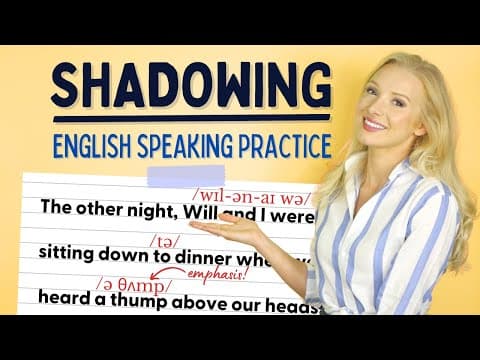
- Speed reading aloud while timing yourself and trying to beat your previous time improves fluency, velocity, and connected speech, meaning how you join one word or sound to another. Reputable news sources work well for formal practice, and conversational bloggers for informal speech.
- Preparing monologues and stories in advance removes pressure from predictable conversations. Elevator pitches, answers to what you do for a living or where you come from, and funny dinner party stories can all be kept 'up your sleeve', an English phrase meaning to have something prepared.
- Focusing on pronunciation over grammar matters because bad grammar habits are much easier to correct than bad pronunciation habits. Bad grammar can make someone difficult to understand, but bad pronunciation can make someone impossible to understand entirely.
- Speaking with a variety of native speakers who have different accents makes the brain more flexible at understanding speech. Lucy contrasts herself, who has lived in different locations and taught students worldwide, with her mother, who is surrounded by one accent and struggles badly with Scottish, Irish, or Spanish-accented English.
Install to Summarize YouTube Videos and Get Transcripts
Explore YouTube Video Summarizer or Get YouTube Transcript Extractor
Questions & Answers
Q: How can I improve my English pronunciation by myself?
Start by getting to know the parts of your body used while speaking English, specifically your lips, tongue, throat, and face. Find a close-up, zoomed-in video of a native speaker or a speaker you admire, then record yourself up close at the same distance saying the same sentence. Analyse how their lips move compared to yours, how far they stick their tongue out or push it back, and compare voice quality, meaning how much voice escapes through the throat. Being very critical about your current speech is necessary if you are serious about improving.
Q: Why is watching yourself in the mirror not enough for pronunciation practice?
Watching yourself in the mirror while speaking English is a common tip that many teachers give, but Lucy recommends going one step further. The mirror only shows you what you are doing; it gives you no reference point for what a target speaker is doing. The stronger method is side-by-side comparison: a close-up video of a speaker you admire versus your own close-up recording of the same sentence at the same distance. That comparison surfaces differences in lip movement, tongue position, and voice quality that a mirror alone will never reveal.
Q: What is the best way to connect English spelling with pronunciation?
Combine reading and listening at the same time. Take a book you have already read in English, or one you would like to read, and read it again while listening to the audiobook version. If you listen to a word as you read it, your brain starts making connections, so the next time you hear that word you will know how it is spelled, and the next time you read it you will know how it is pronounced. This matters especially in English, where the written form of a word normally gives very little indication of how it should be spoken.
Q: How does speed reading improve English speaking fluency?
Speed reading aloud targets three things at once: fluency, meaning how fluently you speak English; velocity, meaning how quickly you speak; and connected speech, meaning how you join one word to another or one sound to another. The method is to find a text suited to your level, read it aloud while timing yourself, then read it again and try to beat your previous time. Repeating this familiarises you with the common sounds in English. Lucy notes she gets bored of a text after about four repetitions. A further step is recording yourself and sending it to your language instructor or using it as a topic in your next lesson.
Q: Why should I prepare stories and monologues in advance for speaking English?
Certain questions come up again and again, such as what do you do for a living or where do you come from, along with funny stories you might want to tell at a dinner party and your elevator pitch. Preparing these answers in advance means you have them 'up your sleeve', an English expression meaning to have something ready. Lucy first thought of this while dating, when she would get stuck and not know what to talk about, and she felt more confident going into those situations with her best stories prepared. She compares speaking a second language to dating: it can be nerve-wracking, so preparation helps.
Q: Should I focus on pronunciation or grammar when learning English?
Lucy's opinion, which she acknowledges some teachers will disagree with, is to focus on pronunciation over grammar. Her reasoning is that bad grammar habits are much easier to correct than bad pronunciation habits. It is easier to understand somebody with great pronunciation and bad grammar than someone with perfect grammar and terrible pronunciation. She has met students who know every grammar rule and can sometimes correct her, but whose pronunciation plateaued because they were taught badly or never corrected from a young age. Bad grammar makes you hard to understand; bad pronunciation can make you impossible to understand.
Q: How do I start thinking in English?
A good way to start is to have a little English narrator in your head. Choose a voice you like, Lucy notes many people use Emma Watson's voice, and for a couple of hours or even a couple of minutes a day, have that person narrate everything you are doing: I am washing the dishes, I am picking up the spoon, I am putting it on the table. Chat to yourself as you would in your own language, but in English. After a while you might automatically start thinking in English, and even dreaming in English, which is said to be a sign you are becoming truly fluent.
Q: Why should I listen to many different English accents instead of just one?
It is tempting to focus on one specific accent, but doing so is a disservice to yourself. The wider the variety of people you speak with, the more flexible your brain becomes at understanding speech. Lucy uses her mother as an example: she is surrounded mainly by English people who all speak the same accent, and she struggles badly with Scottish accents, Irish accents, and Spanish people speaking English. Lucy, by contrast, has been to many countries, taught students from all over the world, and lived in different locations, so she finds different accents easy to understand despite sharing genetics and upbringing with her mother.
Summary & Key Takeaways
-
Mastering spoken English starts with physical awareness. Learners should identify which parts of the face, tongue, and throat are used when speaking English, then find a close-up video of an admired speaker, record themselves at the same distance saying the same sentence, and compare lip movement, tongue position, and voice quality critically.
-
Reading and listening simultaneously fixes the gap between English spelling and pronunciation. Since written English gives little indication of how a word is spoken, reading a book while playing the audiobook version builds brain connections so a heard word recalls its spelling and a read word recalls its sound.
-
Speed reading practice improves fluency, velocity, and connected speech. Learners pick a text at their level, read it aloud while timing themselves, then repeat and try to beat the previous time. Recording the attempt and sending it to a language instructor, or using it as a lesson topic, extends the exercise further.
Read in Other Languages (beta)
Share This Summary 📚
Summarize YouTube Videos and Get Video Transcripts with 1-Click
Try YouTube Summary with ChatGPT & Claude or YouTube Transcript Generator
Explore More Summaries from English with Lucy 📚





Summarize YouTube Videos and Get Video Transcripts with 1-Click
Try YouTube Summary with ChatGPT & Claude or YouTube Transcript Generator