How will continual learning change AI performance in businesses
TL;DR
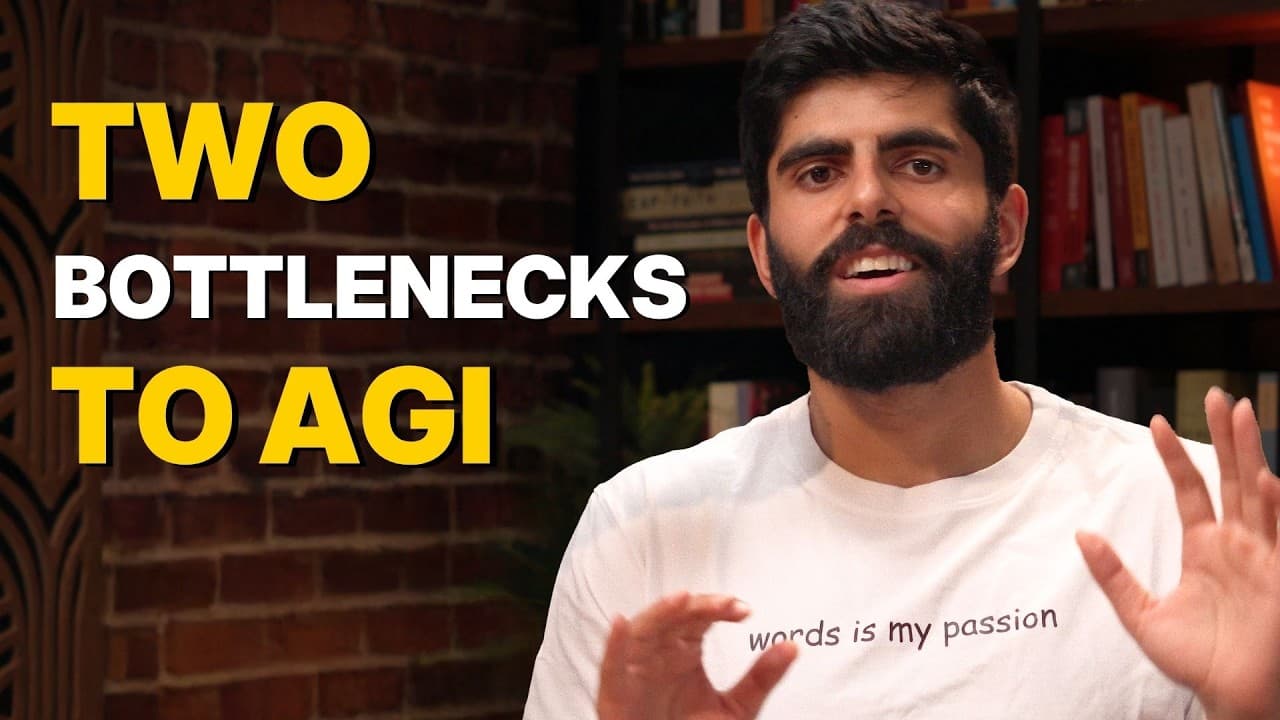
Continual learning remains the main bottleneck for AI deployment in real work. LLMs today are impressive but lack durable, context rich learning from feedback. Humans outperform AIs in adaptability because we build context and refine skills over time. Without true continual learning, broad workplace impact stays limited for now, despite strong single task capabilities.
Transcript
I’ve had a lot of discussions on my podcast where we haggle out our timelines to AGI. Some guests think it’s 20 years away. Others 2 years. Here’s where my thoughts lie as of July 2025. Sometimes people say that even if all AI progress totally stopped, the systems of today would still be far more economically transformative than the internet. I ... Read More
Key Insights
- Continual learning is identified as the central bottleneck that prevents AI from acting like a durable employee. Without adaptive feedback loops, models cannot improve across conditions. This limits long term productivity gains in firms.
- Humans maintain context, assess failures, and implement small improvements over time, whereas current LLMs rely on static prompt engineering and isolated fine tuning, which cannot emulate true on the job learning.
- The author uses the saxophone teaching analogy to illustrate why one time instructions fail to teach a skill, emphasizing the need for iterative practice and feedback.
- There is skepticism about near term fully autonomous agents for complex tasks like taxes due to needs for long rollout times and multimodal data integration.
- Even without major algorithmic breakthroughs, there is potential for a practical, better system through memory summaries, but brittleness outside text based domains remains a concern.
- The piece predicts a future where AI learns across all copies of itself, potentially enabling rapid generalization, but stresses that this requires reliable continuous learning.
- Industry forecasts cited in the talk about end of next year should be taken cautiously due to data, compute, and rollout constraints.
- The author remains bullish about AI over decades, anticipating a discontinuity when continual learning becomes feasible and broadly deployed.
- More videos from this channel:
- More from this channel: Dwarkesh Patel
Install to Summarize YouTube Videos and Get Transcripts
Explore YouTube Video Summarizer or Get YouTube Transcript Extractor
Questions & Answers
Q: What is the main bottleneck preventing LLMs from becoming true employees in firms?
The main bottleneck is the lack of continual learning. LLMs can perform individual tasks reasonably well within a session, but they do not learn and adapt over time the way humans do. Without a deliberate, adaptive process to learn from feedback, models cannot build up context or improve across subtasks, which keeps them from acting as real employees.
Q: Why does the saxophone teaching analogy matter for AI learning?
The saxophone analogy shows that teaching through one off instructions is ineffective for skill development. A student needs multiple attempts, immediate feedback, and iterative refinement to learn a complex task. Similarly, AI needs ongoing, interactive learning and feedback rather than static prompts and isolated fine tuning to develop robust capabilities.
Q: What is the predicted impact of continual learning on AI value, according to the speaker?
If continual learning is solved, there could be a huge discontinuity in the value of AI. Even without a software only singularity, broadly deployed AI that learns across tasks could rapidly increase productivity and transform the economy, because a single AI would accumulate knowledge across many jobs and contexts.
Q: What is the speaker skeptical about regarding near term AI agents for taxes?
The speaker is skeptical because end users require long horizon rollouts to complete complex tasks like taxes. Agents must process emails, orders, and documents, coordinate with people, and ensure accuracy before submitting official forms. The data, compute needs, and the time required for reliable results make this forecast unlikely in the near term.
Q: How does the talk describe the role of human editors in workflows?
Human editors are described as highly effective because they notice small, practical improvements and adapt content to audience needs and personal style. They operate without bespoke RL environments for every task, learning by doing and refining their approach over time, which is something AI currently lacks without continual learning capabilities.
Q: What are the reasons given for the slow progress toward truly useful AI in the near future?
Reasons include the absence of continual learning, the difficulty of transferring improvements across contexts, and the brittleness of text based summaries to preserve tacit knowledge. Additionally, the need for long rollout times for multimodal data and the lack of comprehensive pretraining data for real world agent tasks slow progress.
Q: What alternative path to improvement does the speaker mention besides continual learning?
An alternative path is developing memory like summaries that compact session memory every so often. While this could help preserve past preferences, it may not be robust outside domains with strong textual data. The speaker notes that such scaffolding might not capture deep tacit experience that informs future decisions.
Q: What is the speaker’s stance on the timelines for AI progress to disrupt white collar work?
The speaker is bearish on transformative AI disruption in the next few years because continual learning remains unsolved and practical deployment across many white collar tasks is difficult. However, he is bullish about AI progress over the coming decades as learning capabilities improve and systems start to generalize better across tasks.
Summary & Key Takeaways
-
The article argues that current AI lacks continual learning, which limits long term usefulness in white collar work. It contrasts human learning with model learning and explains why this gap slows broad adoption in firms. The piece remains bearish on near term transformative AI but bullish over decades as learning improves.
-
It discusses how feedback, context, and incremental refinements make humans superior at complex tasks, and why single task performance does not translate to general employment automation.
-
The author foresees possible online or continuous learning breakthroughs and describes expectations about computer use agents and practical AI tools in professional settings.
Read in Other Languages (beta)
Share This Summary 📚
Summarize YouTube Videos and Get Video Transcripts with 1-Click
Try YouTube Summary with ChatGPT & Claude or YouTube Transcript Generator
Explore More Summaries from Dwarkesh Patel 📚




Summarize YouTube Videos and Get Video Transcripts with 1-Click
Try YouTube Summary with ChatGPT & Claude or YouTube Transcript Generator