What inspired OpenAI to build ChatGPT and how it evolved
TL;DR
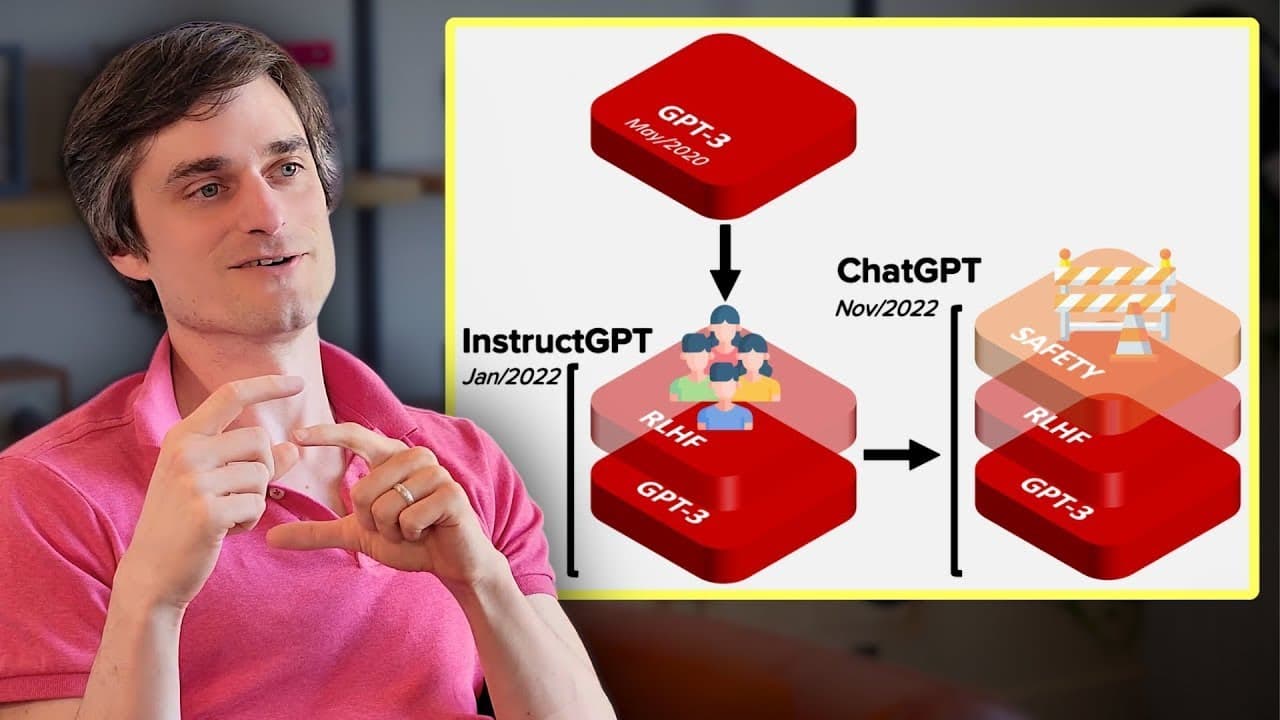
ChatGPT came from instruction following models and a shift to a conversational design. OpenAI mixed instruct and chat data, used fine tuning with human feedback, and added elements like limited browsing early on before focusing on internal knowledge. The result was a more coherent, helpful chat model with safer behavior.
Transcript
you let the creation of Chad jbt at what point do you did you realize first of all these llms are the pat to go and then a Chad bot would be or some way to instruct them would be a useful thing to do before chat gbt open AI had these instruction following models and uh that was B the idea there was um we had base models and people can um prompt the... Read More
Key Insights
- ChatGPT was built by combining instruction following models with a chat friendly design.
- The initial chat direction grew from observing that a conversational interface could ask clarifying questions when needed.
- OpenAI used RLHF and iterative supervised fine tuning to improve alignment and reduce hallucinations.
- Browsing was considered but deemphasized as the model internal knowledge proved strong.
- The early models had strengths in language and code, guiding the focus of development.
- Chat models offered a more coherent personality and safer, more sensible behavior than purely instruct models.
- Mixing data from instruct and chat datasets aimed to capture strengths of both approaches.
- The question of how to fine tune involved multiple iterations and human-in-the-loop feedback.
- More videos from this channel:
- More from this channel: Dwarkesh Patel
Install to Summarize YouTube Videos and Get Transcripts
Explore YouTube Video Summarizer or Get YouTube Transcript Extractor
Questions & Answers
Q: What started the shift from instruction following models to a chat oriented approach?
The shift happened because questions in a chat setting naturally require follow ups and clarifications, and a conversational interface was seen as easier for people to understand than a bare instruction task. This insight led to focusing on a chat assistant rather than only task oriented text completion.
Q: What role did 3.5 play in the development of ChatGPT?
GPT 3.5 provided a strong language and code base that made it feasible to build a conversational assistant. It demonstrated that a model could handle code related tasks well and set the stage for a more robust chat experience with improved interactivity and user guidance.
Q: Why was browsing eventually deemphasized in ChatGPT development?
Browsing was deemphasized because the model's internal knowledge was already strong and reliable enough for many tasks. The focus shifted to improving the model’s own reasoning and factuality rather than relying on external web retrieval.
Q: What is RLHF and why was it important?
RLHF stands for reinforcement learning from human feedback. It was important because it provides a mechanism to align the model with human expectations of helpfulness and safety. It helped reduce unhelpful or unhinged outputs while preserving useful capabilities.
Q: How did OpenAI handle data to train the chat model?
OpenAI mixed together data from instruct and chat datasets to combine the strengths of both approaches. This data fusion aimed to create a model that could follow instructions and maintain a natural, conversational style.
Q: What limitations did early instruction following models have compared to chat models?
Early instruction following models struggled with defining the task clearly and producing consistent, context aware responses. They lacked the intuitive sense of how a helpful robot should behave in a dialogue, making it harder to predict outputs and maintain coherence.
Q: Why was it considered hard to get human written data to fit model outputs perfectly?
Even high quality human written data can be difficult for a model to imitate perfectly. This is because the model may not be able to reproduce the exact patterns and nuance in the data, necessitating iterative processes like RL and human editing to improve alignment.
Q: What final approach helped achieve a more robust chat model according to Schulman?
The more robust approach combined instruction following and chat data through iterative supervised fine tuning and RL with human feedback. This created a chat model with a coherent personality and safer, more reliable behavior while preserving useful capabilities in language and coding tasks.
Summary & Key Takeaways
-
ChatGPT evolved from base models that were hard to prompt into instruction following models that were easier to guide.
-
A key shift was turning from a generic language model to a conversational assistant that could ask clarifying questions and follow up.
-
The development involved fine tuning and RL with human feedback to balance helpfulness and reliability.
Read in Other Languages (beta)
Share This Summary 📚
Summarize YouTube Videos and Get Video Transcripts with 1-Click
Try YouTube Summary with ChatGPT & Claude or YouTube Transcript Generator
Explore More Summaries from Dwarkesh Patel 📚



Summarize YouTube Videos and Get Video Transcripts with 1-Click
Try YouTube Summary with ChatGPT & Claude or YouTube Transcript Generator