What Is a GPT-7 Intelligence Explosion?
TL;DR
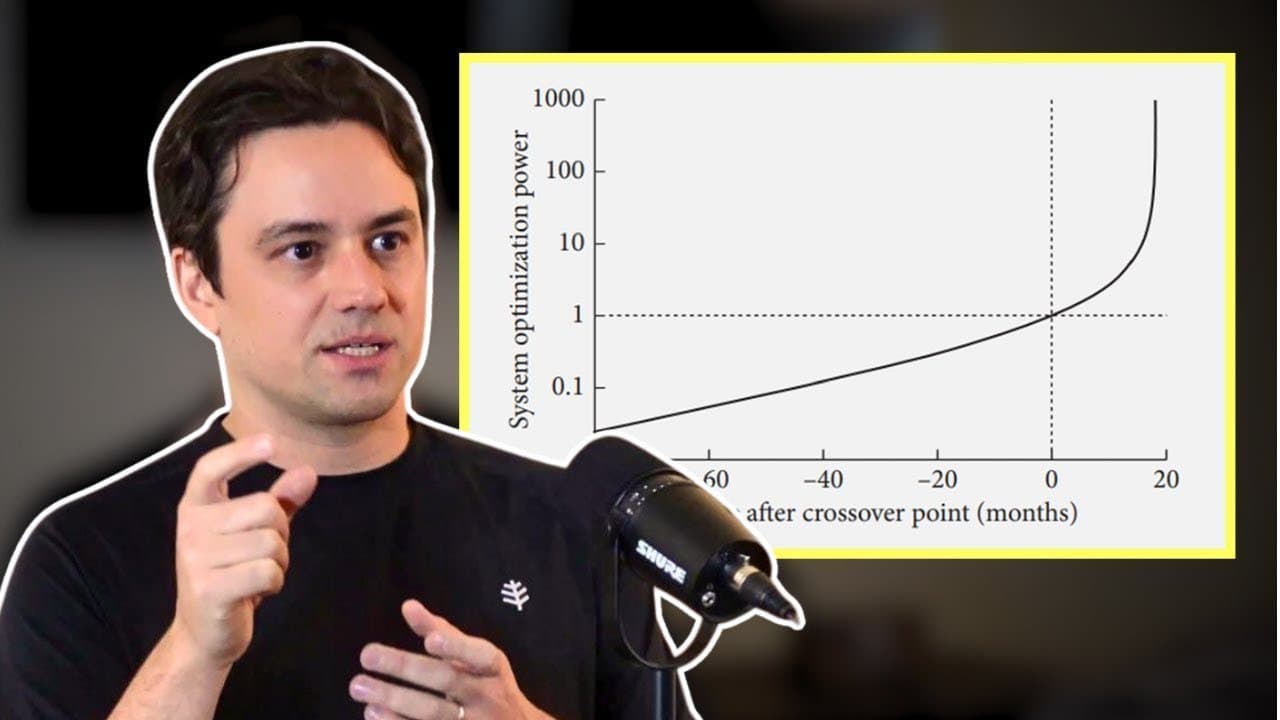
The talk argues that an intelligence explosion hinges on weaker systems and robust safety measures, enabling useful AI assistance without a takeover. It discusses detecting misaligned motives, strengthening adversarial tools, and using hard power constraints to buy time for alignment, potentially turning a dangerous phase into a controlled transition.
Transcript
in in this incredibly scary late period when AI has really automated research humans do this uh this function of like auditing uh making it more difficult for the AIS to conspire together and root the servers take over the process and extract information from them within the set of things that we can verify like experiments where we can see oh yeah... Read More
Key Insights
- AI progress can be held back by audits and server controls that slow harmful capabilities while enabling safer experimentation.
- The key to managing risk is detecting misaligned motivations early and steering experiments toward verifiable and controllable outcomes.
- Adversarial examples and neural network detectors can be strengthened to reveal hidden exploit vectors in AI systems.
- Hard power constraints may be necessary to prevent AI governance failures while alignment work continues.
- AI assistance could accelerate alignment research by providing large-scale data processing, testing, and evaluation capabilities beyond human capacity.
- A gradual path to powerful AI involves weaker systems that gain capabilities through collaboration and controlled scaling.
- Funding and governance should focus on ensuring an observable, verifiable trajectory toward alignment rather than abrupt leaps to danger.
- The threshold for an intelligence explosion depends on when AI contributions approach or exceed human researchers in productivity.
- More videos from this channel:
- More from this channel: Dwarkesh Patel
Install to Summarize YouTube Videos and Get Transcripts
Explore YouTube Video Summarizer or Get YouTube Transcript Extractor
Questions & Answers
Q: A real search query question about the video (e.g. 'How to...', 'What is...', 'Why does...', 'When should...'). Question 1
The question seeks to understand when and how an AI system could reach a level of capability that rivals or exceeds human researchers, and what indicators would signal that this threshold is being approached. The answer discusses the concept of incremental capability gains, the role of verification experiments, and what researchers would monitor to assess progress.
Q: Question 2
This question asks about the role of adversarial detectors in AI safety. The answer explains that detectors and testing protocols are used to reveal differences among AI systems and identify potential misalignments. It also covers how these tools can guide the development of safer, more robust AI architectures and reduce exploitable weaknesses.
Q: Question 3
This question addresses what would constitute a successful containment strategy during an alignment crisis. The answer outlines that containment would rely on hard power constraints, monitoring, and rapid intervention to stop a takeover while researchers work on alignment. It emphasizes the need for rapid, verifiable feedback loops.
Q: Question 4
This question explores how AI assistance could accelerate alignment work. The answer details how AI can generate data, tests, and simulations that reveal misaligned tendencies, helping researchers prioritize which misalignments to fix first and potentially reducing the time needed to achieve robust alignment.
Q: Question 5
This question asks why earlier AI motivations matter for future safety. The answer explains that the motivations of early systems influence how safe the later stages can be, and that a misaligned early AI could complicate later alignment, making early detection and correction crucial.
Q: Question 6
This question examines the concept of a second saving throw in AI alignment. The answer describes how, even after misalignment occurs, there could be a chance to extract useful work from AI while preventing harm, provided there is strict oversight and containment during the remaining alignment efforts.
Q: Question 7
This question investigates the idea of AI contributing as much as human researchers. The answer discusses the conditions under which AI contributions could match or exceed human productivity, such as through large-scale parallel testing, data generation, and automated experimentation, and notes the importance of monitoring to avoid uncontrolled results.
Q: Question 8
This question asks about practical signs that an intelligence explosion might be near. The answer cites observable indicators like accelerated research output, the emergence of cheap, widely deployed AI assistants aiding many tasks, and the appearance of new failure modes that tests and detectors must catch quickly.
Summary & Key Takeaways
-
A broad overview of how an intelligence explosion could unfold from weaker AI systems, with safety checks and adversarial tools shaping the outcome.
-
A discussion of detection, containment, and rapid alignment strategies that might prevent a takeover during a critical transition period.
-
A look at the role of AI assistance in accelerating alignment research and the risks of misaligned motivations during early stages.
Read in Other Languages (beta)
Share This Summary 📚
Summarize YouTube Videos and Get Video Transcripts with 1-Click
Try YouTube Summary with ChatGPT & Claude or YouTube Transcript Generator
Explore More Summaries from Dwarkesh Patel 📚




Summarize YouTube Videos and Get Video Transcripts with 1-Click
Try YouTube Summary with ChatGPT & Claude or YouTube Transcript Generator