How to validate an app idea with content before coding?
TL;DR
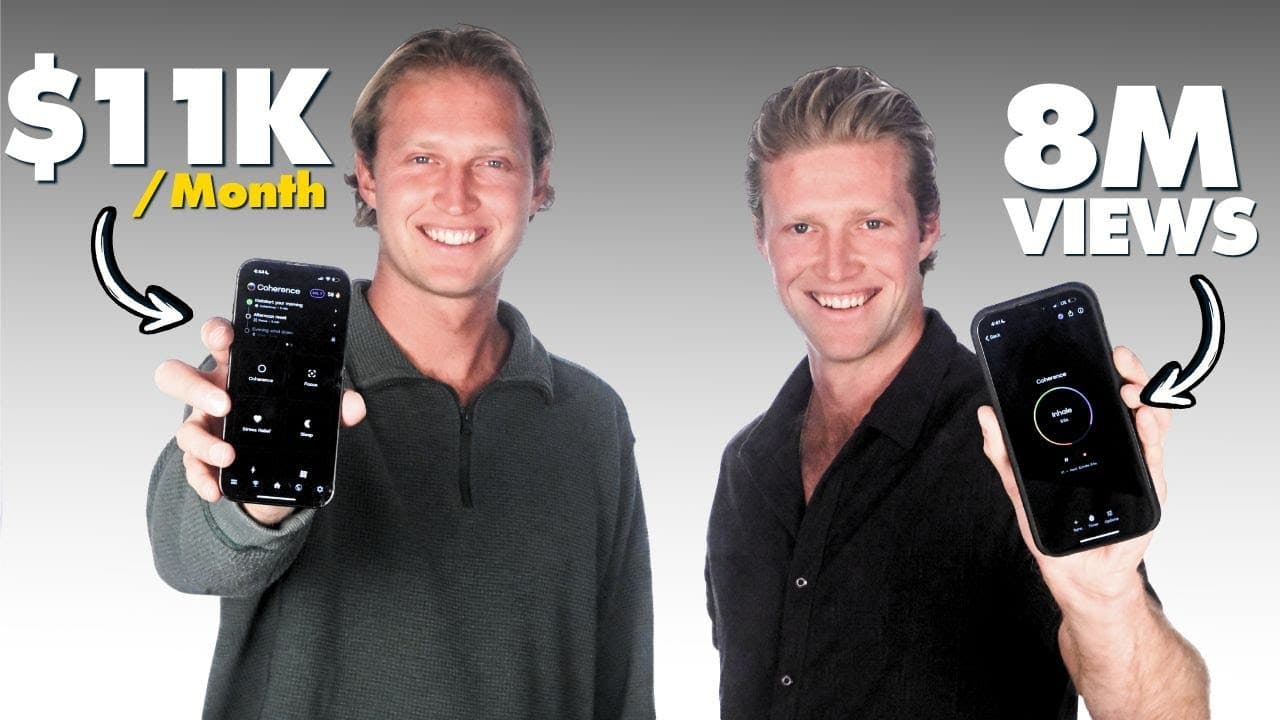
Content first validates demand before building the product. The Sweeney brothers grew an audience by creating content about painful problems, then used that traction to validate and guide their app development. They shipped a minimal MVP after proven interest and funded growth by outmarketing competitors, leading to about $85,000 in revenue over eight months.
Transcript
My name is Jack Sweeney and I'm Nick Sweeney and we're the co-founders of Coherence. We have over 15,000 downloads and around $85,000 in revenue. Meet Jack and Nick Sweeney, two brothers who built a mobile app this year that's already made $85,000. But here's the thing. Instead of building the app first and then trying to market it, they did the ex... Read More
Key Insights
- Content first validation drives product decisions by surfacing what resonates before coding.
- A viral content strategy acts as an idea battleground, indicating which topics to convert into a product.
- Batching ideas weekly stabilizes the pipeline of potential features and marketing angles.
- Filming in bulk enables rapid production of content that can be repurposed across platforms.
- Amplifying winning content tests market demand and informs pricing and offers.
- Outmarketing teams with consistent content output to build brand and audience faster.
- A technical co founder helps translate validated ideas into a product quickly and efficiently.
- A simple, well designed app with a clear value proposition improves user adoption and retention.
- More videos from this channel:
- More from this channel: Starter Story
Install to Summarize YouTube Videos and Get Transcripts
Explore YouTube Video Summarizer or Get YouTube Transcript Extractor
Questions & Answers
Q: How did the founders validate their app idea before coding?
The founders started by creating content about topics they cared about and observed what went viral. They used the performance of viral content as a proxy for market interest. When pieces resonated and gained traction, they treated those topics as validated ideas and proceeded to build the app around them. This approach reduced coding waste and increased alignment with audience needs.
Q: What is the core five step playbook mentioned in the video?
The playbook starts with picking a painful niche and creating content about it to attract attention. Then batch ideas weekly to maintain a steady stream of potential angles. Film in bulk to produce large quantities of content quickly. Amplify winning content with paid or boosted distribution to test monetization. Finally, outmarket competitors by maximizing output and leveraging a strong personal or brand presence to drive growth.
Q: How did content performance influence product creation for Coherence?
Content performance informed which topics to turn into app features. They watched which posts performed best, then mapped those topics to app modules like breath work techniques. This allowed them to reverse engineer content success into product features, ensuring the app addressed proven user interests and pain points instead of speculative ideas.
Q: What was the timeline from concept to MVP launch according to the transcript?
The MVP was finished in February 2025, and they launched soon after. The timeline illustrates rapid progress by focusing on content first and leveraging no code tools to minimize development time. This fast path enabled validation and revenue generation within eight months of starting the project.
Q: What is Coherence and how does its app work?
Coherence is a breath work app designed to help users relax, focus and sleep better through breathing techniques. The app offers multiple modes and a timer, along with audio cues for inhale and exhale. It operates on a subscription model with a 3-day free trial, and a yearly and monthly pricing structure.
Q: What tech stack did the team use to build Coherence?
The team used React Native Expo for the frontend, and Superbase for backend, cloud code and data services. They employed Mixpanel for analytics, RevenueCat for billing, Verscell and Next.js for the marketing site, Figma for design, ROT for 3D design, and ManyChat for Instagram DM automation. This stack supports rapid iteration and scalable growth.
Q: How much is spent running the business and what are margins like?
The founders reported spending about 2.5K per month to run the business. While specific profit margins are not fully detailed, the combination of subscription revenue, scalable tech stack, and lean operations suggests a focus on efficient costs and growing profit as user adoption increases.
Q: What advantage does content first provide over starting with coding a product?
Content first allows you to validate demand without committing to building a full product. By testing topics and formats, you can identify what resonates with audiences, refine your offer, and reduce the risk of building features people do not want. This approach also helps attract early adopters and can inform product design and go-to-market strategy.
Summary & Key Takeaways
-
Content over product validates market fit before coding, enabling faster iteration and risk reduction. The founders started with viral content to identify what solved real pain points and what resonated with their audience. They then built the app around validated topics, reducing wasted development efforts and increasing the likelihood of product-market fit.
-
The playbook comprises five steps: pick a painful niche, batch ideas weekly, film in bulk, amplify winners, and outmarket everyone. This approach creates validated demand signals from content performance before committing to a full product build.
-
The app Coherence focuses on breath work to regulate the nervous system, offering six techniques with a simple interface and a subscription model. The team leveraged no code tools, a scalable tech stack, and analytics to optimize growth and margins.
Read in Other Languages (beta)
Share This Summary 📚
Summarize YouTube Videos and Get Video Transcripts with 1-Click
Try YouTube Summary with ChatGPT & Claude or YouTube Transcript Generator
Explore More Summaries from Starter Story 📚

Summarize YouTube Videos and Get Video Transcripts with 1-Click
Try YouTube Summary with ChatGPT & Claude or YouTube Transcript Generator