How is China building an AI stack on domestic chips?
TL;DR
GLM image is trained end to end on Huawei Ascend Atlas hardware using MindSpore, showing China can run a complete multimodal model without Nvidia. Google upgrades Veo 3.1 for reference images, vertical video, higher resolution, and watermarking, while MedGemma 1.5 targets health workflows. Rokid unveils AI glasses with translation and payments.
Transcript
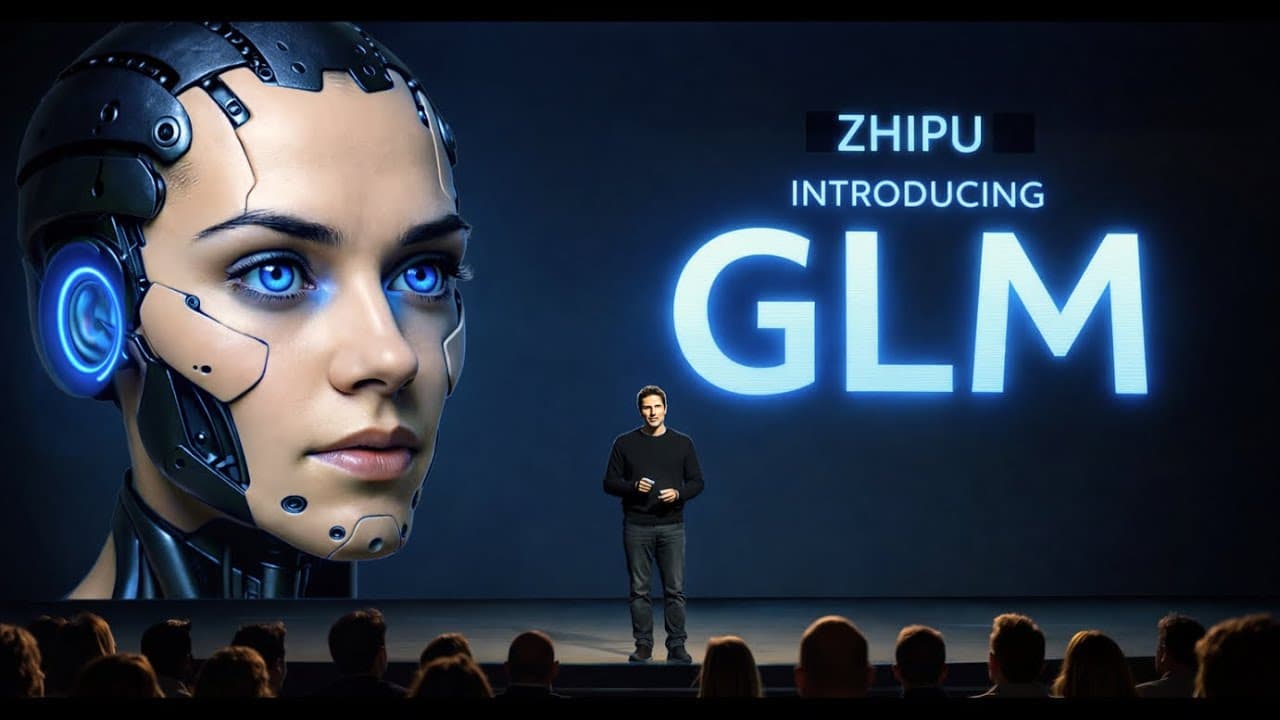
JIPU and Huawei just open-sourced GLM image trained entirely on Ascend Atlas 800 TA2 hardware and Mindpore. A straight signal that China's AI stack is becoming independent and competitive. Google upgrades VO3.1 with reference image video generation, native vertical output, 1080p plus 4K upscaling, and synth ed watermarking, rolling it out across Ge... Read More
Key Insights
- GLM image is trained end to end on domestic hardware using Huawei Ascend Atlas 800TA2 and MindSpore.
- The pipeline runs on MindSpore and Ascend devices with joint debugging and optimization to push hardware limits.
- Hybrid auto regressive plus diffusion decoder architecture is used to integrate language and image generation.
- GLM image claims soda level performance on a domestically developed chip stack and emphasizes full stack innovation.
- Commercial API pricing for image generation is 0.1 yuan per image, reflecting mass deployment potential.
- Google Veo 3.1 introduces reference image based video generation and native vertical outputs for mobile platforms.
- Veo 3.1 adds 1080p output and 4K upscaling to meet professional needs, with broader rollout across Gemini, YouTube, and Vertex AI.
- MedGemma 1.5 to 4B supports 3D CT, MRI volumes, large pathology slides, and improved document extraction benchmarks.
- More videos from this channel:
- More from this channel: AI Revolution
Install to Summarize YouTube Videos and Get Transcripts
Explore YouTube Video Summarizer or Get YouTube Transcript Extractor
Questions & Answers
Q: What makes GLM image different from other multimodal models in the report?
GLM image is described as being trained end to end entirely on domestically produced chips using Huawei Ascend Atlas 800TA2 hardware and MindSpore, with the pipeline itself optimized for this stack. This contrasts with models trained on western hardware and ported later. The emphasis is on full stack independence, including data processing, training, and inference, which is framed as a major step toward a competitive domestic AI ecosystem.
Q: How does the architecture of GLM image work according to the video?
The video notes a hybrid auto regressive plus diffusion decoder architecture for GLM image. This approach aims to unify language and image generation more tightly than traditional latent diffusion models, potentially improving knowledge heavy generation tasks. The design is highlighted as part of the full stack optimization and is presented as key to achieving better performance on domestic hardware.
Q: What is the commercial pricing model mentioned for GLM image generation?
The article quotes a cost of 0.1 yuan per generated image under the API pricing model. This is framed as a mass scale pricing point rather than research demo pricing, indicating an intention to deploy at scale and compete in real-world usage while keeping costs low for widespread access.
Q: What improvements does Veo 3.1 bring to AI video according to the video?
Veo 3.1 adds reference image based video generation to improve expressiveness with minimal prompts, native vertical output for mobile, and higher resolution options up to 1080p and 4K upscaling. It also includes better identity consistency and granular control over backgrounds and textures, positioning it as a production ready tool across consumer and enterprise ecosystems.
Q: How is Google integrating Veo 3.1 across products?
Veo 3.1 is being rolled out across multiple Google products and services, including the Gemini app, YouTube Shorts and YouTube Create Flow, Google Vids, Gemini API, and Vertex AI. This broad integration shows a strategy to create a consistent AI video experience across consumer, creator, and enterprise platforms.
Q: What is MedGemma 1.5 and what does it support?
MedGemma 1.5 is a compact multimodal model aimed at medical AI tasks. The 4B variant supports text, 2D images, high dimensional volumes such as CT and MRI, and whole slide pathology images. It is designed to work with clinical workflows by performing tasks like document extraction and image based disease findings, with improvements shown on several benchmarks.
Q: What benchmarks show improvement for MedGemma 1.5?
MedGemma 1.5 shows improvements on internal benchmarks for disease related CT findings, MRI findings, and histopathology. Notably, CT accuracy moves from 58 to 61 percent, MRI from 51 to 65 percent, and histopathology scores near 0.49, indicating meaningful gains in medical imaging tasks and pathology analysis.
Q: What does the report say about China’s path to independent AI compute?
The report frames China’s efforts as moving toward an independent AI compute ecosystem with a domestically developed chip stack. It emphasizes that compute bottlenecks are being addressed by building full stacks that include chips, frameworks, and tooling, reducing dependence on foreign hardware and potentially reshaping the AI computing landscape over time.
Summary & Key Takeaways
-
GLM image is presented as trained entirely on domestic chips with a full stack from data processing to training, signaling independence of the compute stack.
-
Veo 3.1 brings reference-image video generation, native vertical outputs, higher resolutions, and built in watermarking across multiple Google products and services.
-
MedGemma 1.5 expands medical AI capabilities to handle CT, MRI, pathology, lab reports, and text to support real clinical workflows and improve extraction benchmarks.
Read in Other Languages (beta)
Share This Summary 📚
Summarize YouTube Videos and Get Video Transcripts with 1-Click
Try YouTube Summary with ChatGPT & Claude or YouTube Transcript Generator
Explore More Summaries from AI Revolution 📚




Summarize YouTube Videos and Get Video Transcripts with 1-Click
Try YouTube Summary with ChatGPT & Claude or YouTube Transcript Generator