How Does Abacus Route AI Models to Build Apps?
TL;DR
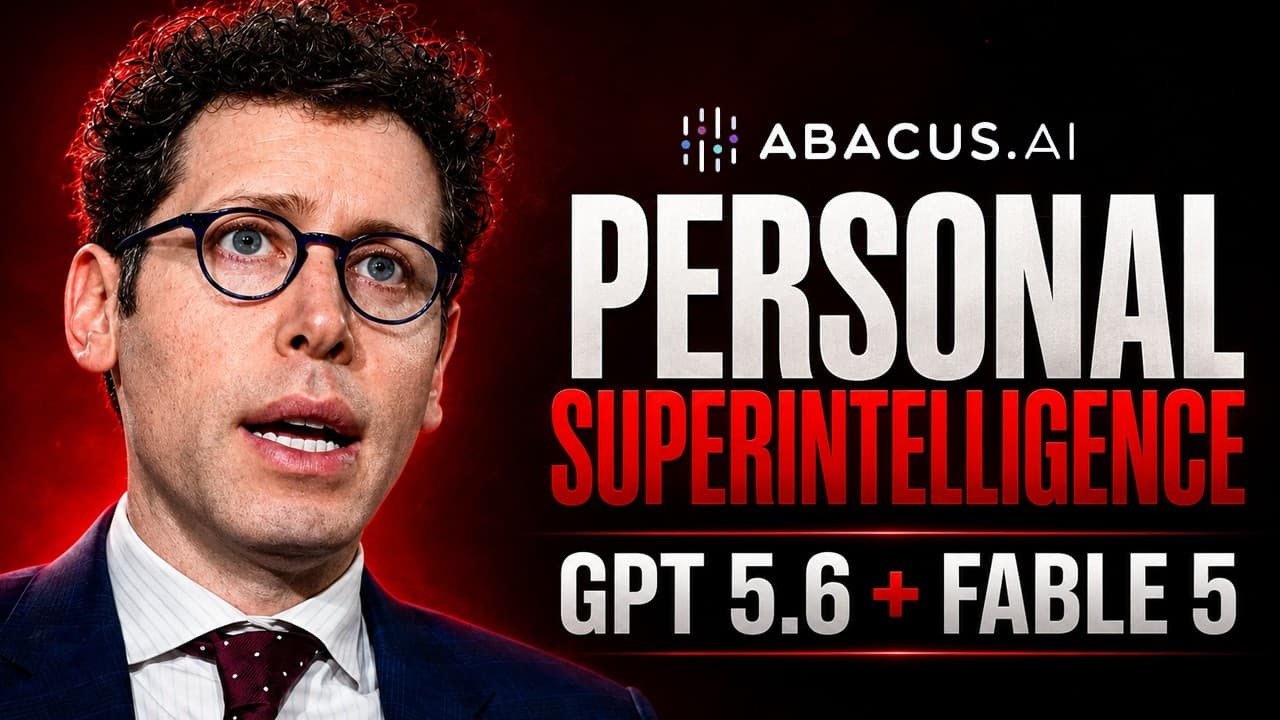
Abacus combines custom model routing with an always-on cloud computer, letting agents select different AI models for planning, coding, debugging, and routine work. With root access, these agents can install dependencies, create databases and interfaces, test software, fix errors, deploy public services, and keep applications running after the conversation ends.
Transcript
Two days after GPT-5.6 launched, the benchmark arguments are already starting to settle down. Most people now know roughly where it is strong, where Fable 5 is stronger, and which model they would rather use for coding, research, or reasoning. But that creates a more interesting problem. If GPT-5.6 is better at one part of a task, Fable is better a... Read More
Key Insights
- Custom routing is an orchestration layer that assigns different parts of a request to different AI models, rather than training a new superintelligent model. Its advantage comes from selecting specialized or lower-cost models according to the requirements of each task.
- The smart coding router classifies work before execution. Architectural planning and difficult engineering can go to Fable 5, routine refactoring and test generation to Claude Sonnet 4.6, and questions about an existing repository to GPT-5.6 Soul.
- The Abacus Supercomputer is an always-on cloud environment that supports databases, APIs, S3-compatible storage, SSH access, GPU-heavy workloads, and public services. It can also connect to AWS and GitHub, host open-source language models, and keep agents running continuously.
- Root access allows Fable 5 in Max mode to operate where the software will run. It can install dependencies, write and execute scripts, examine output, repair errors, configure services, deploy applications, and verify that public versions work from the same conversation.
- The 3D castle demonstration shows autonomous testing beyond initial code generation. Fable wrote more than 1,200 lines, tested movement, opened the application, captured screenshots, checked whether named areas were reachable, and performed another visual review without being asked.
- The trading strategy laboratory is a full software system rather than a single trading script. It combines PostgreSQL, a FastAPI back end, a Next.js interface, nine specialized agents, market analysis, backtesting, risk controls, approval workflows, monitoring, and an audit trail.
- The self-hosted Qwen 2.5 project demonstrates persistent deployment of an open model. Fable configured llama.cpp, downloaded a GGUF model, created a Node.js proxy and interface, enabled streaming through Nginx, and installed systemd services that automatically restart.
- Cost optimization is a central reason to route requests across models. Abacus can reserve Fable 5 and other capable models for demanding work while sending summaries, rewrites, simple questions, creative writing, or lightweight reasoning to less expensive models.
- More videos from this channel:
- More from this channel: AI Revolution
Install to Summarize YouTube Videos and Get Transcripts
Explore YouTube Video Summarizer or Get YouTube Transcript Extractor
Questions & Answers
Q: How does Abacus route tasks between different AI models?
Abacus first classifies the type of work contained in a request, then applies routing rules that select an appropriate model for each category. Difficult system design may go to Fable 5, debugging to Claude Opus 4.8, and simple scripts or syntax questions to GLM 5.2. A router can also define fallback behavior for requests that do not clearly match a category.
Q: What does personal superintelligence mean in Abacus AI?
Personal superintelligence refers to an orchestration layer that coordinates multiple existing models and computing resources. It does not mean that the user trains a new superintelligent model. The system can behave more capably than one fixed model by deciding when to use GPT-5.6, Fable 5, Claude Opus, or a cheaper open model for different parts of a task.
Q: What can an Abacus agent do with root access?
Root access lets an Abacus agent work directly inside the cloud environment where an application will run. The agent can install dependencies, write and execute scripts, inspect their output, diagnose failures, modify configurations, create services, deploy the application, and test its public version. This removes the need for users to copy generated code into a separate terminal and return error screenshots.
Q: What applications did the Abacus demonstrations build?
The demonstrations included a self-contained browser castle with first-person exploration, an AI trading strategy laboratory, a ChatGPT-style interface for a self-hosted Qwen 2.5 model, an always-on internet television station, and a social feed with one-to-one video calls. These examples combined front ends, back ends, storage, monitoring, testing, deployment, and persistent service management.
Q: How did the agent test the browser-based 3D castle?
The agent did more than generate the castle's HTML and procedural geometry. It built the environment, tested player movement, opened the application in a browser, took screenshots, checked whether the requested named areas could actually be reached, and completed another visual review without an additional prompt. The final result expanded from six walkable areas to eight and included collision detection and environmental effects.
Q: How was Qwen 2.5 deployed as a persistent chat service?
Fable recommended 4-bit quantization to reduce resource use, verified llama.cpp, downloaded the GGUF model, and launched an inference server under systemd. It also built a Node.js proxy and front end, configured Nginx for server-sent event streaming, and tested local and public endpoints. The systemd services automatically restart and keep the model server and interface available after the build session ends.
Q: Why can model routing reduce the cost of AI tasks?
Model routing reduces unnecessary use of expensive models by matching capability to task difficulty. Fable Max mode can be reserved for demanding building work, while simpler questions, summaries, rewrites, creative text, or lightweight reasoning can go to lower-cost models. Abacus provides both cost-optimized and performance-oriented routing configurations, and users can create their own routing rules in plain English.
Q: What safeguards were included in the AI trading laboratory?
The trading laboratory included demo, paper, and live trading modes, real-time equity tracking, a kill switch, risk settings, approval controls, live-position monitoring, and an audit trail. Its nine agents handled stages including market analysis, research extraction, news regime detection, strategy generation, backtesting, ranking, execution, and monitoring. The transcript also warns against using an AI-generated system with real money without independent testing.
Summary & Key Takeaways
-
Abacus replaces the fixed-model workflow with routers that classify requests and assign each part to a suitable model. Difficult engineering can go to Fable 5, debugging to Claude Opus 4.8, codebase questions to GPT-5.6 Soul, and simple coding to GLM 5.2, with configurable fallback behavior.
-
The Abacus Supercomputer gives agents an always-on cloud environment with root access, databases, APIs, S3-compatible storage, SSH access, and public deployment. Agents can install software, execute scripts, inspect results, correct errors, configure services, and verify deployed applications without requiring users to transfer code or error screenshots manually.
-
Demonstrations include a browser-based 3D castle, a multi-agent trading laboratory, a self-hosted Qwen 2.5 chat interface, an internet television station, and a social feed with video calls. These projects illustrate end-to-end assembly of interfaces, back ends, databases, monitoring, service management, testing, and deployment within one environment.
Read in Other Languages (beta)
Share This Summary 📚
Summarize YouTube Videos and Get Video Transcripts with 1-Click
Try YouTube Summary with ChatGPT & Claude or YouTube Transcript Generator
Explore More Summaries from AI Revolution 📚




Summarize YouTube Videos and Get Video Transcripts with 1-Click
Try YouTube Summary with ChatGPT & Claude or YouTube Transcript Generator