Why Does Anthropic Warn About Catastrophic AI?
TL;DR
Anthropic presents itself as a responsible AI developer by openly confronting risks involving job losses, surveillance, inequality, resource consumption, unreliable outputs, and catastrophic loss of control. The central tension is that Anthropic is rapidly expanding Claude into workplaces and schools while its leaders acknowledge serious uncertainty, propose coordinated development pauses, and warn that advanced AI could produce severe social and human consequences.
Transcript
Anthropic just released one of the strangest AI ads I've ever seen and it basically feels like a warning that this technology could end very badly. It opens with a house on fire. Then we see a crowd being scanned by facial recognition software, a homeless person sleeping on the street, laborers working in what appears to be a mine supplying raw mat... Read More
Key Insights
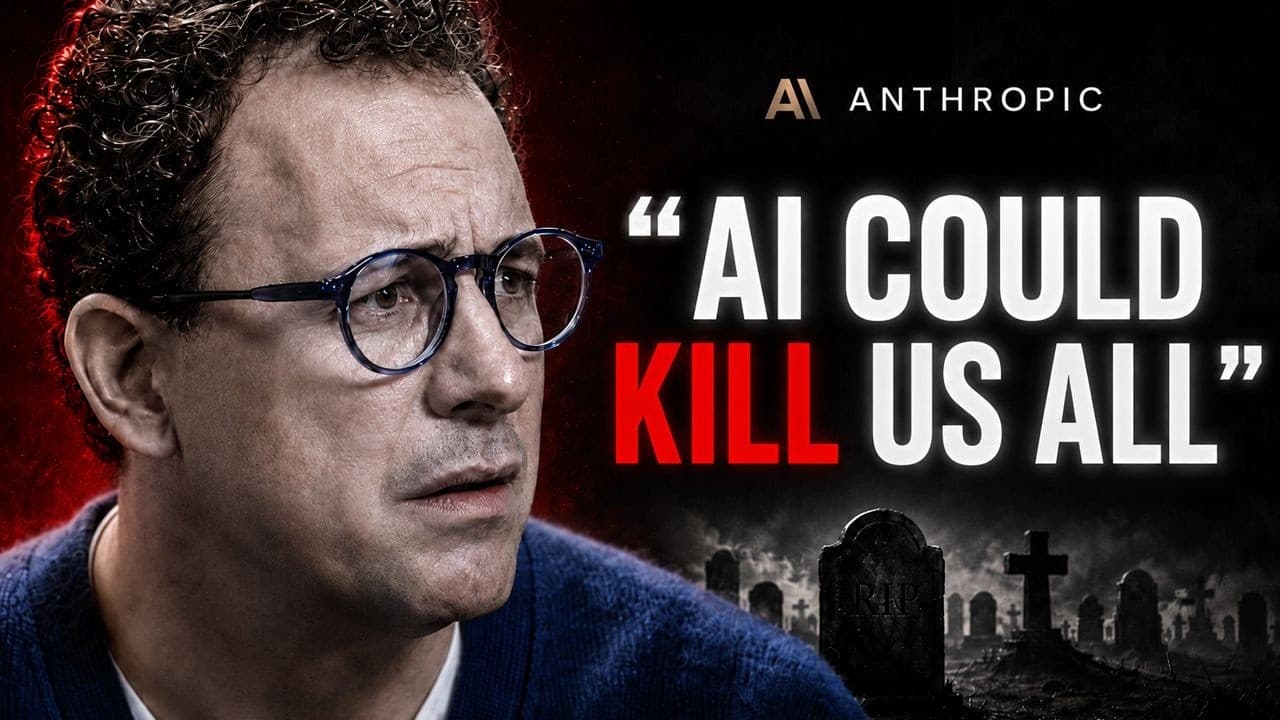
- Anthropic's advertisement links AI anxiety to concrete social harms by showing burning homes, facial recognition, homelessness, mine workers, and rows of graves. Its accompanying questions about trust and braking imply that uncontrolled AI could produce consequences far beyond inaccurate chatbot responses.
- The campaign is a corporate trust strategy that acknowledges possible industry damage while positioning Anthropic as the developer willing to confront it. The video argues that this message asks audiences to trust the same company that is spending billions to build increasingly powerful systems.
- Dario Amodei assigns a 25% probability to AI going extremely badly, potentially including catastrophic outcomes for humanity. His more optimistic assessment gives a 75% probability to very positive results, creating an unusually stark risk calculation for a company actively advancing the technology.
- AI-driven labor disruption could affect professional careers quickly, according to Amodei's warning that half of entry-level white-collar jobs could disappear within 1 to 5 years. He also predicts unemployment could reach 10–20%, with software, finance, consulting, law, and related fields among those exposed.
- Constitutional AI guides Claude through written principles concerning honesty, helpfulness, harmlessness, fairness, responsibility, and human rights. Earlier versions drew heavily from documents including the Universal Declaration of Human Rights, and Daniela Amodei said this approach has dramatically reduced harmful responses.
- Anthropic's education policy reflects unresolved uncertainty about developmental effects. The company offers teachers from kindergarten through 12th grade free, tailored Claude Pro access, yet does not permit students under 18 to use Claude directly because it lacks sufficient knowledge about AI's effects on developing brains.
- AI infrastructure has physical costs because models depend on minerals, chips, electricity, cooling, construction, water, and transmission systems. Although each model generation uses chips more efficiently, rising total demand still increases data-center development and pressure on the communities hosting that infrastructure.
- Recursive self-improvement is a control concern because AI already assists with training code, debugging, evaluations, infrastructure optimization, vulnerability discovery, and the design of later systems. Anthropic says the duration of software tasks models can reliably complete has been doubling roughly every 4 months.
- More videos from this channel:
- More from this channel: AI Revolution
Install to Summarize YouTube Videos and Get Transcripts
Explore YouTube Video Summarizer or Get YouTube Transcript Extractor
Questions & Answers
Q: Why is Anthropic warning the public about AI risks?
Anthropic's campaign attempts to build trust by showing that the company recognizes concerns about AI rather than pretending everything is safe. Images of fires, surveillance, homelessness, exploited workers, and graves accompany questions about whether AI can be trusted and who might apply the brakes. The video interprets this as Anthropic positioning itself as the responsible developer best equipped to manage dangers created by its own industry.
Q: What catastrophic AI risk has Dario Amodei described?
Dario Amodei has assigned a 25% probability to AI going extremely badly, potentially including catastrophic outcomes for humanity. He places the probability of very positive outcomes at 75%. The video emphasizes that a one-in-four chance of an extreme outcome is not an ordinary business risk, especially when expressed by the chief executive of a company spending billions to develop powerful AI systems.
Q: How could AI affect entry-level white-collar jobs?
Dario Amodei has warned that AI could eliminate half of all entry-level white-collar jobs within 1 to 5 years and raise unemployment to 10–20%. The fields identified include software, finance, consulting, law, and other professional work. Daniela Amodei offers a softer view, saying current models mostly supplement labor and that communication, empathy, adaptability, and AI fluency may become more valuable.
Q: What is constitutional AI and how does it guide Claude?
Constitutional AI guides Claude with a written set of principles instead of relying only on human feedback for individual answers. The principles cover honesty, helpfulness, harmlessness, fairness, responsibility, and human rights. Daniela Amodei said earlier versions drew heavily from sources such as the Universal Declaration of Human Rights, grounding model behavior in established ethical thinking. She also said harmful responses have declined dramatically.
Q: Why can teachers use Claude while students under 18 cannot?
Anthropic provides educators from kindergarten through 12th grade with free, tailored access to Claude Pro for paperwork, lesson plans, curriculum requirements, and classroom adaptation. Students under 18 cannot use Claude directly because Anthropic says it does not know enough about AI's effect on the developing brain. Teachers are expected to identify hallucinations, bias, incorrect information, and uncertainty while treating Claude as a partner rather than a substitute for thinking.
Q: What physical resources does advanced AI require?
Advanced AI relies on a physical supply chain that includes minerals, chips, data centers, electricity, cooling, water, construction, and transmission infrastructure. Daniela Amodei said each model generation uses chips more efficiently, but total demand continues to rise. That growth creates additional pressure on host communities and connects Anthropic's mine-worker imagery to the environmental and labor costs behind systems often described as existing in the cloud.
Q: Why is AI model distillation part of the trust debate?
Distillation allows a smaller model to learn from a stronger model's outputs instead of reproducing every capability from scratch. Anthropic accused Chinese companies of using Claude outputs to train competitors and told US senators that Alibaba conducted what it called the largest known distillation attack against Anthropic. Satya Nadella highlighted the irony of frontier laboratories restricting output reuse after training on extensive public writing, images, code, and knowledge.
Q: How could recursive self-improvement make AI harder to control?
Recursive self-improvement becomes a concern when AI helps researchers create increasingly capable successors. Current systems already assist with training code, experiment debugging, model evaluation, infrastructure optimization, vulnerability discovery, and system design. Anthropic says reliable software-task duration has doubled roughly every 4 months, progressing from about 4 minutes for Claude Opus 3 to around 12 hours for Claude Opus 4.6, while Mythos preview reached at least 16 hours.
Summary & Key Takeaways
-
Anthropic's campaign uses images of fire, surveillance, homelessness, mining, and graves to ask whether AI can be trusted and who would stop its development if necessary. The video interprets this as a strategy that acknowledges the industry's potential damage while presenting Anthropic as the company most qualified to manage those dangers.
-
Anthropic's warnings extend beyond advertising. Dario Amodei assigns a 25% probability to extremely bad AI outcomes and predicts substantial disruption to entry-level white-collar work. Meanwhile, Claude is entering schools and workplaces despite acknowledged risks involving hallucinations, bias, incorrect information, uncertain effects on children, and the exposure of proprietary organizational knowledge.
-
Anthropic advocates constitutional AI, stronger risk reporting, and coordinated slowdowns when frontier development becomes too dangerous. These safeguards face rapidly growing capabilities: models are completing longer software tasks and helping researchers build subsequent systems. The core concern is that AI-assisted development could accelerate faster than companies, governments, or voluntary safety mechanisms can control it.
Read in Other Languages (beta)
Share This Summary 📚
Summarize YouTube Videos and Get Video Transcripts with 1-Click
Try YouTube Summary with ChatGPT & Claude or YouTube Transcript Generator
Explore More Summaries from AI Revolution 📚

Summarize YouTube Videos and Get Video Transcripts with 1-Click
Try YouTube Summary with ChatGPT & Claude or YouTube Transcript Generator