How Do Living Brain Cells Power Biocomputers?
TL;DR
Living human neurons can be placed on electrode-equipped chips and trained through structured electrical feedback to improve at tasks such as Pong. Researchers see these systems as tools for studying learning, memory, neurological disease, and drug effects, while their ability to respond, remember, and anticipate raises unresolved questions about sentience, consciousness, and the ethical status of increasingly complex brain organoids.
Transcript
Every cell in you has the potential to get smarter. Not metaphorically. Hand a biologist a scraping of skin off your arm. Let them manipulate those cells carefully enough and they could grow you a brain. Not the one behind your eyes. A real glob of gray matter with a few million neurons firing electrical signals at each other. And they do it consta... Read More
Key Insights
- Brain organoids are grown by reverting adult cells to an embryonic-like state called induced pluripotency, then directing those cells toward neural development. Skin, blood, hair, or teeth can provide the starting material, allowing researchers to create donor-specific neural tissue without invasive brain sampling.
- Organoids can develop measurable electrical rhythms after months of growth. The transcript describes eight-month-old cultures producing repetitive oscillations that a machine-learning system could not readily distinguish from signals in premature infant tissue, although the organoids remain small, simplified models rather than complete brains.
- Living neural cultures are programmable through patterns of electrical feedback. In Cortical Labs' Pong experiment, predictable pulses rewarded correct behavior and chaotic bursts followed mistakes, encouraging the neurons to reorganize in ways that reduced unpredictable stimulation and improved their performance during a session.
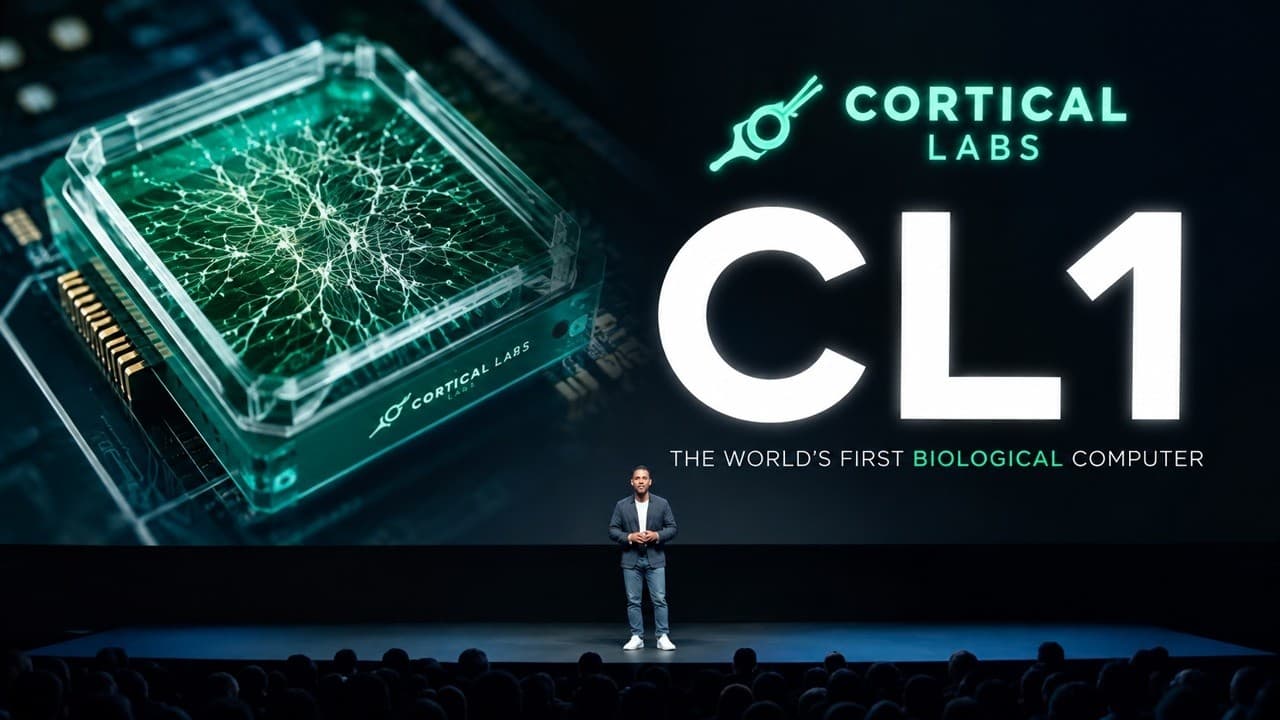
- The CL1 biological computer supports up to one million neurons with integrated life-support controls for temperature, oxygen, and carbon dioxide. Its cultures can remain alive for six months, and customers can access neural computing experiments without maintaining all the specialized wet-lab infrastructure themselves.
- Organoid intelligence is positioned as a method for studying learning, memory, disease, and drug responses. Researchers can teach tissue a task, measure whether the acquired behavior persists, and then examine how conditions such as Alzheimer's disease or candidate treatments affect that learned performance.
- Drug development is a major practical motivation for human brain organoids because neuropsychiatric drugs fail in human clinical trials about 95 percent of the time, according to the researchers cited. Thousands of organoids can also be produced in multiwell plates, providing far greater experimental scale than primate studies.
- Organoid growth is limited by the absence of a vascular system. As tissue expands, oxygen cannot adequately reach its center and waste cannot escape, producing a necrotic core near the current size ceiling. Researchers are developing artificial arteries, blood-vessel networks, and perfusion systems to overcome this constraint.
- Consciousness in organoids remains scientifically and ethically unresolved because researchers lack an agreed quantitative test. Proposed thresholds based on neuron count, physical size, sensory experience, or the presence of a brain stem remain disputed, especially as laboratories improve organoid longevity, environmental feedback, and biological complexity.
- More videos from this channel:
- More from this channel: AI Revolution
Install to Summarize YouTube Videos and Get Transcripts
Explore YouTube Video Summarizer or Get YouTube Transcript Extractor
Questions & Answers
Q: How are human brain organoids made from adult cells?
Researchers begin with adult material such as skin, blood, hair, or teeth. They expose those cells to proteins that return them to an embryonic-like state, producing induced pluripotent stem cells that can develop into many tissue types. Scientists then guide the cells toward neural development, creating small organoids containing neurons and supporting glial cells that organize and exchange electrical signals.
Q: How can living neurons learn to play Pong?
Living neurons are placed on a microelectrode array that both delivers information and records neural activity. In the Cortical Labs experiment, correct decisions produced predictable electrical pulses, while mistakes triggered chaotic bursts. The neurons reorganized their activity to avoid unpredictable stimulation, improving during play. A two-hour session could produce rallies reaching ten accurate shots, according to the transcript.
Q: What is the Cortical Labs CL1 biological computer?
The CL1 is a biological computing system that combines living neural cultures with silicon hardware and life-support equipment. Each unit is described as roughly the size of an elongated toaster and can maintain up to one million neurons for six months. Researchers can control environmental factors, send electrical signals, record responses, and run experiments through a cloud-accessible system.
Q: Why might living neurons be useful for computing?
Living neurons naturally adapt to changing input, reorganize their connections, and operate with low energy demands. Cortical Labs argues that biology also offers longevity, resilience, and self-repair, characteristics sought in artificial intelligence systems. The proposed advantage is not established general-purpose superiority, but a different computing substrate that may learn from real-time feedback and support research into adaptive behavior.
Q: What is organoid intelligence used for?
Organoid intelligence uses cultured neural tissue as an experimental platform for learning, memory, disease research, and biological computing. Scientists can train an organoid through electrical signals, observe whether it retains a learned behavior, and test how toxins, diseases, or pharmaceuticals change its performance. The transcript presents this research instrument as more immediate and practical than replacing conventional silicon computers.
Q: Why are brain organoids valuable for drug testing?
Brain organoids provide human neural tissue at a scale that animal experiments cannot easily match. The transcript states that neuropsychiatric drugs fail in human clinical trials about 95 percent of the time, partly because animal models are not always physiologically relevant. One six-well plate can produce up to 4,000 organoids, allowing researchers to compare many treatments across standardized human-derived samples.
Q: What limits the size of current brain organoids?
Current brain organoids lack a vascular system capable of pumping oxygen into deeper tissue and carrying waste away. As they grow, their centers become deprived of oxygen, form a necrotic core, and eventually suffocate. Researchers are addressing this problem with biomimetic artificial arteries, rough blood-vessel networks grown from endothelial organoids, and perfusion systems intended to support larger cultures.
Q: Could a human brain organoid become conscious?
The transcript presents consciousness as an unresolved question rather than an established property of organoids. Researchers do not have an agreed quantitative measurement for consciousness, and they dispute whether it requires a body, sensory experience, a brain stem, a particular size, or a minimum neuron count. Organoids can respond, remember, and anticipate, but those behaviors do not settle whether subjective awareness exists.
Summary & Key Takeaways
-
Researchers can reprogram adult skin, blood, hair, or tooth cells into induced pluripotent stem cells and grow them into brain organoids. These small cultures contain neurons and supporting glial cells, produce electrical activity, and provide a visible experimental model of human neural development that avoids invasive tissue collection and many limitations of animal studies.
-
Cortical Labs integrates living human neurons with electrode arrays inside CL1 biological computers. Its cultures receive information and feedback through electrical pulses, allowing them to reorganize during games such as Pong. The company proposes that biology could supply adaptable, resilient, self-repairing, and energy-efficient computing, although researchers remain divided over claims of sentience.
-
Organoid intelligence may prove most valuable as a research instrument rather than a replacement for silicon computing. Scientists want to train organoids, measure how long memories persist, and test how diseases or drugs alter learned behavior. Scaling remains difficult because organoids lack vascular systems, while their increasing complexity creates unresolved ethical questions about consciousness.
Read in Other Languages (beta)
Share This Summary 📚
Summarize YouTube Videos and Get Video Transcripts with 1-Click
Try YouTube Summary with ChatGPT & Claude or YouTube Transcript Generator
Explore More Summaries from AI Revolution 📚






Summarize YouTube Videos and Get Video Transcripts with 1-Click
Try YouTube Summary with ChatGPT & Claude or YouTube Transcript Generator