How Does Annie Duke’s Thinking in Bets Help You Make Better Decisions Under Uncertainty?
TL;DR
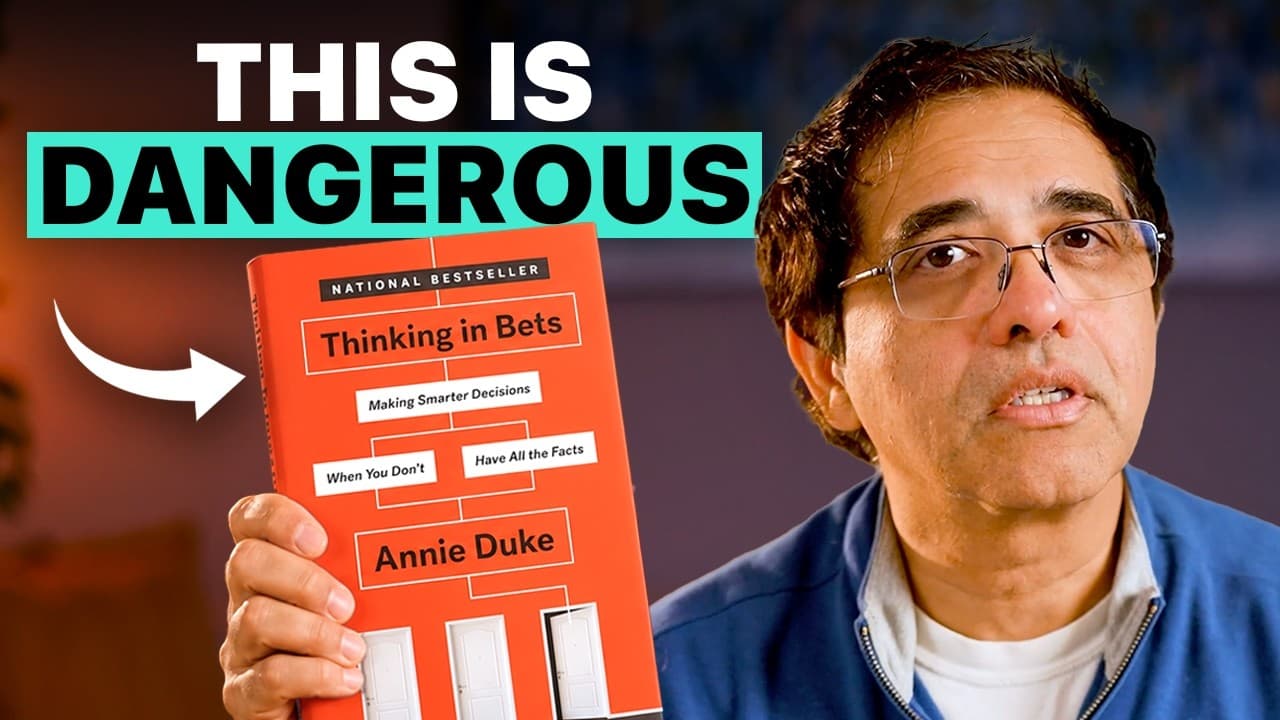
Better decisions under uncertainty come from judging the decision process, not merely its outcome, and separating skill from luck, timing, and emotion. Drawing on Annie Duke’s Thinking in Bets and her 20 years as a poker player, the page introduces the AVA framework for mapping scenarios, assigning payoffs, and calculating expected values. Read on to see how these ideas address accidental success, bias, tilt, and regret.
Transcript
This book changed the way I make decisions. It didn't come from a CEO or a business school professor or a billionaire investor. It came from Annie Duke, a worldclass poker player who spent 20 years at the table and won millions. Now, poker is interesting because that's where you can make a right decision and still lose money. You can make a terribl... Read More
Key Insights
- Good results can be misleading, as they don't always indicate good decisions.
- Thinking in bets involves treating every decision as a wager on future outcomes.
- Separating skill from luck is crucial in evaluating past decisions.
- More information can lead to analysis paralysis, complicating decision-making.
- The AVA framework helps map out scenarios, assign payoffs, and calculate expected value.
- Tilt is a condition where past outcomes negatively influence future decisions.
- Beliefs can distort perception, affecting decision quality.
- Regret should be used as a learning tool, not a paralyzing force.
Install to Summarize YouTube Videos and Get Transcripts
Explore YouTube Video Summarizer or Get YouTube Transcript Extractor
Questions & Answers
Q: How can you make better decisions under uncertainty?
Treat each choice as a bet on an uncertain future rather than expecting a guaranteed result. Evaluate possible scenarios, payoffs, and expected values, then review outcomes by asking what came from skill, luck, timing, or emotion.
Q: What does “thinking in bets” mean?
Thinking in bets means recognizing that a sound choice can produce a bad outcome and a terrible choice can still be rewarded. It shifts attention from whether you won or lost to whether your reasoning was sound given the information available.
Q: Why are good results sometimes bad teachers?
A favorable result can reward a poor decision and make accidental success look like skill. The transcript illustrates this with a drunk driver who gets home safely after speeding through three red lights, even though driving was still a terrible decision.
Q: How do you separate skill from luck when reviewing a decision?
Do not ask whether you were skilled or lucky, because both may have influenced the result. Instead, pull the outcome apart and ask what came from skill, what came from luck, and what you could do better next time.
Q: How does the AVA framework support decision-making?
The AVA framework provides a structured way to make choices when you cannot see around the corner. It maps possible scenarios, assigns payoffs, and calculates expected values so options can be assessed more objectively.
Q: What is self-serving bias in decision-making?
Self-serving bias makes people credit their wins to skill while blaming losses on luck. It can also reverse the judgment for others: their wins are labeled lucky, while their losses are attributed to insufficient skill.
Q: What is tilt in decision-making?
Tilt is the condition in which previous outcomes negatively influence later decisions. Emotions from earlier wins or losses can cloud judgment, producing choices that are impulsive or overly cautious.
Q: How should regret be used when evaluating past choices?
Regret should be used to identify what went wrong and what can be improved, rather than allowing a past mistake to paralyze future action. This turns an emotional response into information for the next decision.
Summary & Key Takeaways
-
Annie Duke's 'Thinking in Bets' emphasizes that good outcomes can be deceptive, as they may result from luck rather than skill. The video explores how to make better decisions by treating each choice as a bet against the future, focusing on separating skill from luck and avoiding emotional biases.
-
The AVA framework is introduced as a tool to improve decision-making under uncertainty. It involves mapping out possible scenarios, assigning payoffs, and calculating expected values to evaluate decisions more objectively.
-
The concept of 'tilt' is discussed, where previous outcomes can negatively impact future decisions. The video highlights the importance of using regret constructively to inform future choices and avoid being paralyzed by past mistakes.
Read in Other Languages (beta)
Share This Summary 📚
Summarize YouTube Videos and Get Video Transcripts with 1-Click
Try YouTube Summary with ChatGPT & Claude or YouTube Transcript Generator
Explore More Summaries from Sandeep Swadia 📚
Summarize YouTube Videos and Get Video Transcripts with 1-Click
Try YouTube Summary with ChatGPT & Claude or YouTube Transcript Generator