How Does the Notebook System That Saved My Brain Work?
TL;DR
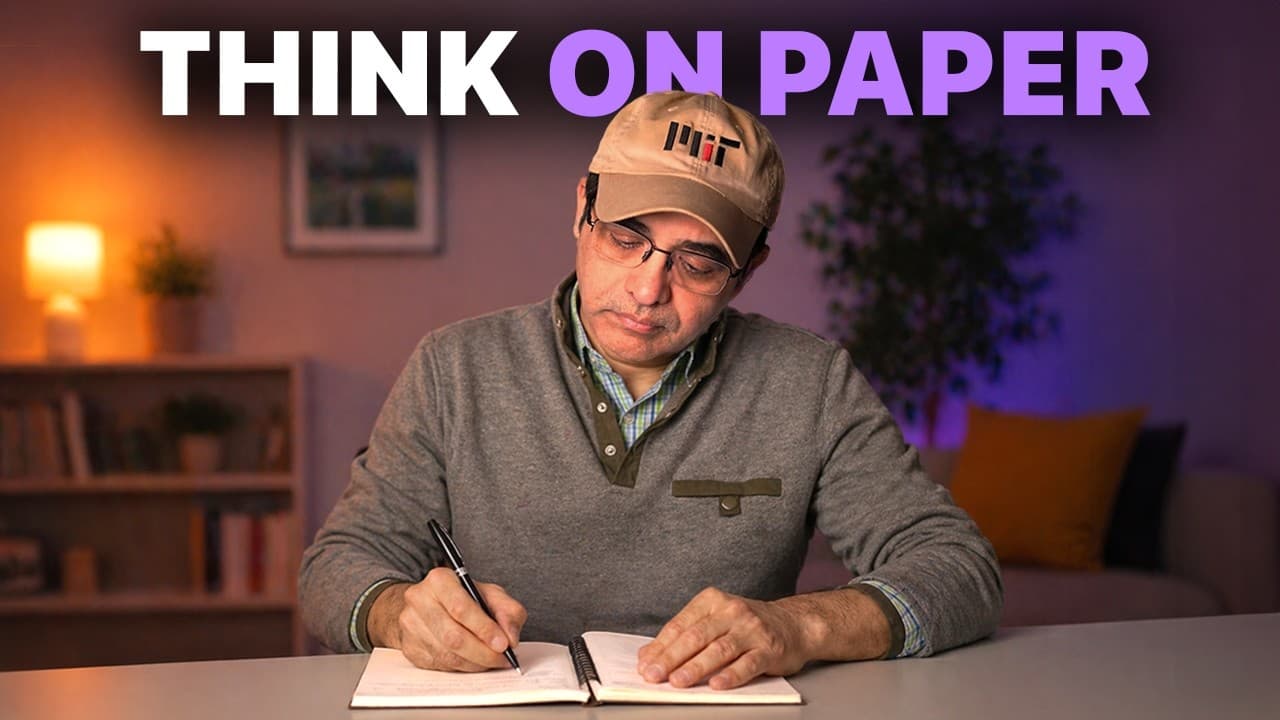
Thinking on paper works by engaging ideas, memories, and learning through the physical act of handwriting. The system uses paper for free-form invention, emotional introspection, and problem-defining intuition, then brings in a keyboard for structure and AI for feedback and refinement. Paper can cost as little as one dollar, yet it provides a uniquely personal way to develop thoughts. Read on for the practical framework.
Transcript
If you want to think more clearly than 99% of people, learn more quickly, and master almost anything in the age of AI, you need to bring back one forgotten skill. How to think on paper. I've spent decades in boardrooms and tech companies worth billions, and the sharpest thinkers I know still reach for pen and paper. So, in this video, I'm going to ... Read More
Key Insights
- Writing on paper activates parts of the brain associated with ideas, memories, and learning.
- Top thinkers and leaders often use paper for brainstorming and idea generation.
- Handwriting creates a sensory fingerprint, linking thoughts to physical actions.
- Doodling and writing by hand can reduce anxiety and improve focus.
- The 'three originals'—invention, introspection, and intuition—are best fostered on paper.
- Blank page syndrome is a barrier to creativity, but overcoming it leads to clarity.
- Handwriting notes leads to deeper understanding than typing, despite slower speed.
- Ideas require different tools—paper for freedom, keyboard for form, AI for feedback.
Install to Summarize YouTube Videos and Get Transcripts
Explore YouTube Video Summarizer or Get YouTube Transcript Extractor
Questions & Answers
Q: How does the notebook system help you think on paper?
The system uses paper for three kinds of original thinking: invention, introspection, and intuition. Writing by hand gives ideas room to emerge, helps make emotions visible, and supports careful problem definition before solutions are considered.
Q: What are the three originals in the notebook system?
The three originals are invention, introspection, and intuition. Invention generates something new, introspection gives language to emotions, and intuition examines what is true, what is assumed, and how a problem should be formulated.
Q: Why can handwriting support clearer thinking better than typing?
Writing is slower than typing, but the transcript argues that this keeps more of the thinking process with the writer. Each handwritten letter involves distinct pressure, speed, and shape, creating what the speaker calls a sensory fingerprint through haptic perception.
Q: How should paper be used for invention and brainstorming?
Write whatever comes to mind without criticizing it while ideas are being generated. Fragments, unrelated thoughts, doodles, and drawings are all welcome because the goal is to create freely and allow new connections to form.
Q: How can writing on paper help with difficult emotions?
Use the page as an external mind by labeling, naming, and accepting what you feel. Once the emotional fog has language and becomes visible on paper, the transcript suggests it becomes easier to navigate and move forward.
Q: How does paper help with problem-solving and intuition?
Paper helps you slow down and define the problem before trying to solve it. Ask what you actually know to be true, what you are assuming, and how the problem should be formulated.
Q: Why do handwritten notes support deeper learning?
The transcript cites Princeton and UCLA researchers who found that students taking notes by hand understood concepts more deeply than students who typed. Typists recorded more words but understood less, illustrating the tradeoff of greater speed with less depth.
Q: How should paper, a keyboard, and AI work together?
Use paper for initial freedom and original thought, a keyboard for organizing and structuring the material, and AI for feedback and refinement. Paper is not presented as a replacement for keyboards or AI; each tool serves a different stage of developing an idea.
Summary & Key Takeaways
-
Writing on paper stimulates brain areas tied to creativity and memory, offering a unique advantage over typing or AI. This method is crucial for generating and developing ideas, as it allows for a more personal and tactile engagement with thoughts.
-
The 'three originals'—invention, introspection, and intuition—are best explored through handwriting. This process encourages the free flow of ideas, helping to overcome creative blocks and fostering a deeper connection to one's thoughts.
-
Using paper, keyboard, and AI in tandem creates a comprehensive system for idea development. Each tool serves a specific purpose: paper for initial freedom, keyboard for structuring, and AI for refining and expanding ideas.
Read in Other Languages (beta)
Share This Summary 📚
Summarize YouTube Videos and Get Video Transcripts with 1-Click
Try YouTube Summary with ChatGPT & Claude or YouTube Transcript Generator
Explore More Summaries from theMITmonk 📚






Summarize YouTube Videos and Get Video Transcripts with 1-Click
Try YouTube Summary with ChatGPT & Claude or YouTube Transcript Generator