How to Simplify a Four-Variable Karnaugh Map
TL;DR
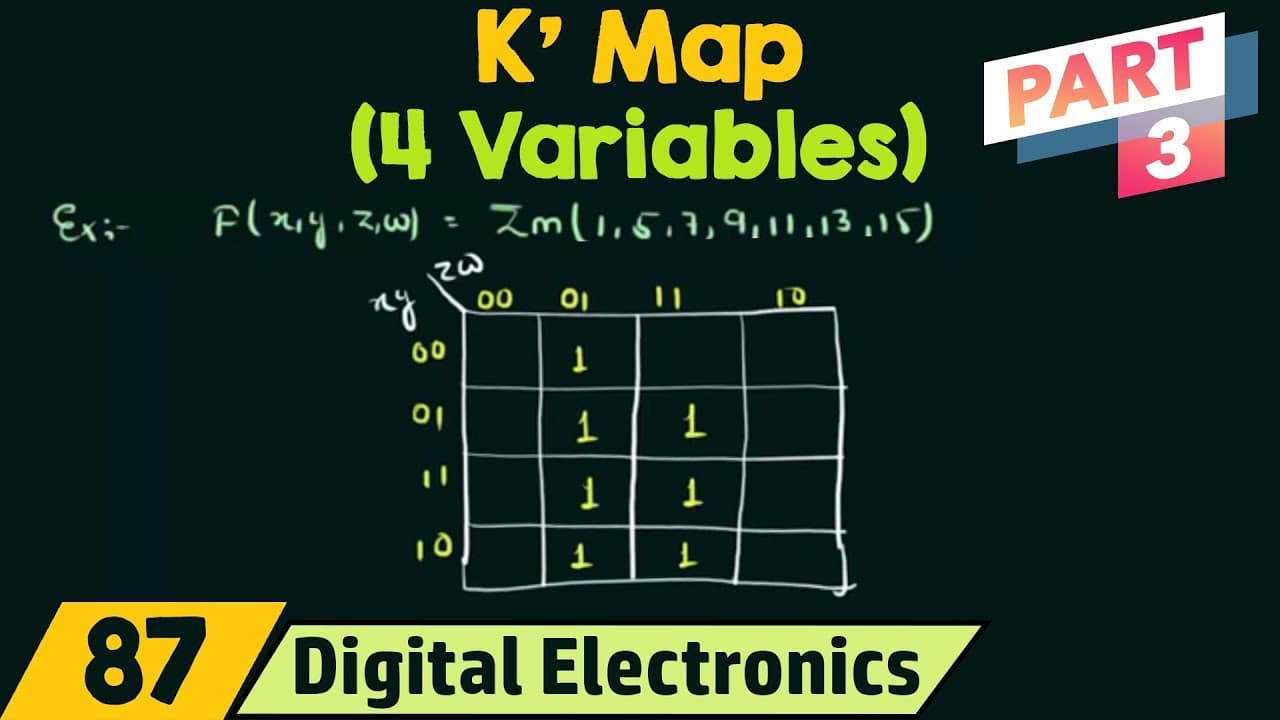
Place ones for minterms 1, 5, 7, 9, 11, 13, and 15 in a 16-cell Karnaugh map, then form three overlapping quads that cover every one. Variables that change within each quad are eliminated, producing the reduced function F = XW + YW + Z̄W and avoiding the several steps that Boolean algebra could require.
Transcript
let's move to the another example in the four variable k-map the function f with four variables let's say X Y Z and W is there and the min terms are 1 5 7 1 5 7 9 11 13 9 11 13 and 15 so here we are having the min terms as M 1 M 5 m 7m 9 m xi m 13 and M 15 now we have to reduce this by using the key map we can do it by the boolean algebra also but ... Read More
Key Insights
- A four-variable Karnaugh map contains 16 cells because the transcript calculates the required size as 2 to the power of 4. These cells represent the possible combinations of the variables X, Y, Z, and W.
- The function is defined by minterms 1, 5, 7, 9, 11, 13, and 15. Simplification starts by placing a one in each corresponding Karnaugh map cell before attempting to identify any groups.
- The grouping rule is to form the largest available groups of ones. In this example, the populated cells can be covered with three quads, including overlapping groups that ensure the otherwise remaining one is included.
- The first quad produces XW because X remains unchanged and W remains equal to one across its cells. The changing variables Y and Z are removed from the product term for that group.
- The second quad produces YW because Y and W remain constant throughout the selected four cells. Variables that change across the quad are excluded when the corresponding simplified product term is written.
- The third quad produces Z̄W because X and Y change from zero to one, while Z remains zero and W remains one. A constant zero for Z is represented by its complemented form.
- The reduced function is F = XW + YW + Z̄W. Each product term comes from one quad, and the three terms are joined by plus signs representing the OR combination described in the example.
- Karnaugh map minimization saves time compared with the several Boolean algebra steps mentioned in the lecture. The instructor also states that forming these groups and writing the reduced function becomes faster with practice.
Install to Summarize YouTube Videos and Get Transcripts
Explore YouTube Video Summarizer or Get YouTube Transcript Extractor
Questions & Answers
Q: How do you simplify the given four-variable Karnaugh map?
Create a 16-cell Karnaugh map for X, Y, Z, and W, then place ones in the cells for minterms 1, 5, 7, 9, 11, 13, and 15. Form the largest available groups, using three overlapping quads to cover all the ones. Translate the constant variables in those quads into XW, YW, and Z̄W, giving F = XW + YW + Z̄W.
Q: Why does a four-variable Karnaugh map have 16 cells?
The lecture determines the map size by calculating 2 to the power of 4, which equals 16. The exponent comes from the four variables X, Y, Z, and W. Therefore, the example requires a Karnaugh map with 16 cells before the listed minterms can be placed and grouped for simplification.
Q: Which minterms are placed in the Karnaugh map example?
The function contains minterms 1, 5, 7, 9, 11, 13, and 15. A one is placed in the Karnaugh map cell corresponding to each of these minterms. These populated cells provide the pattern used to create the three quads and derive the reduced product terms.
Q: Why are the largest available groups selected in a Karnaugh map?
The example explicitly instructs that groups should be made as large as possible. Following this rule allows the listed ones to be covered using quads rather than smaller pairs. Three quads are formed in the worked solution, and each quad removes the variables that change across its four cells, leaving a shorter product term.
Q: How is the product term XW obtained from the first quad?
Within the first quad, Y changes from one to zero and Z changes from zero to one, so neither variable appears in its product term. X does not change, and W also remains unchanged at one. Retaining only those constant variables gives XW as the term represented by the first quad.
Q: How is the product term YW obtained from the second quad?
The second quad covers four ones for which Y remains equal to one and W also remains constant. The other variables change across the grouped cells, so they are removed from the simplified term. Keeping only the variables that remain unchanged throughout the quad produces the product term YW.
Q: Why does the third quad produce Z̄W?
In the third quad, X and Y change from zero to one, so they do not appear in the resulting product term. Z remains fixed at zero, which is written as the complemented variable Z̄, while W remains fixed at one. The constant values therefore produce the term Z̄W.
Q: What is the final reduced function for the Karnaugh map?
The three selected quads contribute the product terms XW, YW, and Z̄W. These terms are combined using plus signs, giving the final reduced function F = XW + YW + Z̄W. The result covers the ones placed for minterms 1, 5, 7, 9, 11, 13, and 15.
Summary & Key Takeaways
-
The function uses four variables, X, Y, Z, and W, with minterms 1, 5, 7, 9, 11, 13, and 15. Because four variables produce 16 possible combinations, the solution begins with a 16-cell Karnaugh map whose rows and columns follow the displayed binary ordering.
-
A one is entered into every cell corresponding to the listed minterms. The populated cells are then grouped into the largest available groups. Three overlapping quads are selected, ensuring that the remaining isolated one is included while every listed minterm receives coverage from at least one quad.
-
Each quad contributes a product term containing only variables that remain constant throughout that group. The first quad gives XW, the second gives YW, and the third gives Z̄W. Combining these terms with OR operations produces the reduced function F = XW + YW + Z̄W.
Read in Other Languages (beta)
Share This Summary 📚
Summarize YouTube Videos and Get Video Transcripts with 1-Click
Try YouTube Summary with ChatGPT & Claude or YouTube Transcript Generator
Explore More Summaries from Neso Academy 📚






Summarize YouTube Videos and Get Video Transcripts with 1-Click
Try YouTube Summary with ChatGPT & Claude or YouTube Transcript Generator