How to Grow a YouTube Channel in 90 Days
TL;DR
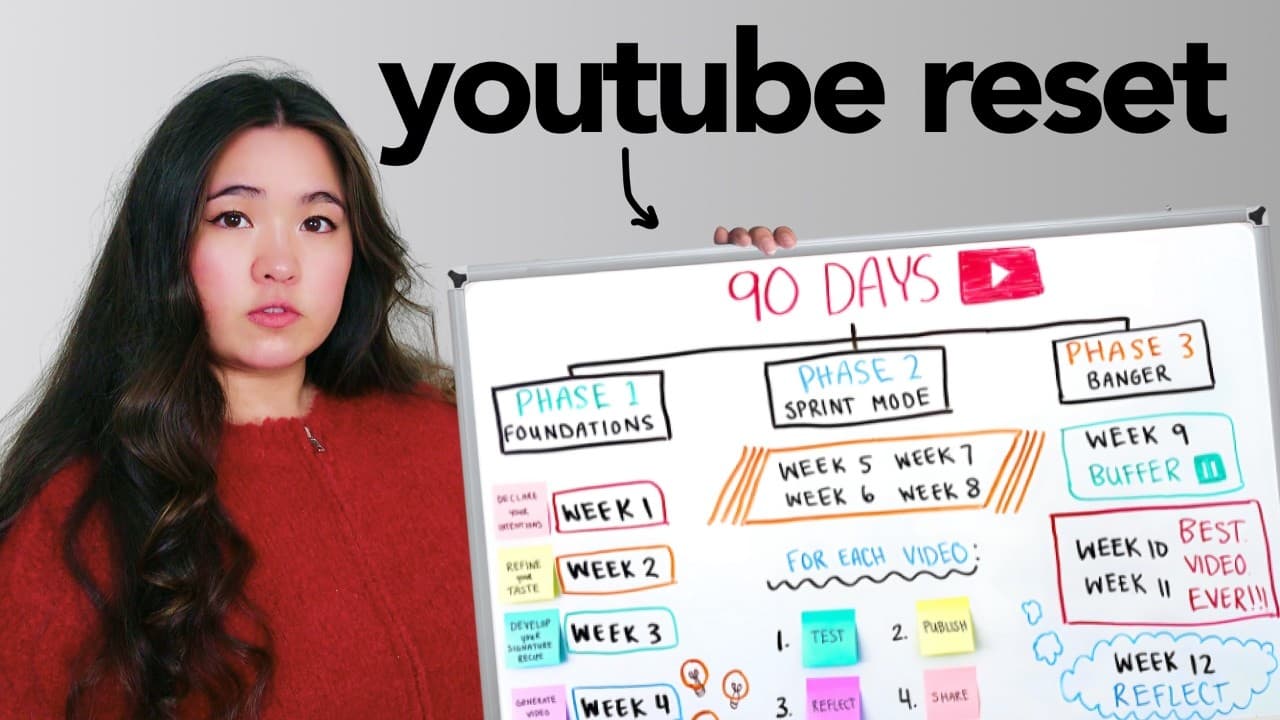
Grow a YouTube channel by committing publicly, studying successful videos, defining a signature content recipe, and testing feasible ideas at twice your normal upload pace. The 12-week challenge turns eight planned ideas into focused experiments, helping you improve through deliberate observation, faster production, and repeated publishing rather than relying on motivation alone.
Transcript
I'm about to show you the 90-day YouTube challenge that led to the two biggest growth spurts of my entire YouTube career. The first time I followed it, it got me monetized. The second time, it broke me through a major plateau and eventually led to me hitting 100,000 subscribers. This is the most effective system I have ever used for growing on YouT... Read More
Key Insights
- Written and public commitment is an accountability mechanism for completing the challenge. The cited study led by Dr. Gail Matthews found that people who wrote down a goal were 42% more likely to achieve it than people who merely thought about it, with further improvement among those who shared it.
- Creative taste is a filter for choosing topics and evaluating pacing, editing, titles, thumbnails, lighting, music, and other decisions. The week-two exercise requires studying at least 30 videos as a creator, asking why each video earned a click, maintained attention, created a feeling, or became boring.
- A swipe file is a reusable collection of titles, thumbnails, hooks, effects, and editing choices that produce a strong response. It can live in any frictionless tool, including Google Docs, Apple Notes, or Notion, and should capture lessons from multiple niches, formats, and styles.
- A signature video recipe combines five ingredients: audience, value, format, vibe, and differentiator. These ingredients clarify who the content serves, what viewers gain, how the value is delivered, what feeling the experience creates, and why that version deserves attention over competing videos.
- One to three draft video recipes provide enough direction for intentional experimentation without requiring permanent decisions. Creators can base the drafts on their strengths and recurring preferences in the swipe file, then refine the combinations through the videos produced during the challenge.
- Every proposed video idea must satisfy testability, view potential, and feasibility. It should test part of the creator's recipe, offer a plausible breakout opportunity based on concepts that have already performed, and remain practical to script, film, edit, and publish at double the usual pace.
- Sprint mode requires publishing eight videos at twice the creator's normal upload cadence. A weekly creator publishes twice weekly, while a creator who normally posts every other week publishes weekly. The accelerated schedule forces faster decisions and creates more opportunities to test the planned recipes.
- A buffer week is built into the five-week sprint phase because production setbacks can occur. At the default weekly schedule, eight videos at twice-weekly frequency require four weeks, so the remaining week provides time to catch up without abandoning the larger 12-week commitment.
Install to Summarize YouTube Videos and Get Transcripts
Explore YouTube Video Summarizer or Get YouTube Transcript Extractor
Questions & Answers
Q: How do you grow a YouTube channel in 90 days?
Start by publicly committing to a 12-week challenge, then study at least 30 varied videos to sharpen your creative taste and build a swipe file. Define one to three content recipes using audience, value, format, vibe, and differentiation. Generate eight testable, high-potential, feasible ideas, then publish those eight videos at twice your normal cadence during sprint mode.
Q: What should a creator do during the first week?
The first week should be used to make a clear, written commitment rather than planning individual videos. Share the commitment through a community post, channel update, Instagram story, tweet, Discord server, or direct conversation with a friend or family member. The purpose is to create accountability that remains useful when motivation fades or competing responsibilities appear.
Q: How can creators develop better taste for YouTube videos?
Creators can develop taste by studying at least 30 videos in one week as producers rather than passive viewers. They should examine why they clicked, what maintained attention after 30 seconds, how music and lighting affected them, and exactly when boredom appeared. Studying vlogs, challenges, tutorials, breakdowns, and commentaries expands the range of creative techniques available.
Q: What is a YouTube swipe file and what should it contain?
A YouTube swipe file is a personal collection of creative elements that attract attention or create a memorable response. It can include clickable titles, compelling thumbnails, effective opening hooks, editing techniques, and visual or audio effects. The file can be stored in Google Docs, Apple Notes, Notion, or another low-friction system and reused throughout the challenge.
Q: What are the five parts of a signature video recipe?
A signature video recipe contains audience, value, format, vibe, and differentiator. Audience identifies whom the content serves. Value defines what viewers gain. Format determines how that value is delivered. Vibe describes the feeling created by the content. The differentiator explains why the creator's version is worth choosing, such as personality, skills, access, depth, insight, or novelty.
Q: How should creators choose eight video ideas for the challenge?
Each of the eight ideas should pass three tests: testability, view potential, and feasibility. An idea should explore part of a draft video recipe, possess breakout potential based on concepts, titles, or thumbnails that have already performed, and remain possible to complete at twice the normal production speed. Complex ideas should be simplified or saved for later.
Q: How does the double upload schedule work in sprint mode?
Sprint mode doubles the creator's existing upload cadence for eight videos. A creator who normally publishes once each week should publish twice each week, while someone who publishes every other week should aim for weekly uploads. At the default cadence, producing eight videos takes four weeks, and the five-week phase includes an additional buffer week for catching up.
Q: Why does the challenge use faster publishing instead of only planning?
Faster publishing turns each idea into a practical experiment that can refine the creator's signature recipe. The creator tests formats, vibes, audience choices, and types of value through eight actual uploads rather than keeping those decisions theoretical. The tighter production window also requires clear, achievable ideas that can be scripted, filmed, edited, and released without oversized production demands.
Summary & Key Takeaways
-
The first four weeks build the foundation for consistent publishing. Creators declare their commitment, analyze at least 30 varied videos, collect effective titles, thumbnails, hooks, and editing choices in a swipe file, then draft one to three signature video recipes based on audience, value, format, vibe, and differentiation.
-
Week four converts the foundation into eight executable video ideas. Every idea must test an aspect of the creator's recipe, possess meaningful view potential, and remain feasible at twice the normal publishing pace. Previously successful concepts can provide direction, but each concept should be filtered through the creator's own recipe and strengths.
-
Weeks five through nine form sprint mode, when creators publish eight videos at double their usual cadence. Someone publishing weekly would move to twice weekly, while someone publishing every other week would move to weekly. The phase includes five weeks, allowing one buffer week for delays while preserving the production challenge.
Read in Other Languages (beta)
Share This Summary 📚
Summarize YouTube Videos and Get Video Transcripts with 1-Click
Try YouTube Summary with ChatGPT & Claude or YouTube Transcript Generator
Explore More Summaries from Aprilynne Alter 📚
Summarize YouTube Videos and Get Video Transcripts with 1-Click
Try YouTube Summary with ChatGPT & Claude or YouTube Transcript Generator