How Do the Six Core Concepts of Modern AI Work?
TL;DR
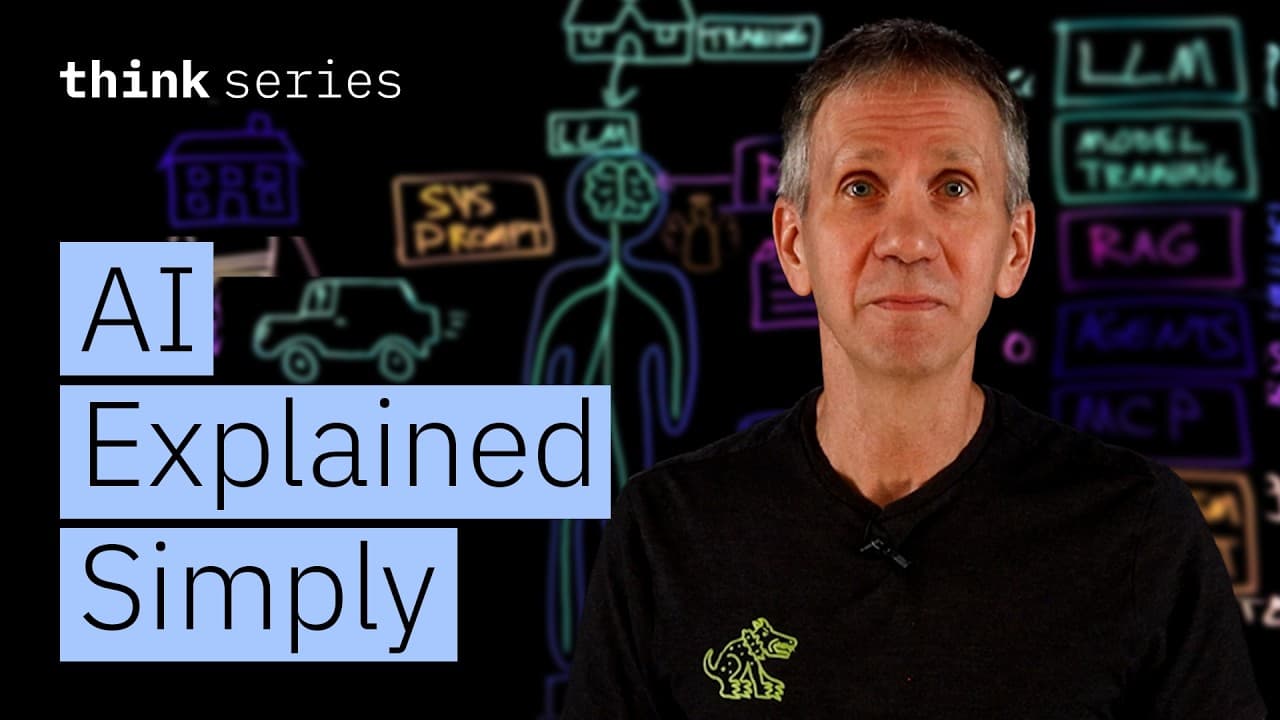
Modern AI combines a trained large language model with external knowledge, tools, communication protocols, and behavioral instructions. The model generates probabilistic outputs, RAG supplies trusted and current information, agents take actions through tools, MCP coordinates connections, and system prompts establish boundaries that must evolve as attackers discover new ways to manipulate the system.
Transcript
AI is everywhere, and along with it are a bunch of new terms and concepts being thrown around as if everyone already understands what they mean. Here's a news flash, not everyone does. And if you're one of those people still trying to grasp what all this stuff really means, then this video is for you. We're going to simplify modern AI and explain i... Read More
Key Insights
- Artificial intelligence is a computer science subfield focused on matching or exceeding human intelligence in a computer. This definition uses human intelligence as the reference point for deciding whether a computer demonstrates intelligence.
- A large language model is the brain of a modern AI system. It contains core intelligence, supports reasoning, and generates content by using probabilities to predict outputs from inputs, resembling highly expanded autocomplete.
- Model training and tuning are how an LLM learns foundational capabilities. The process is compared to attending school because it teaches the model language, mathematics, history, basic functions, and patterns that support reasoning.
- Retrieval Augmented Generation is a method for extending AI knowledge through trusted external sources. It can provide updated information, ground responses in accepted material, and reduce hallucinations, which are confident errors produced by incorrect guesses.
- An AI agent is a model that uses tools autonomously in a loop. Tools give the model the equivalent of hands and feet, allowing it to search the web, write code, access databases, and complete tasks.
- Model Context Protocol is a communication mechanism connecting AI models with tools. Like a central nervous system linking a brain to the body, MCP helps coordinate actions after the model reasons and develops a plan.
- A system prompt is a set of guidelines that constrains model behavior without requiring the model to be rebuilt. It supplies principles about what the AI should do, what it should refuse, and how it should respond.
- Prompt injection is an attack that tricks an AI into doing something it should not do. It resembles social engineering because both exploit trust, and defenses must adapt as malicious actors discover new ways to misuse systems.
Install to Summarize YouTube Videos and Get Transcripts
Explore YouTube Video Summarizer or Get YouTube Transcript Extractor
Questions & Answers
Q: What are the six core concepts behind modern AI systems?
The six concepts are large language models, model training and tuning, Retrieval Augmented Generation, AI agents with tools, Model Context Protocol, and system prompts. Together they represent a brain, education, access to updated knowledge, hands and feet for taking action, a nervous system for communication, and guiding principles that constrain behavior.
Q: How does a large language model generate content?
A large language model generates content by using probabilities to predict an output from a given input. The process is compared to autocomplete operating at a much larger scale, because it can complete a paragraph or an entire document instead of merely finishing a short sentence. It can generate words, images, sounds, and other content.
Q: Why do AI models need training and tuning?
AI models need training and tuning because an untrained model is not very useful. Training is compared to sending a human brain to school, where it learns language, mathematics, history, and foundational ways of thinking. This process develops the model's basic functions and reasoning capabilities before other information sources or tools are added.
Q: What is Retrieval Augmented Generation and why is it useful?
Retrieval Augmented Generation extends an AI system's knowledge through trusted external sources. It gives the model access to information such as recent research papers, product documentation, news reports, and weather forecasts. RAG also helps ground responses in information considered trustworthy and can reduce hallucinations, which are confident but incorrect outputs based on bad guesses.
Q: What is an AI agent and how does it work?
An AI agent is a model that uses tools autonomously in a loop. The model reasons, selects or operates tools, evaluates progress, and continues working toward a goal. Tool access lets it move beyond answering questions and perform actions such as searching the web, reading or writing database information, producing code, and potentially purchasing items.
Q: How does Model Context Protocol connect AI models and tools?
Model Context Protocol connects an AI model to the tools it can use. In the human analogy, it acts like the central nervous system that carries messages between the brain and the parts of the body responsible for action. The model performs reasoning and planning, while MCP provides an orchestration layer that coordinates tool-driven actions.
Q: How do system prompts guide AI behavior?
A system prompt gives an AI model guidelines that constrain what it should and should not do. This approach can shape behavior without repeatedly rebuilding and retraining the model, which would be time-consuming and expensive. The instructions can require refusal of harmful requests, but they must be updated as new manipulation techniques and misuse patterns appear.
Q: What is prompt injection and why is it difficult to prevent?
Prompt injection is an attack that attempts to trick an AI into performing actions or providing information that it should withhold. It is compared to social engineering because it exploits a tendency to trust instructions. Prevention is difficult because users can disguise harmful intent through seemingly legitimate framing, so system prompts must evolve as attackers devise new approaches.
Summary & Key Takeaways
-
A large language model functions as the brain of a modern AI system. Model training and tuning resemble sending that brain to school, where it learns language, mathematics, history, and basic reasoning. Generative AI then uses probabilities to predict and create words, images, sounds, and other outputs from provided inputs.
-
Retrieval Augmented Generation extends a model with trusted external information, including current research, product documentation, news, and weather. This grounding can reduce hallucinations, which are confident but incorrect guesses. RAG helps overcome the limitation that a trained model does not automatically know information created or changed after its training.
-
AI agents combine models with tools in autonomous loops so they can act instead of merely answering questions. Model Context Protocol connects models to those tools and coordinates their actions. System prompts provide behavioral guidelines, constrain unsafe responses, and require continued adaptation as malicious users develop new prompt-injection techniques.
Read in Other Languages (beta)
Share This Summary 📚
Summarize YouTube Videos and Get Video Transcripts with 1-Click
Try YouTube Summary with ChatGPT & Claude or YouTube Transcript Generator
Explore More Summaries from IBM Technology 📚
Summarize YouTube Videos and Get Video Transcripts with 1-Click
Try YouTube Summary with ChatGPT & Claude or YouTube Transcript Generator