How Does JEV Automate Decisions Without an LLM?
TL;DR
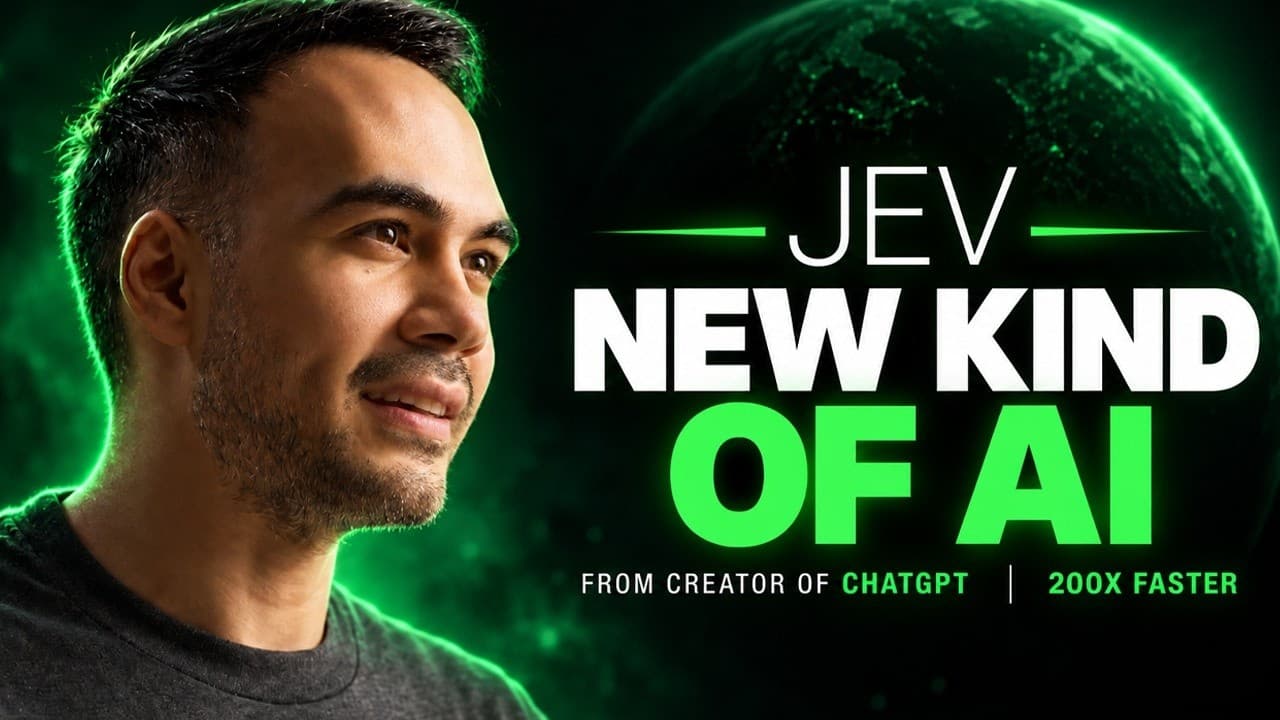
JEV returns predefined, probability-weighted decisions instead of generating text, allowing software to branch on its output without parsing or schema validation. Typesafe claims this machine-native approach matches frontier LLMs on system-one tasks while delivering calibrated confidence, 70–500 millisecond latency, and substantially lower costs for automation, routing, classification, and other structured workflows.
Transcript
So, one of the people behind chatgpt says chat GPT broke his heart. Diego Almeida was an open AI researcher who helped build the chatbot and co-invented RLHF, reinforcement learning from human feedback, which is probably the training technique most responsible for this whole AI era. And yet, he was disappointed. In his words, we have lightning in a... Read More
Key Insights
- JEV is a transformer-based system-one model that produces typed probabilistic decisions rather than text. It accepts structured or unstructured state, evaluates questions through choice, score, and null primitives, and returns outputs that software can use directly for branching and automation.
- Type safety is JEV's structural safeguard against malformed output. Developers specify allowable response types in advance, so the system cannot return a chat response, refusal, invented citation, or other value outside that schema, eliminating separate parsing and schema-validation steps.
- Calibrated confidence is central to JEV's automation value. Typesafe says higher confidence corresponds to higher accuracy and similar inputs receive similar answers, allowing software to act above a chosen threshold while ignoring uncertain results or escalating them to a human.
- JEV produces its requested decisions in parallel through a single hardware query rather than generating tokens sequentially. Typesafe reports end-to-end latency of 70–500 milliseconds, compared with 3–329 seconds for frontier LLMs, with claimed speed improvements ranging from 40 to 200 times.
- JEV's published price is $0.042 per million input tokens, equivalent to $42 per billion, with output free. The transcript contrasts this with Terra at $2 per million input tokens and $12 per million output tokens, while noting that Typesafe cannot prove its pricing is unsubsidized.
- RLCD is Typesafe's training method for reinforcement learning from calibrated decisions, not the model architecture itself. The company says JEV also uses a new architecture and parallel sampler, while its training data is exclusively synthetic and internally produced.
- Reliable workflows are described as collections of small, independent, probability-driven questions ending in software branches. Typesafe says JEV occupied the Pareto frontier across nearly two orders of magnitude in its workflow evaluations, although the workflows were created by its own team and could reflect bias.
- JEV is designed for machine-facing tasks such as selecting tools or subagents, deciding whether to continue or retry, scoring risk, routing models, monitoring agent traces, and escalating uncertainty. Language models remain better suited to chatbots, copilots, coding agents, and language-generating tasks.
- More videos from this channel:
- More from this channel: AI Revolution
Install to Summarize YouTube Videos and Get Transcripts
Explore YouTube Video Summarizer or Get YouTube Transcript Extractor
Questions & Answers
Q: How does JEV differ from a traditional LLM?
JEV differs from a traditional large language model because it does not generate open-ended text one token at a time. It accepts state such as JSON or a plain string, then returns predefined choices, scores, or Boolean results with probabilities. That structure lets software branch directly on its output without parsing generated language or checking whether the response matches an expected schema.
Q: How does JEV prevent malformed or hallucinated outputs?
JEV requires developers to define the allowed output structure before the model runs. It can return only values within that structure, so Typesafe describes schema-matching errors as mathematically impossible. This prevents invented tool-call formats and unexpected text, but it does not guarantee that every decision is correct. A valid probability or permitted choice can still represent a mistaken judgment.
Q: Why is calibrated confidence important for automation?
Calibrated confidence helps software distinguish decisions it can act on from cases requiring caution. If a system performs correctly 95% of the time but cannot identify its uncertain 5%, full automation remains risky. JEV returns probabilities intended to track actual accuracy, enabling workflows to accept high-confidence results, ignore weak signals, retry, or send uncertain cases to a human reviewer.
Q: How fast is JEV compared with frontier language models?
Typesafe reports that JEV completes requests in 70–500 milliseconds, while frontier LLM requests take 3–329 seconds end to end. Its claimed improvement is 40 to 200 times, depending on the comparison. In one simplified side-by-side demonstration, JEV responded in 0.114 seconds while Terra required 8.566 seconds, although Typesafe acknowledged that the example favored JEV's design.
Q: How much does JEV cost to use?
The published JEV price is $0.042 per million input tokens, or $42 per billion input tokens, and output is free. The transcript compares that with Terra at $2 per million input tokens and $12 per million output tokens. Typesafe says its pricing is transparent but also acknowledges that it cannot prove the service is not subsidized and expects costs to decline.
Q: What kinds of software workflows can use JEV?
JEV can support agents choosing their next tool or subagent, workflows deciding whether to continue, retry, stop, or ask the user, and systems scoring risk before taking action. Other proposed uses include model routing, command-safety classification, agent-trace monitoring, jailbreak verification, real-time applications, model harnesses, and escalating uncertain decisions to human reviewers.
Q: What evidence supports JEV's performance claims?
Typesafe published workflow evaluations in which every model received the same workflow and results were scored against the average judgments of GPT6 Astra and Fable 5.1. The company says JEV led the Pareto frontier across nearly two orders of magnitude, with homepage figures of 193.6 times faster and 444.6 times cheaper. However, Typesafe built the workflows itself, so bias remains possible.
Q: Why did developers adopt JEV so quickly after launch?
Developers saw JEV as a faster, cheaper, and more robust way to place structured intelligence inside code. Vercel reported that within 24 hours it reached more than twice as many paid teams as any previous AI Gateway launch, reaching nearly 13% of paid teams. Early users also reported faster safety classification and valued receiving real probabilities for workflow automation.
Summary & Key Takeaways
-
JEV is Typesafe AI's first system-one model, created after co-founder Diego Almeida concluded that strong conversational ability was not producing widespread automation. Instead of generating language, JEV transforms unstructured state into typed choices, scores, or Boolean answers with probabilities that software can consume directly and evaluate in parallel.
-
Developers define JEV's allowable outputs before inference, preventing responses outside the requested structure. Typesafe pairs this type safety with calibrated confidence, a parallel sampler, and reinforcement learning for calibrated decisions. The company reports 70–500 millisecond responses and major cost reductions compared with frontier language models in its evaluated workflows.
-
JEV targets smart if statements inside software, including tool selection, retry decisions, risk scoring, model routing, trace monitoring, and human escalation. Early tests reported faster execution and useful probabilities, while Vercel recorded unusually rapid adoption. However, probabilities can still be wrong, and Typesafe's internally built evaluations may contain bias.
Read in Other Languages (beta)
Share This Summary 📚
Summarize YouTube Videos and Get Video Transcripts with 1-Click
Try YouTube Summary with ChatGPT & Claude or YouTube Transcript Generator
Explore More Summaries from AI Revolution 📚






Summarize YouTube Videos and Get Video Transcripts with 1-Click
Try YouTube Summary with ChatGPT & Claude or YouTube Transcript Generator