How to Fix Five Common English Grammar Mistakes
TL;DR
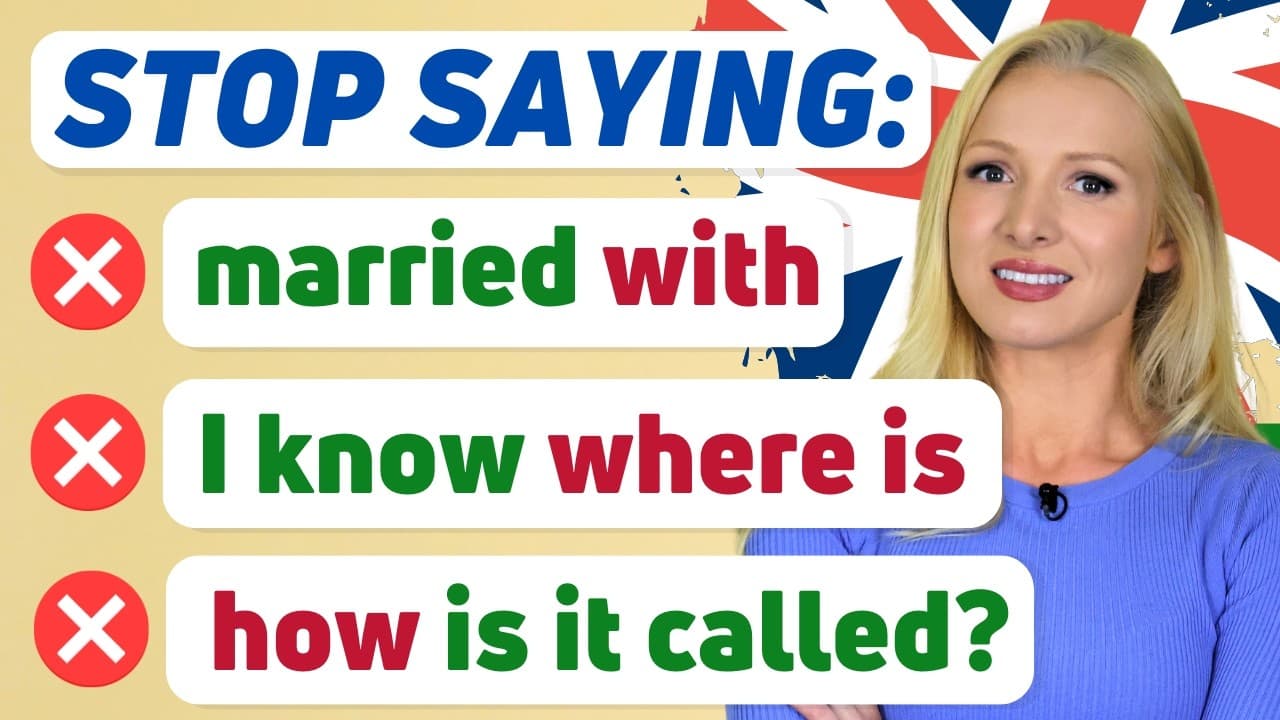
Replace “I think yes” with “I think so,” ask “What is it called?”, and say someone is “married to” another person. Use “explain something to somebody,” and keep statement word order inside indirect questions, as in “I don’t know where Diego is.” These corrections eliminate five errors that occur among both beginner and advanced English students.
Transcript
Hello, everyone, and welcome back to English with Lucy. Do you make common mistakes like these? 'He explained me why not.' 'I think yes.' 'How's it called?' Now, if you do, I'm going to help you stop. In this video, I'm going to teach you 5 of the most common mistakes in English. I hear my beginner students make these mistakes, but also some of... Read More
Key Insights
- “I think so” is the standard response when a speaker believes the answer to a yes-or-no question is affirmative. Alternatives include a complete clause such as “I think she is” or the standalone answer “yes,” but not “I think yes.”
- “I don’t think so” is the usual negative counterpart to “I think so.” A speaker can also use a complete clause such as “I don’t think he does” or answer simply “no,” while “I think no” is not presented as correct English.
- “What is it called?” is the correct way to request the name of something. English uses “what,” rather than “how,” in questions such as “What’s that called?”, “What do you call it?”, “What’s she called?”, and “What’s your dog called?”
- “Whatchamacallit” is a dictionary word used when a speaker cannot remember the name of a thing or even a person. It can temporarily fill the missing name while the speaker searches for the intended word, as in the example involving a whisk.
- “Married to” identifies a person’s husband or wife, as in “I’m married to Will.” The pronunciation of “married” has two syllables, and the phrase can also be figurative, describing someone who is extremely committed to something, such as a job.
- “Married with children” means that a person is married and has children. It does not identify the person’s spouse. Therefore, “Ken’s married with three children” and “Ken’s married to someone” communicate different relationships and should not be treated as interchangeable structures.
- “Explain” is not generally followed directly by a person, so constructions such as “explain me” and “explain him” are incorrect. English permits “explain something,” “explain to somebody,” “explain something to somebody,” and clauses beginning with words such as how, why, or what.
- Indirect questions use statement word order inside the embedded clause. “I don’t know where Diego is” is correct because the subject precedes the verb. Question-form introductions such as “Do you know” still take a question mark, but the embedded clause retains subject-verb order.
Install to Summarize YouTube Videos and Get Transcripts
Explore YouTube Video Summarizer or Get YouTube Transcript Extractor
Questions & Answers
Q: How do you replace “I think yes” in English?
Replace “I think yes” with “I think so” when you believe the answer to a yes-or-no question is affirmative. For example, the response to “Is Katherine coming today?” can be “I think so.” You may also say “Yes, I think she is,” “I think she is, yes,” or simply “yes.” The phrase “I think yes” may be understood, but it is not presented as technically correct.
Q: How do you give an uncertain negative answer in English?
Use “I don’t think so” when you believe the answer is negative but want to express some uncertainty. For example, “Does Mark eat meat?” can be answered with “I don’t think so.” Other acceptable choices include “No, I don’t think he does,” “I don’t think he does, no,” or simply “no.” The corresponding phrase “I think no” is not used in the lesson’s recommended English structures.
Q: What is the correct way to ask the name of something?
Ask “What is it called?” or “What do you call it?” when requesting the name of an object, person, or phenomenon. English uses “what” because the question seeks specific information. Examples include “What’s that called?”, “What’s your dog called?”, and “What is it called when you wake up but can’t move your body for a short time?” The forms “How is it called?” and “How do you call it?” are incorrect.
Q: What does “whatchamacallit” mean in English?
“Whatchamacallit” is a word used when someone cannot remember or immediately produce the name of a thing or even a person. It acts as a temporary substitute while the speaker searches for the intended name. In the lesson’s example, a speaker begins, “I need to whatchamacallit,” before remembering the word “whisk.” The expression reinforces that questions about names use “what,” not “how.”
Q: When should you use “married to” and “married with”?
Use “married to” when identifying someone’s husband or wife, as in “I’m married to Will” or “He’s been married to Alice for fifty years.” Use “married with children” to say that someone is married and also has children. For example, “Ken’s married with three children” means Ken has a spouse and three children, but the phrase does not identify whom he married.
Q: How should the verb “explain” be used with a person?
Place “to” before the person receiving an explanation. You can say “She explained the situation to us,” “Will you explain it to me?”, or “Ian explained to us what he was doing.” You can also omit the person and say “She explained the rules.” Forms such as “She explained me the rules,” “Explain him how this works,” and “Explain John the rules” are not correct structures in the lesson.
Q: What sentence structures can follow “explain”?
“Explain” can be followed by a thing, as in “She explained the rules,” or used without an object, as in “Please let me explain.” It can introduce clauses beginning with how, who, where, what, when, or why, and it can precede a that-clause. A person may be included with “to,” producing structures such as “explain something to somebody” or “explain to somebody what happened.”
Q: How does word order work in indirect questions?
An indirect or embedded question uses statement word order, with the subject before the verb. Therefore, say “I don’t know where Diego is,” not “I don’t know where is Diego.” The same rule produces “We don’t know who Beth is,” “Do you know where Helena is?”, and “Could you tell me what time it is?” A question mark is used when the introductory phrase itself has question word order, as with “Do you know?”
Summary & Key Takeaways
-
English speakers normally answer uncertain yes-or-no questions with “I think so,” not “I think yes.” For a negative answer, use “I don’t think so,” a complete clause such as “I don’t think he does,” or simply “no.” These forms replace phrases that often result from direct translation from other languages.
-
Questions about the name of a person, object, or phenomenon use “what,” as in “What is it called?” or “What do you call it?” When identifying a spouse, use “married to.” The construction “married with children” has a different meaning: the person is married and also has children.
-
The verb “explain” can introduce a thing, a clause, or a phrase using “to somebody,” but it is not normally followed directly by a person. Indirect questions also require statement word order after their introductory phrase, producing forms such as “Do you know where Helena is?” and “I wonder who’s coming.”
Read in Other Languages (beta)
Share This Summary 📚
Summarize YouTube Videos and Get Video Transcripts with 1-Click
Try YouTube Summary with ChatGPT & Claude or YouTube Transcript Generator
Explore More Summaries from English with Lucy 📚
Summarize YouTube Videos and Get Video Transcripts with 1-Click
Try YouTube Summary with ChatGPT & Claude or YouTube Transcript Generator