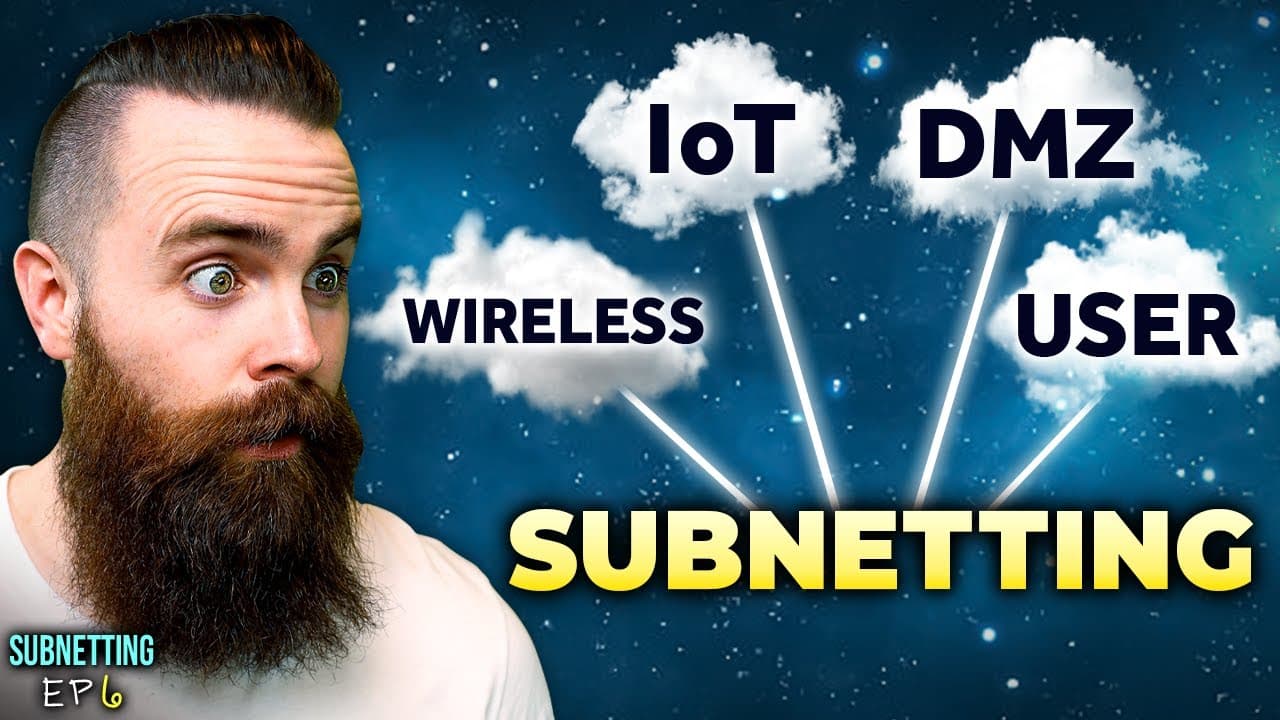
How to subnet your home network into four networks
TL;DR
Subnetting a single network into four smaller networks is done by borrowing bits from the host portion of the subnet mask, converting to binary, and using the resulting increment to define each new network range. The steps yield four distinct subnets with clear network, host, and broadcast boundaries, and you can validate the results with standard addressing practices.
Transcript
This is your home network. You have this subnet mask and this many addresses to use, but that's insecure. What are you doing? You can't keep all your stuff on the same network. So let's change that, but not in the normal way. We're gonna do something weird instead of simply adding networks like a lazy, a loser. I'm just kidding. By the way, we're g... Read More
Key Insights
- Four networks can be created from a single network by borrowing host bits from the subnet mask
- Subnetting works by moving bits from the host portion into the network portion of the address
- Binary conversion is used to determine how many bits to hack and what the new mask will be
- Nora Two is used as a fun helper to map decimal values to binary for quick calculation
- The increment is defined by the last network bit in the new mask and sets subnet boundaries
- The new subnet mask in decimal corresponds to a specific slash notation that reflects the number of network bits
- Each new subnet has a defined range and a broadcast address based on the increment and mask
- Homework and practice help solidify understanding and extend to other address classes
- More videos from this channel:
- More from this channel: NetworkChuck
Install to Summarize YouTube Videos and Get Transcripts
Explore YouTube Video Summarizer or Get YouTube Transcript Extractor
Questions & Answers
Q: How do you determine how many host bits to hack when subnetting into four networks
To determine how many host bits to hack you look at the number of networks you want and use binary to find the smallest power of two that can cover that many networks. In this case four networks require enough bits to represent four values, which means converting the needed networks into binary and selecting the corresponding host bits to move into the network portion. This gives you the new subnet mask and defines how many host bits remain for usable addresses in each subnet. The process provides a clear rule for any similar subnetting task and helps you predict the resulting address ranges and boundaries.
Q: What is the role of binary in subnetting as described in the video
Binary in subnetting acts as the language that defines which parts of the IP address serve as the network and which serve as hosts. By converting the subnet mask to binary you can see exactly where to borrow bits from the host portion to create more networks. The ones in the mask denote network bits and the zeros denote host bits. Flipping host bits to ones effectively expands the network portion, creating smaller subnets.
Q: How is the increment used to define subnet ranges
The increment is the value of the last network bit in the subnet mask. It determines the step between the starting addresses of consecutive subnets. By knowing the increment you can list each subnet's range from the first address to the last usable address, ensuring you include the network and broadcast addresses appropriately. This makes it straightforward to enumerate all the new subnets and verify coverage without overlaps.
Q: What is the significance of the slash notation in subnetting
Slash notation indicates how many bits in the IP address are used for the network portion. It summarizes the size of the subnet in a compact form. In subnetting, increasing the slash value means more network bits, which results in more subnets with fewer usable host addresses per subnet. This notation helps communicate subnet structure quickly and unambiguously.
Q: How do you determine the ranges for each new subnet after subnetting
To determine the ranges you start with the first network address and use the increment to step through each subnet. The network address marks the beginning of the range, the broadcast address marks the end, and all addresses in between are usable. Subnetting also requires counting the usable hosts by considering the network and broadcast addresses as reserved, which guides you in calculating how many hosts each subnet can support.
Q: Why is it important to validate subnets after subnetting
Validation confirms that the subnets cover the intended address space without gaps or overlaps and that each subnet has the correct range and broadcast address. It helps catch mistakes in the mask, increment, or address boundaries before deployment. Validation also ensures scalability for future growth and compatibility with devices and routing policies in the network.
Q: How does the video suggest approaching subnetting across different address classes
The video notes that the same four-step approach works across different address classes, though the feel of the steps may change with classful addressing. The core idea is to borrow host bits to increase the number of networks, convert to binary to understand the mask, determine the increment, and then compute the ranges. This method is adaptable and reinforces the underlying concept regardless of class.
Q: What is the practical takeaway from the homework exercise in the video
The practical takeaway is to apply the learned method to a new scenario by creating five networks from the given base network and to show both the standard and CIDR notations along with all network ranges. This exercise reinforces the process of determining how many bits to hack, recalculating the mask, and listing the resulting subnets, which builds competence for real-world subnet planning.
Summary & Key Takeaways
-
You learn to split a single network into four separate subnets by manipulating the subnet mask and host bits, creating dedicated segments for different parts of your home network.
-
The method uses binary conversion and a simple increment to determine the boundaries of each new subnet, making the ranges easy to compute and verify.
-
Practice exercises reinforce the concept and prepare you to apply the same technique to different address classes and larger network requirements.
Read in Other Languages (beta)
Share This Summary 📚
Summarize YouTube Videos and Get Video Transcripts with 1-Click
Try YouTube Summary with ChatGPT & Claude or YouTube Transcript Generator
Explore More Summaries from NetworkChuck 📚



Summarize YouTube Videos and Get Video Transcripts with 1-Click
Try YouTube Summary with ChatGPT & Claude or YouTube Transcript Generator