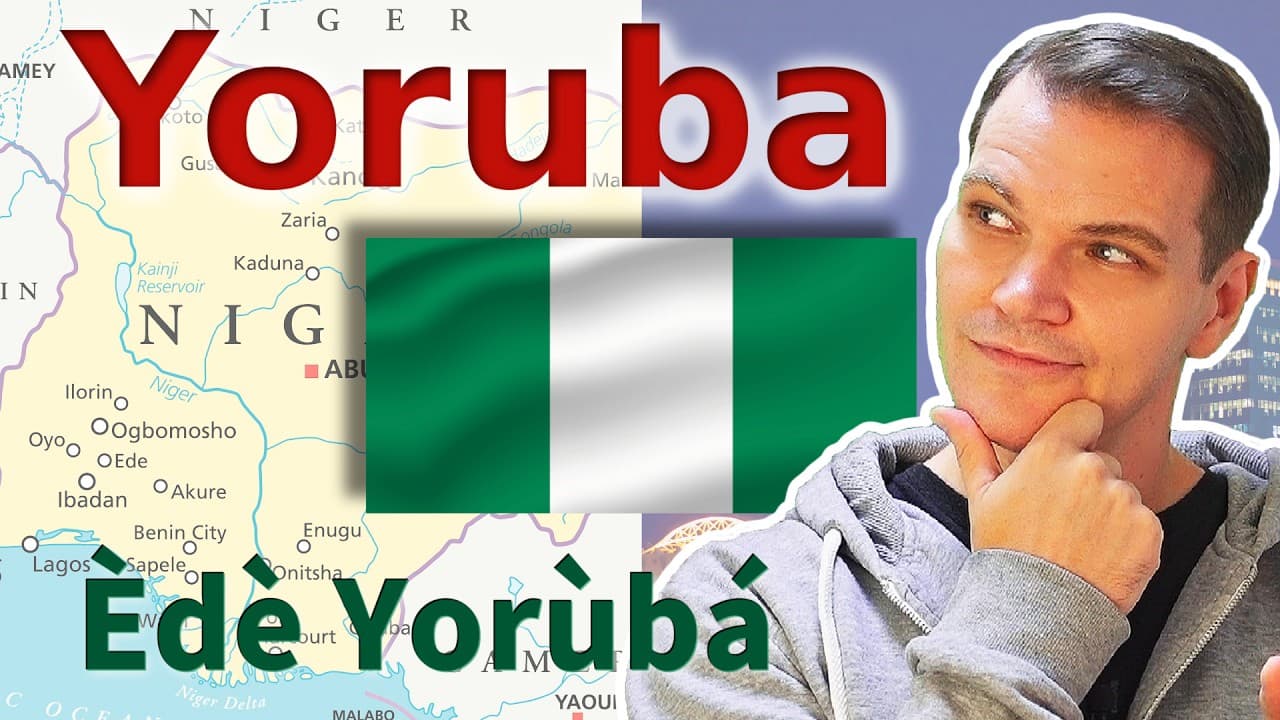
YORUBA - A Language of NIGERIA (and the WORLD)
TL;DR
Yoruba is a major Nigerian language with global significance.
Transcript
I'd bet that some of you have never heard of Yuba which is stunning because it's an incredibly important language maybe just not in your part of the world it's spoken by somewhere between 30 and 45 million people and that number is going to climb rapidly in the coming decades because of the massive population growth in West Africa Yuba is one of th... Read More
Key Insights
- Yoruba is one of Nigeria's three main languages, alongside Hausa and Igbo, and is spoken by millions worldwide due to the Nigerian diaspora.
- The language is primarily spoken in Southwestern Nigeria, including Lagos, and has dialects in Southeastern Benin and parts of Togo.
- Standard Yoruba was developed in the 1850s by Samuel A. Crowther, based on several dialects, and it uses a Latin-based alphabet with accent markings for tones.
- Yoruba is a tonal language with three tones: high, low, and middle, which are crucial for meaning differentiation.
- The language has a simple grammatical structure with no gender, noun cases, plural forms, or articles, making it relatively easy for learners.
- Yoruba's basic word order is Subject-Verb-Object (SVO), but this can change with focus constructions, affecting tone and sentence structure.
- The language features interesting phonetic elements, such as labial-velar stops and nasal vowels, which are represented uniquely in writing.
- Yoruba greetings and expressions often use contractions and focus markers, reflecting the language's emphasis on tone and context.
Install to Summarize YouTube Videos and Get Transcripts
Explore YouTube Video Summarizer or Get YouTube Transcript Extractor
Questions & Answers
Q: What is the significance of Yoruba in Nigeria?
Yoruba is one of the three main languages in Nigeria, alongside Hausa and Igbo. It is spoken by millions of people in Southwestern Nigeria, including Lagos, and has a rich cultural and historical significance. The language is also used by the Nigerian diaspora worldwide, making it an important global language.
Q: How was Standard Yoruba developed?
Standard Yoruba was developed in the 1850s by Samuel A. Crowther, a Yoruba Nigerian and the first Anglican Bishop in West Africa. He created a grammar of Standard Yoruba and translated the Bible into it. The standard form is based on several Yoruba dialects and serves as a formal and written form of the language.
Q: What are the key features of Yoruba grammar?
Yoruba grammar is relatively simple, lacking grammatical gender, noun cases, plural forms, and articles. Verbs are not conjugated for person, number, gender, or tense. Instead, tense and aspect markers are placed before the verb to indicate time. This simplicity makes Yoruba accessible to learners.
Q: How does the tonal system work in Yoruba?
Yoruba is a tonal language with three tones: high, low, and middle. These tones are crucial for meaning differentiation and are marked in writing with accent markings. High tones use an acute accent, low tones a grave accent, and middle tones are unmarked. Tonal differences can change the meaning of words significantly.
Q: What is the basic word order in Yoruba sentences?
The basic word order in Yoruba is Subject-Verb-Object (SVO). However, this order can change with focus constructions, where focus markers are used to emphasize different parts of the sentence. This can affect the tone and structure of the sentence, demonstrating the language's flexibility and emphasis on context.
Q: What are some unique phonetic features of Yoruba?
Yoruba features some interesting phonetic elements, such as labial-velar stops and nasal vowels. Labial-velar stops involve double articulation at the lips and the back of the mouth. Nasal vowels are represented in writing as a combination of a vowel and 'n', which indicates nasalization rather than a separate consonant.
Q: How are greetings and expressions formed in Yoruba?
Yoruba greetings and expressions often use contractions and focus markers. The language emphasizes tone and context, and greetings can vary based on time of day and formality. For example, honorific forms are used for elders or in formal settings, while different tones and contractions convey nuances in meaning.
Q: What challenges might learners face with Yoruba?
While Yoruba's lack of grammatical gender, cases, and articles simplifies learning, the tonal system can be challenging. Learners must become familiar with the three tones and their accent markings, as these are crucial for meaning differentiation. However, the visual representation of tones in writing can aid in learning and remembering them.
Summary & Key Takeaways
-
Yoruba is a significant language in Nigeria and globally, spoken by millions due to diaspora communities. It is one of Nigeria's three main languages, alongside Hausa and Igbo, and is widely used in Southwestern Nigeria, including Lagos.
-
Standard Yoruba was developed by Samuel A. Crowther in the 1850s and is based on several dialects. It uses a Latin-based alphabet with accent markings to indicate tones, which are essential for conveying meaning.
-
Yoruba has a simple grammatical structure, lacking gender, noun cases, plural forms, and articles. It is a tonal language with three tones, and its basic word order is Subject-Verb-Object, though this can change with focus constructions.
Read in Other Languages (beta)
Share This Summary 📚
Summarize YouTube Videos and Get Video Transcripts with 1-Click
Try YouTube Summary with ChatGPT & Claude or YouTube Transcript Generator
Explore More Summaries from Langfocus 📚



Summarize YouTube Videos and Get Video Transcripts with 1-Click
Try YouTube Summary with ChatGPT & Claude or YouTube Transcript Generator