How Do Latches and Flip-Flops Differ?
TL;DR
A latch responds throughout the period when its enable input is high, while a flip-flop operates only when its clock changes from low to high or from high to low. The defining distinction is therefore the triggering method: a latch is level sensitive, whereas a flip-flop is edge triggered.
Transcript
so what is difference between ledge and flip-flop in this presentation we are going to find out the answer for this common question in digital electronics the circuit here you can see is a familiar one to you we have already discussed it it is your Sr ledge okay there is no control input given to it and U in this case when there is no control input... Read More
Key Insights
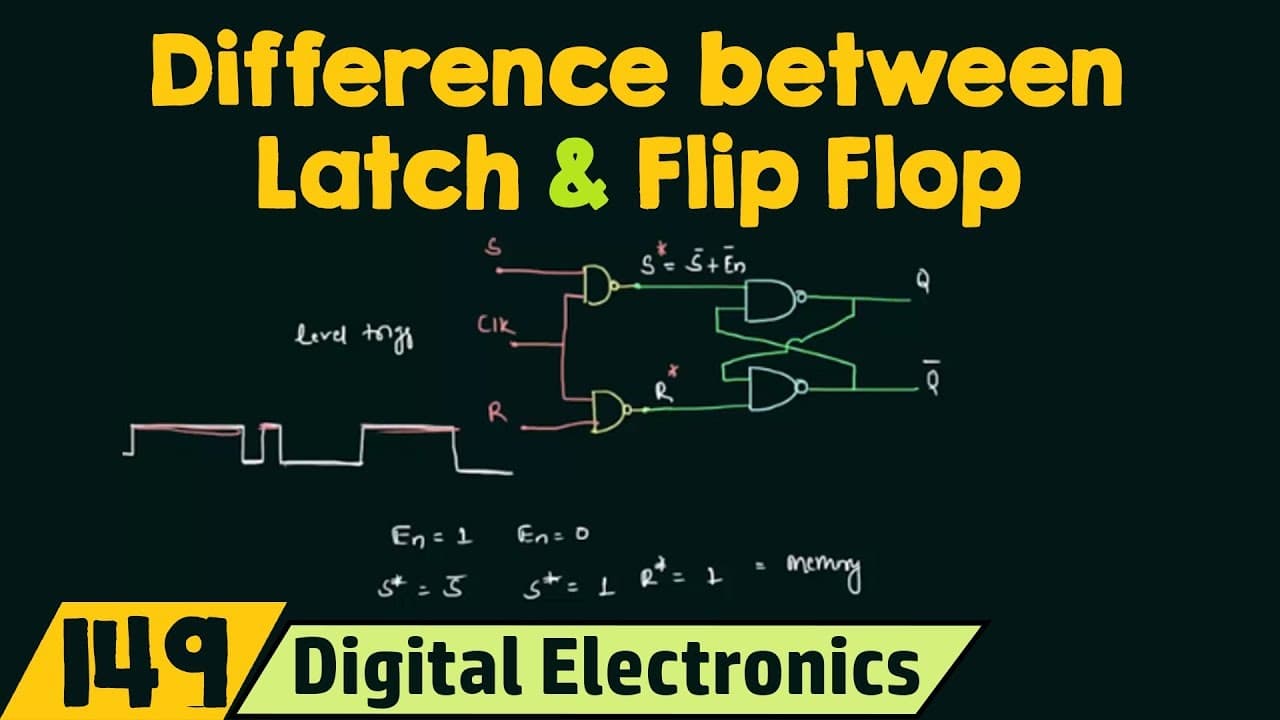
- An uncontrolled SR latch has no control input, so its S and R inputs can be changed accidentally or intentionally. The presented design adds control so the circuit can determine when input changes are allowed to affect Q and Q complement.
- Two additional NAND gates introduce control into the SR latch circuit. One gate connects to the S side, the other connects to the R side, and both gates receive the same shared control input.
- The controlled circuit can function as either a latch or a flip-flop. Its classification depends on whether the shared control input is used as an enable signal or as a clock with edge-triggered operation.
- A latch is level sensitive because it remains operational for the full period during which its enable input is high. It is not operational during the periods when enable is low.
- The enabled NAND gates produce complemented input behavior when enable equals one. The first controlled signal follows the complement of S, while the corresponding R-side signal follows the complement of R.
- The controlled SR latch preserves its stored state when enable equals zero. Both controlled NAND-gate outputs become one, and an SR latch built with NAND gates treats the one-one input condition as memory.
- A flip-flop is edge triggered because it operates only when the clock changes state. The relevant transitions are from low to high and from high to low, rather than the entire high level of the signal.
- The main difference between a latch and a flip-flop is when each circuit checks its inputs. A latch checks them while enabled at the active level, while a flip-flop checks them only during a clock transition.
Install to Summarize YouTube Videos and Get Transcripts
Explore YouTube Video Summarizer or Get YouTube Transcript Extractor
Questions & Answers
Q: What is the difference between a latch and a flip-flop?
A latch is level sensitive, which means it operates throughout the period when its enable input is high. A flip-flop is edge triggered, so it operates only when its clock changes from low to high or from high to low. The difference is therefore determined by whether input checking occurs during an active level or at a clock transition.
Q: How does an enable signal control an SR latch?
The enable signal is supplied as a common input to two NAND gates placed before the S and R connections of the SR latch. When enable is high, the latch can respond to the S and R inputs. When enable is low, both controlled outputs become one, causing the NAND-based SR latch to retain its stored state.
Q: When is a controlled latch operational?
A controlled latch is operational during every interval in which its enable signal is high. It is not operational during intervals when enable is low. Since its response continues for the full duration of the active enable level, rather than being restricted to a signal transition, the circuit is classified as level sensitive.
Q: When does a flip-flop check its inputs?
A flip-flop checks its inputs and becomes operational only when its clock changes state. The described triggering event can be a transition from low to high or from high to low. It does not operate throughout the entire high clock period in the way that an enabled, level-sensitive latch responds during its active interval.
Q: Why is a control input added to an SR latch?
A control input is added because an SR latch without control allows S and R to be changed accidentally or intentionally at any time. The added control determines when those inputs may affect Q and Q complement. This lets the stored output state remain unchanged until the circuit is enabled for another input change.
Q: How can one circuit act as both a latch and a flip-flop?
The circuit can act as either device because its behavior is determined by the shared control input. When that input is an enable signal and the circuit operates while the signal is high, it acts as a latch. When the input is a clock and operation is restricted to clock transitions, it acts as a flip-flop.
Q: What happens when the SR latch enable input is low?
When enable equals zero, the outputs from both input NAND gates become one because enable is connected to both gates. For the NAND-gate SR latch described in the presentation, the one-one input combination represents memory. The previously stored state therefore remains in the latch until the enable input changes and permits new input processing.
Q: Why is a latch called level sensitive?
A latch is called level sensitive because its operation depends on the level of its enable signal. Whenever enable is high, the circuit is operational and checks its inputs throughout that interval. When enable is low, it is not operational and preserves its state. Its response is therefore tied to a sustained signal level, not only a transition.
Summary & Key Takeaways
-
An uncontrolled SR latch allows its S and R inputs to change accidentally or intentionally at any time, making the basic circuit unsuitable for the described use. Adding two NAND gates and a shared control input provides a way to determine when input changes can affect the stored Q and Q complement outputs.
-
The controlled circuit acts as a latch when the shared control input is an enable signal. It operates during every period in which enable is high and stops responding while enable is low. Because its operation depends on the sustained level of the enable signal, the latch is described as level sensitive.
-
The same controlled circuit acts as a flip-flop when the control input is a clock and operation is limited to clock transitions. It checks inputs only while the clock changes from low to high or from high to low. This edge-triggered behavior is the central difference between a flip-flop and a latch.
Read in Other Languages (beta)
Share This Summary 📚
Summarize YouTube Videos and Get Video Transcripts with 1-Click
Try YouTube Summary with ChatGPT & Claude or YouTube Transcript Generator
Explore More Summaries from Neso Academy 📚






Summarize YouTube Videos and Get Video Transcripts with 1-Click
Try YouTube Summary with ChatGPT & Claude or YouTube Transcript Generator