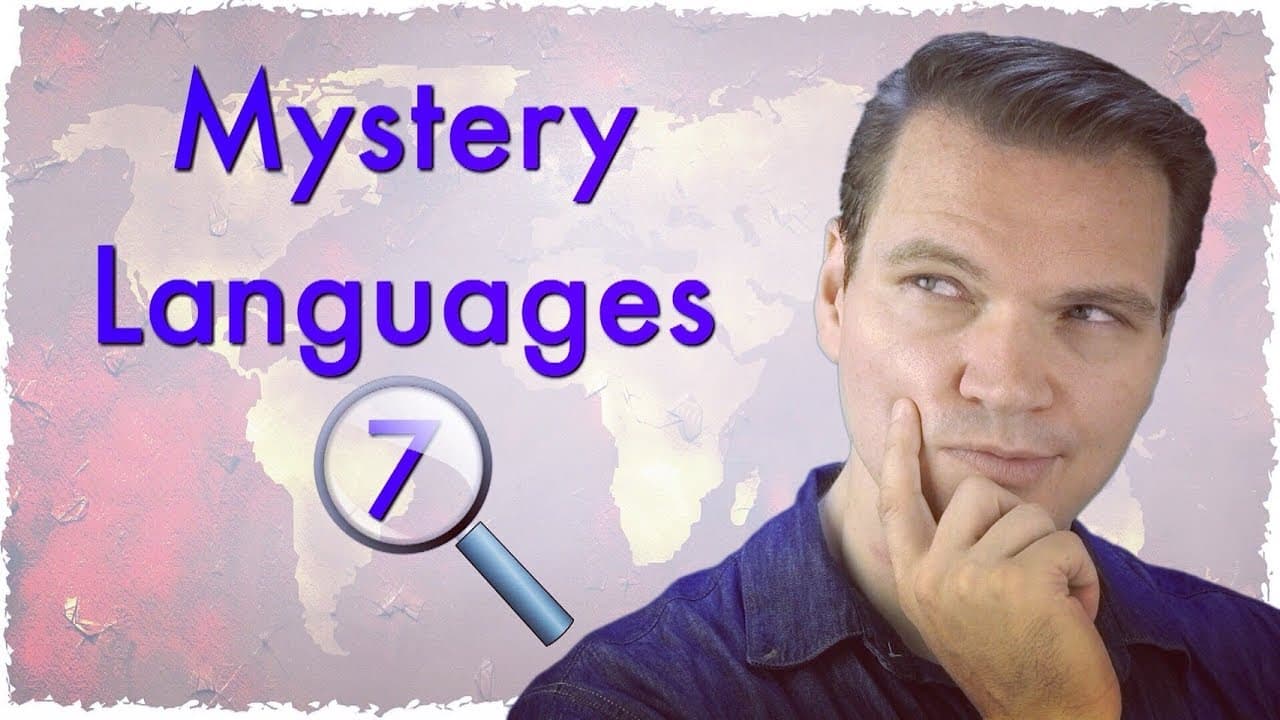
Mystery Languages 7 - Can you guess them all?!
TL;DR
Identify languages through audio and text samples.
Transcript
hello everyone welcome to the Laing focused Channel and my name is Paul and this is mystery languages if you've seen one of these before then you know how it goes all play some audio of a language for you or I'll show you a written sample of a language and you can guess what language it is and if you don't know what language it is maybe you can gue... Read More
Key Insights
- Galician is closely related to Portuguese, both sharing a common ancestor from the 13th century, and is spoken by 2.4 million people in northwestern Spain.
- Estonian, with 1.1 million native speakers, is a Finnic language with significant Germanic vocabulary influence, featuring unique vowel diacritics and doubled vowels.
- Georgian belongs to the Kartvelian language family, known for its complex phonology and consonant clusters, and is spoken in the Caucasus region.
- Kazakh, part of the Kipchak branch of Turkic languages, exhibits vowel harmony, influencing the vowels in suffixes based on the stem's vowels.
- Marathi, an Indo-Aryan language spoken by 90 million people in India, contains numerous Sanskrit borrowings, especially in written form.
- The video encourages viewers to guess languages based on audio and text, enhancing their understanding of language families and regional dialects.
- The content highlights the importance of phonological and orthographic features in identifying languages, such as vowel harmony and consonant clusters.
- The video is interactive, engaging viewers by challenging them to identify languages while providing educational insights into linguistic diversity.
Install to Summarize YouTube Videos and Get Transcripts
Explore YouTube Video Summarizer or Get YouTube Transcript Extractor
Questions & Answers
Q: What is the relationship between Galician and Portuguese?
Galician and Portuguese are sister languages, sharing a common ancestor from the 13th century. They are closely related and formed a dialect continuum. Some consider them two varieties of the same language, although they are recognized as independent languages with separate standard forms in their respective regions.
Q: What are some distinctive features of Estonian?
Estonian, a Finnic language, is known for its vowel diacritics and doubled vowels representing long vowels. It has significant vocabulary borrowed from Germanic languages. Estonian features vowel harmony, and its phonology and orthography are distinct, with umlaut diacritics and unique vowel usage compared to Finnish.
Q: How is Georgian linguistically unique?
Georgian is part of the Kartvelian language family, known for its rich phonology, particularly in consonants. It features ejected consonants, produced with glottal air injection, and complex consonant clusters. Georgian is not related to the Indo-European family, making it linguistically unique in its region.
Q: What is vowel harmony in Kazakh?
Vowel harmony in Kazakh dictates that the vowels in suffixes must match the last vowel of the word stem. If the stem's last vowel is a back vowel, suffix vowels must also be back vowels. This feature is common in Turkic languages and influences word formation and pronunciation.
Q: What influences does Marathi have from other languages?
Marathi, an Indo-Aryan language, has significant influence from Dravidian languages due to geographic proximity. It contains a large amount of vocabulary developed from Sanskrit, with many words intentionally borrowed directly from Sanskrit, known as tatsamas. These borrowings are prevalent in both spoken and written Marathi.
Q: How does the video engage viewers in learning languages?
The video engages viewers by presenting audio and text samples of different languages, encouraging them to guess the languages and learn about their features. It provides insights into language families, phonological distinctions, and orthographic characteristics, enhancing viewers' understanding of linguistic diversity.
Q: What are some key phonological features of the languages discussed?
Key phonological features include Galician's nasal sound disappearance, Estonian's vowel diacritics, Georgian's ejected consonants and consonant clusters, Kazakh's vowel harmony, and Marathi's Sanskrit-derived vocabulary. These features help in identifying and differentiating the languages discussed in the video.
Q: Why is linguistic diversity important as highlighted in the video?
Linguistic diversity is important as it showcases the rich variety of human languages, each with unique phonological, orthographic, and grammatical features. The video highlights this diversity, encouraging appreciation and understanding of different languages and cultures, and promoting language learning and preservation.
Summary & Key Takeaways
-
The video challenges viewers to identify various languages through audio and text samples, enhancing their linguistic knowledge and skills. It features languages like Galician, Estonian, Georgian, Kazakh, and Marathi, highlighting unique phonological and orthographic features.
-
Galician, Estonian, Georgian, Kazakh, and Marathi are explored, showcasing their linguistic characteristics and regional significance. The video emphasizes language identification through features like vowel harmony and consonant clusters.
-
Viewers are encouraged to guess languages based on samples, learning about language families and regional dialects. The video provides insights into linguistic diversity and the importance of phonological and orthographic features in language identification.
Read in Other Languages (beta)
Share This Summary 📚
Summarize YouTube Videos and Get Video Transcripts with 1-Click
Try YouTube Summary with ChatGPT & Claude or YouTube Transcript Generator
Explore More Summaries from Langfocus 📚
Summarize YouTube Videos and Get Video Transcripts with 1-Click
Try YouTube Summary with ChatGPT & Claude or YouTube Transcript Generator