How to pick the top AWS DevOps services to learn
TL;DR
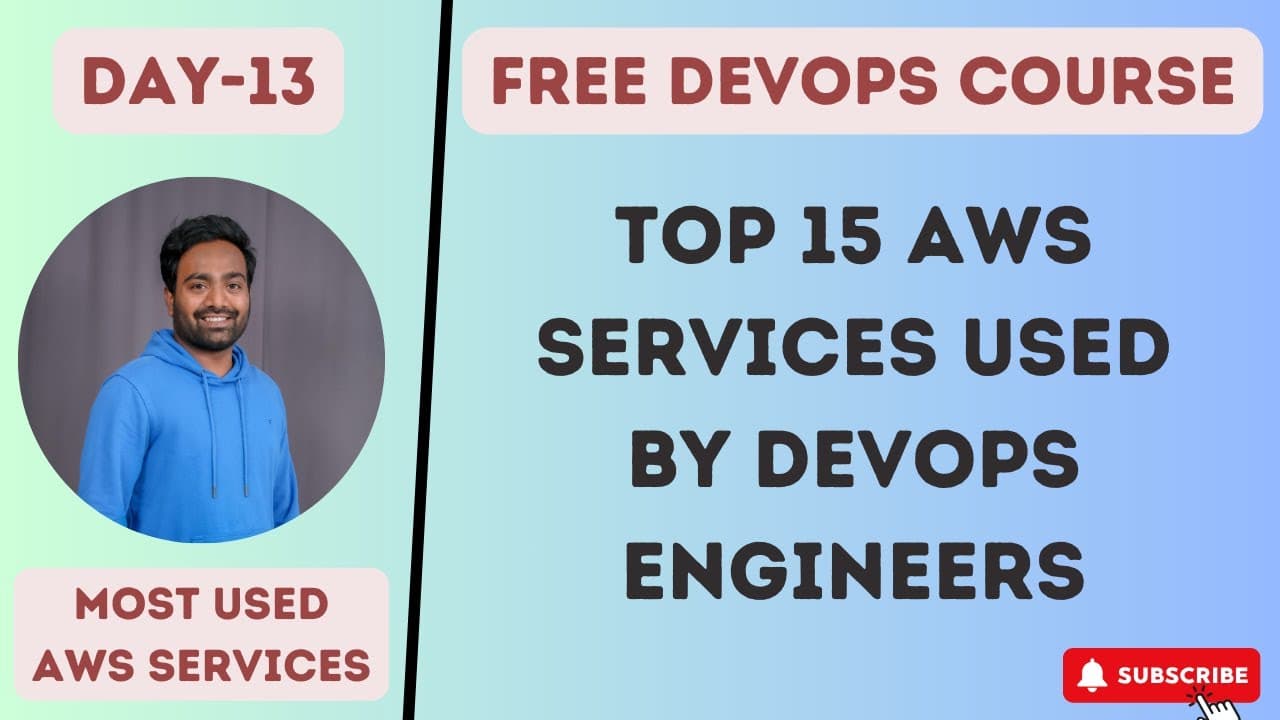
AWS offers close to 200 services, but DevOps focuses on a core set. The video highlights EC2, VPC, EBS, S3, and IAM as essential building blocks, plus automation and efficiency. It also discusses how to approach learning by prioritizing services relevant to DevOps practice and real world projects.
Transcript
hello and my name is Abhishek and welcome back to my channel so today we are at day 13 of our complete devops course so for the people who haven't watched our previous videos just to let you know we are doing 45 days of devops course and uh in the previous videos we covered various good Concepts like Linux shell scripting deploying a live project o... Read More
Key Insights
- AWS provides around 200 to 210 services and not all are needed for every DevOps engineer.
- DevOps on AWS hinges on automation and efficiency as core responsibilities.
- EC2, VPC, and storage services like EBS and S3 are foundational for most DevOps tasks.
- Understanding IAM is critical to manage permissions and access controls across tools and services.
- VPC concepts such as security groups, CIDR blocks, and subnets are key for secure deployments.
- S3 serves as a cheap, scalable storage option and is encrypted by default for data at rest.
- Volume management and backups via EBS are common practices for live applications.
- AWS services are learned in a practical order, prioritizing those that enable real-world automation.
Install to Summarize YouTube Videos and Get Transcripts
Explore YouTube Video Summarizer or Get YouTube Transcript Extractor
Questions & Answers
Q: What is the main purpose of learning AWS in a DevOps role?
The main purpose is to focus on automation and efficiency by using AWS services that enable deployment, management, and scaling of applications with less manual overhead. DevOps engineers should learn services that directly support continuous integration, delivery, and secure, scalable infrastructure, rather than attempting to master every service. Practical familiarity with core services supports faster, reliable operations.
Q: Which AWS services are considered foundational for DevOps according to the video?
Foundational services include EC2 for compute, VPC for networking and security, EBS for block storage, S3 for scalable object storage, and IAM for identity and access management. These form the core toolkit for most DevOps tasks, enabling secure deployments, scalable storage, and controlled access across automation workflows and deployment pipelines.
Q: Why is IAM emphasized in the DevOps context?
IAM is emphasized because it controls who can access what resources and with which permissions, which is critical in collaborative DevOps environments. Proper IAM configuration prevents excessive access, supports least privilege principles, and ensures that automation tools and developers operate within secure, auditable boundaries, reducing risk while enabling efficient workflow automation.
Q: How does the video describe the role of VPC in DevOps?
VPC is described as essential for securing resources, with components like security groups, CIDR blocks, subnets, and inbound/outbound rules. A solid VPC design helps isolate and protect resources, manage traffic, and support scalable, controlled networking for applications deployed in AWS, which is a foundational requirement for robust DevOps operations.
Q: What storage services are highlighted and why?
EBS and S3 are highlighted as storage services to understand because EBS provides attachable volumes for EC2 instances and S3 offers cheap, scalable object storage for large data needs and content delivery. Understanding these allows DevOps engineers to manage data persistence, backups, and cost-effective storage strategies across environments.
Q: What is the suggested approach to learning AWS services for DevOps?
The approach is to start with core, commonly used services that enable live projects and automation, such as EC2, VPC, EBS, S3, and IAM, and then expand to other services as needed. The emphasis is on practical knowledge that improves automation and efficiency, rather than attempting to learn all 200 plus services at once.
Q: What educational context does the video provide for AWS and DevOps?
The video frames the content within a 45 day DevOps course, indicating a structured progression from basics to more intermediate topics. It uses live project examples, such as deploying applications on EC2 and configuring networking, to illustrate how AWS services support DevOps workflows in real scenarios.
Q: What is the video’s stance on the quantity of AWS services a DevOps engineer should know?
The video acknowledges that there are many AWS services, and it is practically impossible for a single person to know all of them. Instead, it encourages focusing on the DevOps relevant subset of services, prioritizing those that enable automation, deployment, security, and cost efficiency, while staying adaptable to project needs.
Summary & Key Takeaways
-
The video introduces a 45 day DevOps course and positions AWS as a platform providing many services in different service models. It emphasizes automation and efficiency as core DevOps goals on AWS. It also sets up the idea that only a subset of AWS services are essential for DevOps engineers.
-
It explains EC2 basics, VPC concepts, and the importance of security groups, subnets, and inbound outbound rules as foundational AWS knowledge for DevOps.
-
It covers storage concepts with EBS and S3, highlighting why volumes and cheap scalable storage matter for live applications and data handling on AWS.
Read in Other Languages (beta)
Share This Summary 📚
Summarize YouTube Videos and Get Video Transcripts with 1-Click
Try YouTube Summary with ChatGPT & Claude or YouTube Transcript Generator
Explore More Summaries from Abhishek.Veeramalla 📚


Summarize YouTube Videos and Get Video Transcripts with 1-Click
Try YouTube Summary with ChatGPT & Claude or YouTube Transcript Generator