How to Answer Tough Kubernetes Interview Questions
TL;DR
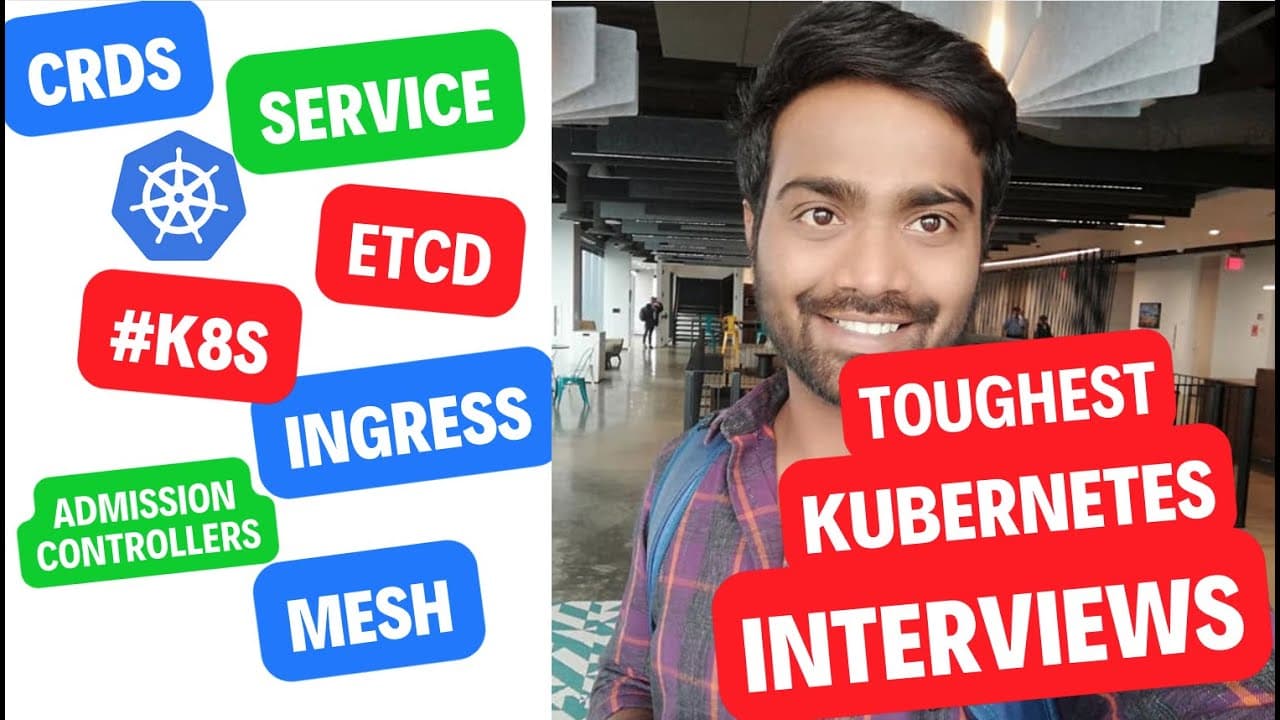
Strong Kubernetes interview answers should emphasize practical challenges, implementation choices, and honest experience instead of definitions alone. Explain monitoring limitations, layered cluster security, pod networking through pause containers, service mesh tradeoffs, and init containers with concrete scenarios, while clearly distinguishing hands-on knowledge from theoretical understanding.
Transcript
hello everyone my name is Abhishek and welcome back to my channel so today we'll be taking a look at some of the toughest kubernetes interview questions and uh just to let you know that all of these questions are not from my interview experiences but I have taken help from GitHub sources I've used some medium blogs and I've also put together my exp... Read More
Key Insights
- Practical experience is the central test in difficult Kubernetes interviews. Interviewers may begin with a familiar tool or concept, then ask about implementation problems, operational limitations, and the specific actions taken to resolve those problems.
- Prometheus high availability is challenging when Grafana depends on Prometheus as its data source. A redundant arrangement may require a load balancer and sticky sessions so Grafana can consistently collect information from a single selected source.
- Thanos is presented as an effective alternative for addressing Prometheus high availability problems. The speaker describes it as a maturing Cloud Native Computing Foundation application that candidates should watch, while avoiding the complicated load-balancer and sticky-session arrangement discussed for Prometheus.
- Kubernetes cluster security is a layered responsibility. A complete interview answer can cover secret protection, pod communication controls, network policies, role-based access control, namespaces, admission controllers, API gateway traffic filtering, and audit logging rather than relying on one security product.
- Role-based access control defines how much Kubernetes cluster access each user receives. Namespaces can complement this control by supporting multiple people or projects on the same cluster and providing a foundation for multi-tenancy.
- Containers in the same pod communicate through localhost and the relevant port. They can do this because Kubernetes uses a pause container to provide shared networking for containers that belong to that pod.
- A service mesh supports secure east-west traffic between services inside a cluster. The capabilities mentioned include mutual TLS, load balancing, observability, traceability, authentication, and authorization, while deeper questioning may cover sidecar injection, the Envoy proxy, and disadvantages.
- An init container performs a specific activity before the primary application container starts. Candidates who have worked on Kubernetes application development may encounter this concept, and they should explain its startup-order purpose through a concrete workload scenario.
Install to Summarize YouTube Videos and Get Transcripts
Explore YouTube Video Summarizer or Get YouTube Transcript Extractor
Questions & Answers
Q: How should I answer difficult Kubernetes interview questions?
A strong answer should move beyond definitions and describe practical implementation experience. Explain the scenario, the challenge encountered, how the relevant Kubernetes component behaves internally, and what solution was applied. If your knowledge is theoretical rather than hands-on, state that clearly instead of claiming practical experience that could lead to deeper questions you cannot answer.
Q: What challenges can Prometheus high availability create with Grafana?
Prometheus high availability becomes complicated when Grafana uses Prometheus as its data source for cluster dashboards. The approach described requires a load balancer in front of the Prometheus applications and sticky sessions so information is directed to a single data source from which Grafana can collect it. This complexity motivates consideration of an alternative such as Thanos.
Q: How does Thanos help with Prometheus high availability?
Thanos is presented as an effective solution to the high availability problems associated with Prometheus. It can reduce the need for the complicated load-balancer and sticky-session arrangement described for redundant Prometheus applications connected to Grafana. The speaker characterizes Thanos as a maturing Cloud Native Computing Foundation application and a tool worth watching for this use case.
Q: How can a Kubernetes cluster be secured?
Kubernetes cluster security should be handled through several complementary controls. The measures described include securing secrets, restricting pod communication with ingress and egress rules, using network policies, enabling role-based access control, separating projects through namespaces, applying validating and mutating admission controls, filtering incoming traffic through an API gateway, and turning on cluster audit logging.
Q: Why are RBAC and namespaces important for Kubernetes security?
Role-based access control defines which users can access the Kubernetes cluster and how much access each user receives. Namespaces help when multiple people or projects share the same cluster by separating their environments and supporting multi-tenancy. Together, these mechanisms provide clearer access boundaries and workload organization as part of a broader cluster security strategy.
Q: How do two containers in the same Kubernetes pod communicate?
Two containers in the same pod communicate by using localhost and the appropriate port number. This works because the containers share the pod's networking. Internally, Kubernetes uses a pause container to support that shared network environment, which explains why containers with the same pod IP address can connect to one another through localhost.
Q: What is a service mesh and why is it used?
A service mesh is used for east-west traffic and secure service-to-service communication within a cluster. The discussion associates it with mutual TLS, load balancing, observability, traceability, authentication, and authorization. Candidates should also be prepared for deeper questions about sidecar injection, the Envoy proxy, and disadvantages if they claim practical service mesh implementation experience.
Q: What is an init container in Kubernetes?
An init container is a container that runs to complete a specific activity before the primary application container starts. Its purpose is to finish prerequisite work before the main workload begins. In an interview, candidates should explain this startup sequence clearly and connect it to an application scenario, especially if they have worked on the Kubernetes development side.
Summary & Key Takeaways
-
The interview scenarios prioritize practical Kubernetes experience over memorized definitions. Candidates should describe challenges they encountered, explain how their implementations worked, and show how they solved operational problems. Prometheus monitoring is one example, particularly its high availability limitations and the complexity of connecting redundant instances reliably to Grafana.
-
Kubernetes cluster security requires a layered answer rather than naming one tool. Relevant measures include protecting secrets, restricting pod communication with ingress and egress rules, applying network policies, enabling role-based access control, separating projects through namespaces, using admission controllers, filtering incoming traffic through an API gateway, and activating audit logging.
-
Containers within one pod communicate through localhost and a port because they share the pod network. Kubernetes supports this shared networking through a pause container. Other interview topics include service meshes for secure service communication and operational capabilities, plus init containers that complete required activities before the primary application container starts.
Read in Other Languages (beta)
Share This Summary 📚
Summarize YouTube Videos and Get Video Transcripts with 1-Click
Try YouTube Summary with ChatGPT & Claude or YouTube Transcript Generator
Explore More Summaries from Abhishek.Veeramalla 📚
Summarize YouTube Videos and Get Video Transcripts with 1-Click
Try YouTube Summary with ChatGPT & Claude or YouTube Transcript Generator