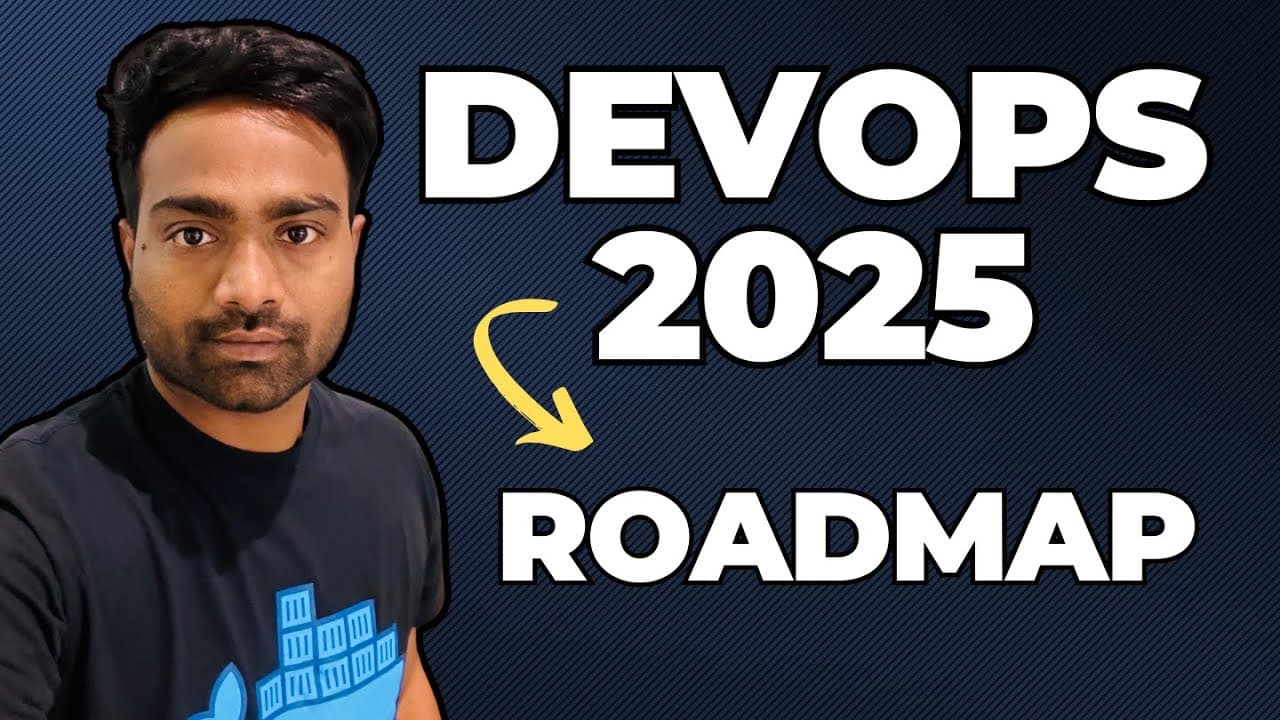
What Is Abhishek Veeramalla’s Updated DevOps 2025 Roadmap?
TL;DR
To become a DevOps engineer in 2025, complete the required DATE foundation: DevOps fundamentals, AWS or Azure, Terraform, and Python for DevOps. Follow a practical sequence through Linux, networking, Git, basic CI/CD, Ansible, Docker, and Kubernetes, then begin interviewing while learning optional skills. Read on for the recommended order, cloud priorities, and portfolio projects.
Transcript
hello everyone my name is abishek and welcome back to my channel in today's video we will take a look at the devops road map for the year 2025 so we are heading towards the end of 2024 and I am pretty sure a lot of you must be waiting for this video from our Channel and let me promise you this video is going to be super detailed where I'm going to ... Read More
Key Insights
- The roadmap is divided into required and good-to-have skills, giving learners a clear stopping point for initial preparation. Once the required skills are complete, candidates can begin DevOps interviews and continue studying additional skills alongside their applications.
- The required DevOps foundation is summarized as DATE: DevOps fundamentals, AWS or Azure, Terraform, and Python for DevOps. These areas remain the core preparation recommended for DevOps and cloud roles in 2025.
- Software development life cycle knowledge is essential because DevOps is intended to accelerate that life cycle. Learners should first understand what DevOps is, why it exists, and how it contributes to faster software development and delivery.
- Linux preparation is focused on practical usage rather than kernel internals or operating-system-level functions. Important topics include basic Bash commands, file and directory operations, system information, CPU utilization, simple shell scripts, and networking concepts such as the OSI model and TCP handshake.
- Git is the recommended distributed version control system, followed by practical work with GitHub or GitLab. Hosting a personal Git server is not emphasized because the described company environments commonly use established platforms instead.
- Containerization must be learned before Kubernetes. Docker preparation should cover virtual machines versus containers, networking, volumes, image-size reduction, Dockerfile practices, communication between containers, and running multiple containers with Compose.
- Kubernetes study should focus on important operational concepts rather than attempting to master the entire platform immediately. Core subjects include pods, deployments, services, networking, service discovery, Ingress, service types, and deploying a simple project.
- Cloud preparation should progress from fundamentals and identity management into networking, compute, load balancing, storage, CI/CD, managed Kubernetes, serverless services, cost optimization, security, compliance, and monitoring. AWS or Azure is recommended when the primary objective is employment.
Install to Summarize YouTube Videos and Get Transcripts
Explore YouTube Video Summarizer or Get YouTube Transcript Extractor
Questions & Answers
Q: What skills are required to become a DevOps engineer in 2025?
Abhishek Veeramalla summarizes the required foundation as DATE: DevOps fundamentals, AWS or Azure, Terraform, and Python for DevOps. The fundamentals include the software development life cycle, Linux, networking, Git, basic CI/CD, Ansible, Docker, and Kubernetes. After completing these required areas, candidates can begin interviewing while developing good-to-have skills.
Q: How should I start learning DevOps in 2025?
Start by understanding what DevOps is, why it exists, and how it accelerates the software development life cycle. Then learn practical Linux usage, Bash commands, simple shell scripting, networking, Git, GitHub or GitLab, and basic CI/CD. Continue with basic Ansible and Terraform before studying Docker and Kubernetes.
Q: When should I start applying for DevOps jobs?
Start interviewing once you have completed the required section of the roadmap rather than waiting to learn every DevOps topic. That section consists of DevOps fundamentals, AWS or Azure, Terraform, and Python for DevOps. Continue studying good-to-have skills while applying and interviewing.
Q: Should I learn Docker before Kubernetes?
Yes, learn Docker and containerization before Kubernetes because orchestration depends on container foundations. Cover virtual machines versus containers, networking, volumes, image-size reduction, Dockerfiles, communication between containers, and running multiple containers with Compose. Then advance to Kubernetes concepts and projects.
Q: What Kubernetes topics should a DevOps beginner study?
Focus first on pods, deployments, services, networking, service discovery, Ingress, and service types. The roadmap advises against trying to master the entire Kubernetes platform immediately. After learning the core concepts, deploy a simple project before progressing to managed services such as EKS or AKS.
Q: Should I learn AWS, Azure, or GCP for DevOps jobs?
Prioritize AWS or Azure when employment is the main objective because the roadmap associates them with more job opportunities. GCP is placed third from an employment perspective. You can initially choose either AWS or Azure instead of learning both.
Q: What cloud topics belong in the DevOps 2025 roadmap?
Begin with cloud fundamentals and identity and access management, then cover networking, compute, volumes, load balancing, and storage. Continue with advanced CI/CD projects, managed Kubernetes, serverless services, cost optimization, security, compliance, and monitoring. This sequence becomes more practical after you have mastered the DevOps fundamentals.
Q: What DevOps projects should I build after learning the fundamentals?
Build CI/CD projects using two-tier or three-tier applications and deploy them to virtual machines or cloud environments. Next, use a managed Kubernetes service such as EKS or AKS and deploy a three-tier architecture on the cluster. These projects combine networking, compute, storage, containers, Kubernetes, and delivery pipelines.
Summary & Key Takeaways
-
The roadmap separates required skills from good-to-have skills so learners know when to stop preparing and begin interviewing. Its required core is DATE: DevOps fundamentals, AWS or Azure, Terraform, and Python for DevOps. Additional skills can strengthen a resume and be studied while job interviews are already underway.
-
DevOps fundamentals should be studied in a deliberate sequence: DevOps purpose, the software development life cycle, Linux usage, Bash commands, shell scripting, networking, Git, GitHub or GitLab, basic CI/CD, Ansible, Terraform, Docker, and Kubernetes. Containerization must come before Kubernetes because orchestration depends on understanding containers, networking, volumes, images, and multi-container applications.
-
Cloud study should prioritize AWS or Azure for job opportunities, with GCP treated as a third priority. The recommended progression covers cloud fundamentals, identity and access management, networking, compute, volumes, load balancing, storage, advanced CI/CD projects, managed Kubernetes, serverless services, cost optimization, security, compliance, and cloud monitoring.
-
The cloud portion becomes more practical after the learner has mastered DevOps fundamentals. At that stage, learners can deploy two-tier or three-tier applications, use managed Kubernetes services such as EKS or AKS, and build a three-tier architecture on a cluster. These projects connect individual tools to realistic delivery workflows.
Read in Other Languages (beta)
Share This Summary 📚
Summarize YouTube Videos and Get Video Transcripts with 1-Click
Try YouTube Summary with ChatGPT & Claude or YouTube Transcript Generator
Explore More Summaries from Abhishek.Veeramalla 📚
Summarize YouTube Videos and Get Video Transcripts with 1-Click
Try YouTube Summary with ChatGPT & Claude or YouTube Transcript Generator