How to Answer Common Docker Interview Questions
TL;DR
Docker is an open-source containerization platform used to build containers and manage their life cycle. A strong interview answer should connect core concepts with practical experience, including writing Dockerfiles, building images, running containers, using the Docker CLI and daemon, and pushing images to registries such as Docker Hub, Quay.io, ECR, or GCR.
Transcript
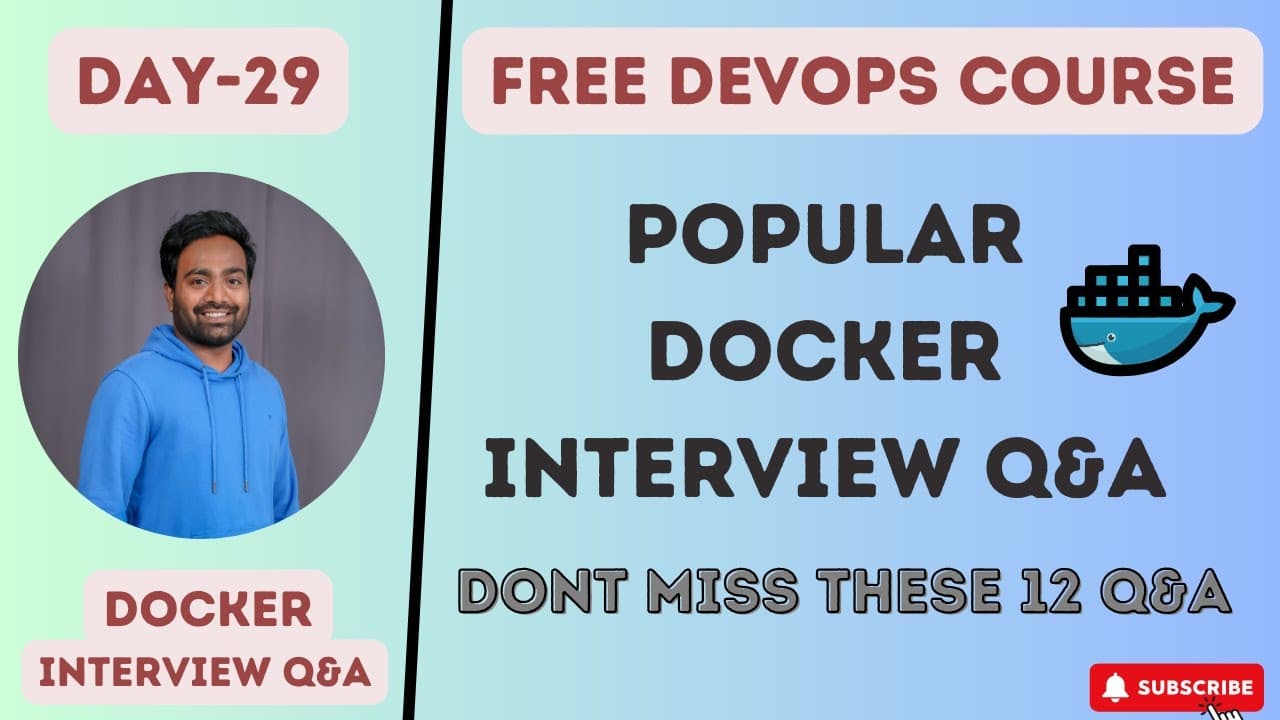
hello everyone my name is Abhishek and welcome back to my channel so today we are at day 29 of our complete devops course and in this video we will take a look at Docker interview questions and answers so the way I prepared this Docker interview questions and answer is to uh like you know not just like any random questions and answers but they are ... Read More
Key Insights
- Docker is an open-source containerization platform used to build containers and manage their life cycle. A complete interview response should also mention practical activities such as writing Dockerfiles, building images, running containers, and pushing images to registries.
- Containers are lightweight because they do not include a complete operating system. They contain the application, its runtime dependencies, and the minimal system libraries required for execution, reducing image size and avoiding some complexities associated with a complete guest operating system.
- Virtual machines include a complete guest operating system in addition to the application and its dependencies. An Ubuntu or Amazon Linux virtual machine includes the operating system, kernel, and system libraries, while a container keeps only the minimal files and dependencies required by its application.
- The Docker life cycle starts with a requirement to containerize an application. A Dockerfile defines the instructions needed to run it, Docker build converts that file into an image, Docker run creates a running container, and the image can be pushed to an external registry.
- A Dockerfile is the starting point for packaging an application with Docker. It contains the set of instructions required to run the application, and the Docker CLI uses the Docker build command to convert those instructions into a Docker image.
- The Docker CLI is the client through which users submit commands such as Docker build and Docker run. These requests are received by the Docker daemon, which interprets the requested action and performs the work of building an image or running a container.
- The Docker daemon is the component responsible for executing Docker actions. It receives requests from the client, identifies the relevant Dockerfile or image operation, and performs the requested task, making it central to Docker operation.
- Interview readiness requires practicing clear English explanations of concepts already understood practically. Knowing Docker commands is insufficient if a candidate cannot explain containers, virtual machines, components, and workflows clearly enough for an interviewer to recognize that practical experience.
Install to Summarize YouTube Videos and Get Transcripts
Explore YouTube Video Summarizer or Get YouTube Transcript Extractor
Questions & Answers
Q: What is Docker and what is it used for?
Docker is an open-source containerization platform used to build containers and manage their life cycle. In an interview, the answer should connect that definition to practical experience, such as writing Dockerfiles, building Docker images, running containers, and pushing images to registries. This demonstrates both an understanding of the platform and experience using it to work with containers.
Q: How are containers different from virtual machines?
Containers are lightweight because they do not include a complete operating system. They package an application, its dependencies, and the minimal system libraries required to run it. Virtual machines include a complete guest operating system, kernel, and system libraries in addition to the application and runtime, which makes their images larger and introduces additional complexity.
Q: What files and dependencies does a Docker container need?
A container needs the application, its application dependencies, and the minimal system libraries required for execution. For a Java application, this means packaging the application, the required Java runtime dependency, and mandatory system libraries. It is inaccurate to say that containers have no operating system components at all, because they still require minimal system dependencies and shared libraries.
Q: What is the Docker container life cycle?
The Docker life cycle begins when a project needs to containerize an application. A Dockerfile is written with the instructions required to run that application. Docker build converts the Dockerfile into an image, and Docker run creates a container from the image. The image can then be pushed to an external registry or pulled when required.
Q: How does a Dockerfile become a running container?
A Dockerfile first records the instructions required to run an application. The user submits Docker build through the Docker CLI, and the Docker daemon receives and performs that action to create an image. The user then submits Docker run, which the daemon interprets as a request to create and execute a container from the resulting image.
Q: What are the main Docker components described in the course?
The described Docker components include the client, represented by the Docker CLI, and the Docker daemon, which receives and executes requests. A user issues commands such as Docker build or Docker run through the client. The daemon interprets those commands, identifies the required operation, and performs work such as building an image or running a container.
Q: What does the Docker daemon do?
The Docker daemon receives actions submitted through the Docker CLI and executes them. When it receives Docker build, it identifies the Dockerfile and creates an image. When it receives Docker run, it understands that a container must be started. The daemon is described as the heart of Docker because Docker operations will not work when it is unavailable.
Q: How should candidates prepare Docker answers for interviews?
Candidates should practice expressing Docker concepts clearly rather than relying only on practical familiarity. They should prepare explanations of containers, virtual machines, the Docker life cycle, and Docker components in English, even when they originally studied the material in another language. Clear wording helps interviewers understand a candidate's practical exposure, knowledge, and ability to describe scenario-based work.
Summary & Key Takeaways
-
Docker interview preparation should focus on scenario-based explanations instead of memorizing isolated commands. Candidates need to describe Docker as a containerization platform, explain what containers contain, compare them with virtual machines, and connect every answer to practical work they have performed while containerizing and running applications.
-
Containers are lightweight because they package an application, its dependencies, and only the system libraries required for execution rather than a complete operating system. Virtual machines include a complete guest operating system, such as Ubuntu or Amazon Linux, along with the application, runtime, kernel, and system libraries, which increases image size and complexity.
-
The Docker life cycle begins by writing a Dockerfile containing the instructions required to run an application. The Docker CLI sends commands to the Docker daemon, which performs actions such as building an image or running a container. Images can then be pushed to external registries or pulled when needed.
Read in Other Languages (beta)
Share This Summary 📚
Summarize YouTube Videos and Get Video Transcripts with 1-Click
Try YouTube Summary with ChatGPT & Claude or YouTube Transcript Generator
Explore More Summaries from Abhishek.Veeramalla 📚
Summarize YouTube Videos and Get Video Transcripts with 1-Click
Try YouTube Summary with ChatGPT & Claude or YouTube Transcript Generator