How to Use 'To Be' in the Past Tense
TL;DR
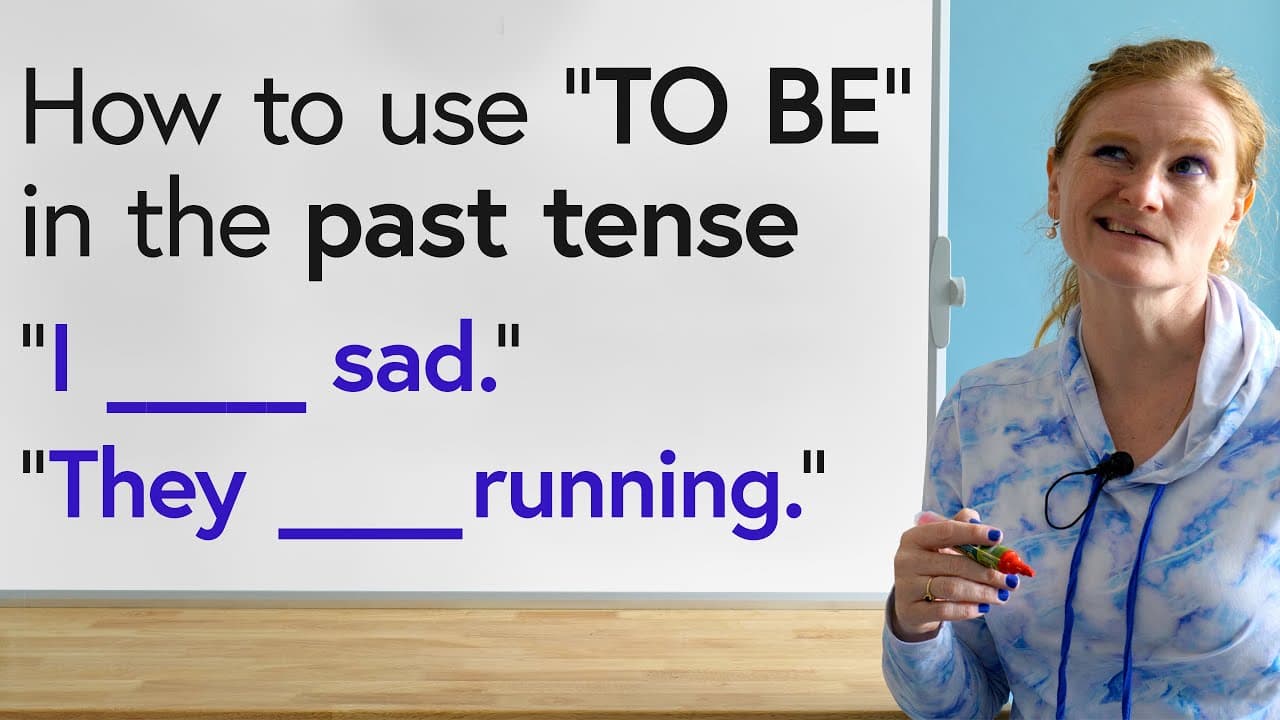
To use 'to be' in the past tense, use 'was' for singular subjects (I, he, she, it) and 'were' for plural subjects (you, they, we). To form negatives, add 'n't' to create contractions like 'wasn't' and 'weren't'. Questions reverse the order, for example, 'Was I thirsty?' or 'Were you happy?'.
Transcript
Hello. Sorry. I am really thirsty. Well, I was thirsty, but now I'm okay. Today, I'm going to teach you about probably the most famous verb ever. Yes, the verb "to be". I know you hate it. I know you've studied the verb "to be" forever, but we have to look at the past tense of the verb "to be" because we use it a lot in the past, and you have to ma... Read More
Key Insights
- 😒 Singular subjects like I, he, she, and it use "was" in the past tense.
- 😒 Plural subjects like you, they, and we use "were" in the past tense.
- 💁 Form negative sentences by adding "n't" after "was" or "were".
- 🍝 Questions in the past tense reverse the subject and verb order for "was" or "were".
- 😒 Past continuous tense uses "was" or "were" with verbs in the "-ing" form for storytelling.
Install to Summarize YouTube Videos and Get Transcripts
Explore YouTube Video Summarizer or Get YouTube Transcript Extractor
Questions & Answers
Q: How do you form the past tense of "to be" for singular subjects?
For singular subjects like I, he, she, and it, use "was" in the past tense, as in "I was tired" or "She was funny".
Q: What is the structure for forming negative sentences in the past tense with "to be"?
Negatives are formed by adding "n't" after "was" or "were", such as "I wasn't tired" or "They weren't bad".
Q: How do you ask questions using the past tense of "to be"?
Questions are formed by reversing the order of the subject and "was" or "were", such as "Were you thirsty?" or "Was she funny?".
Q: How is the past continuous tense of "to be" structured?
The past continuous tense uses "was" or "were" with a verb in the "-ing" form, like "I was eating" or "They were jumping".
Summary & Key Takeaways
-
Learn the past tense of "to be" with "was" for singular subjects like I, he, she, and it, and "were" for plural subjects like you, they, and we.
-
Understand how to form negative sentences by adding "n't" after "was" or "were".
-
Practice asking questions in the past tense using "was" or "were" at the beginning of the sentence.
Read in Other Languages (beta)
Share This Summary 📚
Summarize YouTube Videos and Get Video Transcripts with 1-Click
Try YouTube Summary with ChatGPT & Claude or YouTube Transcript Generator
Explore More Summaries from English with Ronnie · EnglishLessons4U with engVid 📚




Summarize YouTube Videos and Get Video Transcripts with 1-Click
Try YouTube Summary with ChatGPT & Claude or YouTube Transcript Generator