How to Easily Use Continuous Tenses in English
TL;DR
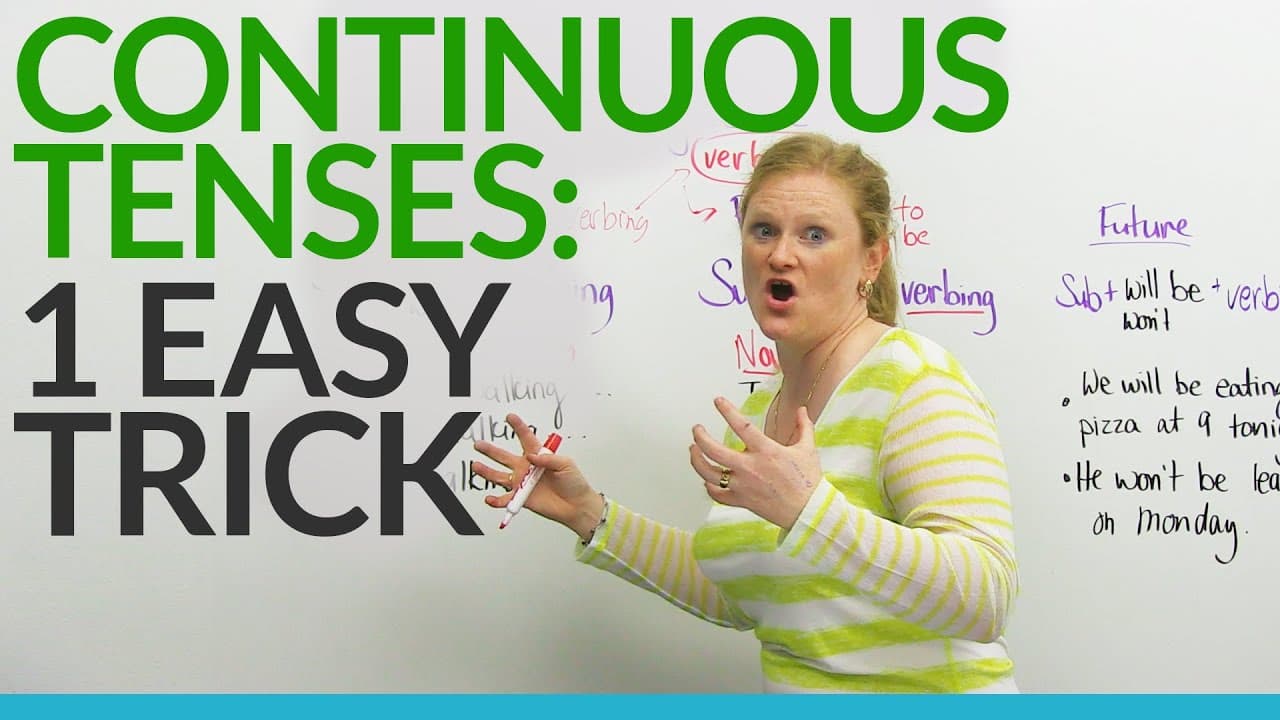
To form continuous tenses in English, remember to include 'verb+ing' in the sentence. Present continuous uses the present form of 'to be' (is, am, are) with verb+ing, past continuous replaces 'to be' with its past form (was, were), and future continuous uses 'will be' or 'won't be' followed by verb+ing.
Transcript
Quack, quack. Hi, my name's Ronnie, and I'm going to go over some grammar with you. Do you hate grammar as much as I do? Oh, it's so confusing. I really, really, really love teaching, but I really hate grammar. But I want to make it easy for you, so I found a new trick. Yes! Check this out. Tricks by Ronnie. Ronnie's turning tricks. [Laughs] We're ... Read More
Key Insights
- 😒 Continuous tenses in English require the use of verb+ing.
- 🎁 Present continuous tense is used to describe actions happening at the moment.
- 🍝 Past continuous tense is used to tell stories or describe past events.
- 😒 Future continuous tense uses "will be" or "won't be" along with verb+ing.
- ⌛ Time markers are important when using future continuous tense.
- 💁 The verb "to be" changes based on the tense when forming continuous tenses.
- ❓ Continuous and progressive tenses are essentially the same and can be used interchangeably.
Install to Summarize YouTube Videos and Get Transcripts
Explore YouTube Video Summarizer or Get YouTube Transcript Extractor
Questions & Answers
Q: What is the trick to forming continuous tenses in English?
The trick is to add verb+ing somewhere in the sentence, regardless of the tense.
Q: How is the present continuous tense formed?
The present continuous tense is formed by using the present tense of the verb "to be" (is, am, are) and adding verb+ing.
Q: When is the past continuous tense used?
The past continuous tense is typically used when telling a story or describing past events.
Q: What is the difference between present continuous and past continuous tenses?
The only difference is in the verb "to be" - present continuous uses the present tense (is, am, are) while past continuous uses the past tense (was, were).
Summary & Key Takeaways
-
The trick to forming continuous tenses in English is adding verb+ing somewhere in the sentence.
-
Present continuous tense is formed by using the present tense of the verb "to be" (is, am, are) and adding verb+ing.
-
Past continuous tense is formed by changing the verb "to be" to the past tense (was, were) and adding verb+ing.
Read in Other Languages (beta)
Share This Summary 📚
Summarize YouTube Videos and Get Video Transcripts with 1-Click
Try YouTube Summary with ChatGPT & Claude or YouTube Transcript Generator
Explore More Summaries from English with Ronnie · EnglishLessons4U with engVid 📚




Summarize YouTube Videos and Get Video Transcripts with 1-Click
Try YouTube Summary with ChatGPT & Claude or YouTube Transcript Generator