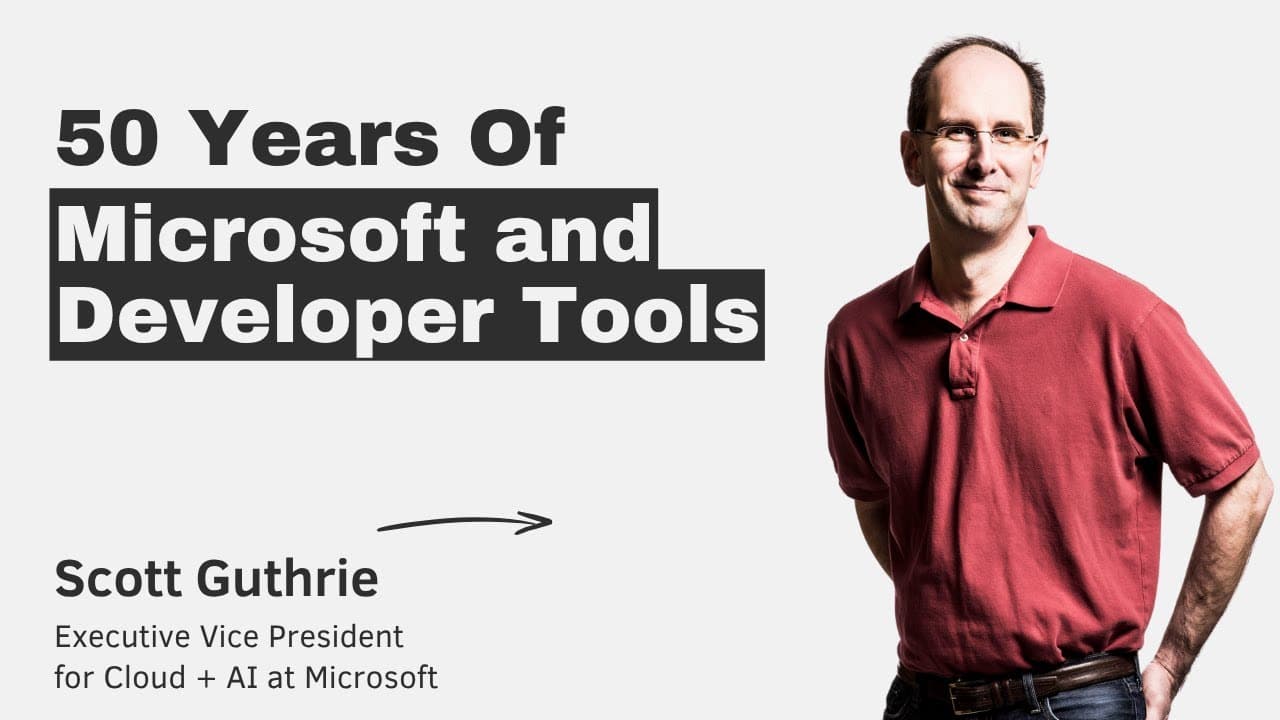
50 Years of Microsoft and Developer Tools with Scott Guthrie
TL;DR
Microsoft revamped its approach to developer tools, emphasizing open source and community engagement.
Transcript
One of the things that we did in the early days of 2014 was kind of just looked around and said, you know, I think we have an opportunity to make a couple of choices that will be bold and aggressive that give us a shot to rein relevance with developers of the world. And if we don't, we're going to be on an iceberg that's going to slowly melt. And a... Read More
Key Insights
- 🥶 Microsoft’s pivotal shift in 2014 led to the introduction of free developer tools, significantly increasing access and engagement within the developer community.
- 🤩 The history of Microsoft reflects a persistent effort to lower the barriers for developers, with Visual Basic serving as a key example of democratizing access to software development.
- 😶🌫️ The successful launch of Azure involved addressing initial usability issues and positioning it strategically within the hybrid cloud market to cater to enterprise needs and regulatory compliance.
- 🫵 Scott Guthrie emphasizes the importance of understanding developer needs and creating tools that enhance productivity through AI, which he views as an evolutionary step rather than a threat to the profession.
- 🤗 Open source became a central tenet of Microsoft’s strategy, moving away from proprietary models to foster community contributions and collaboration in software development.
- 🤗 Visual Studio Code marked a significant breakthrough for Microsoft, combining the robustness of a Microsoft product with the accessibility of open-source software, appealing to a broad range of developers.
- 😵 The ability to run applications on multiple operating systems has become a crucial aspect of modern development, further proving Microsoft’s commitment to cross-platform development.
Install to Summarize YouTube Videos and Get Transcripts
Explore YouTube Video Summarizer or Get YouTube Transcript Extractor
Questions & Answers
Q: What were the key decisions made by Microsoft in 2014 to engage developers?
In 2014, Microsoft made three significant decisions: they introduced a community edition of Visual Studio to provide free access to developers, they open-sourced .NET to foster community contributions, and they recognized the need for lightweight code editors, leading to the development of Visual Studio Code.
Q: How did Scott Guthrie describe the initial perception of Microsoft's transition to open source?
Guthrie mentioned that many people viewed Microsoft's shift to open source with skepticism due to prior fears about losing business models based on software licenses. However, he emphasized that embracing open source would ultimately enhance developer engagement and productivity, which proved to be correct.
Q: What significance does Visual Basic hold in Microsoft’s history according to Scott Guthrie?
Visual Basic was revolutionary because it simplified GUI application development, allowing non-technical users to create software through a drag-and-drop interface. It significantly lowered the barrier to entry for developers and transformed the software development landscape at the time.
Q: How did Microsoft shift its cloud strategy with Azure, according to Guthrie?
Initially, Azure faced usability challenges and didn't support open-source technologies. After a critical evaluation and leadership changes, Microsoft focused on enhancing developer experiences, supporting Linux, and positioning Azure as the cloud platform for modern businesses, which helped it gain significant market traction.
Q: What are Scott’s views on the future of developer tools with AI?
Guthrie believes that AI will enhance developer productivity, allowing them to offload routine tasks to AI assistants like GitHub Copilot. He envisions a future where developers can assign complex tasks to AI agents, freeing them to focus on higher-level problem-solving and innovation.
Q: Why was the transition from a focus on developer tools to open source and cloud relevant?
As development evolved, so did the needs of developers. Microsoft needed to adapt its business model to remain competitive by embracing open source and cloud services, allowing for a more collaborative and efficient development process that aligned with modern practices.
Summary & Key Takeaways
-
In 2014, Microsoft recognized the need to regain relevance among developers and made pivotal decisions like introducing a free community edition of Visual Studio and open-sourcing .NET.
-
The conversation features Scott Guthrie, a veteran at Microsoft, discussing the company’s history with developer tools, from BASIC to Visual Studio, and the importance of supporting developers.
-
Guthrie highlights Microsoft's transition to open source and cloud platforms, culminating in the success of products like Visual Studio Code and Azure, emphasizing their commitment to developer productivity and engagement.
Read in Other Languages (beta)
Share This Summary 📚
Summarize YouTube Videos and Get Video Transcripts with 1-Click
Try YouTube Summary with ChatGPT & Claude or YouTube Transcript Generator
Explore More Summaries from The Pragmatic Engineer 📚




Summarize YouTube Videos and Get Video Transcripts with 1-Click
Try YouTube Summary with ChatGPT & Claude or YouTube Transcript Generator