What Does It Take to Transition from Software to AI Engineer?
TL;DR
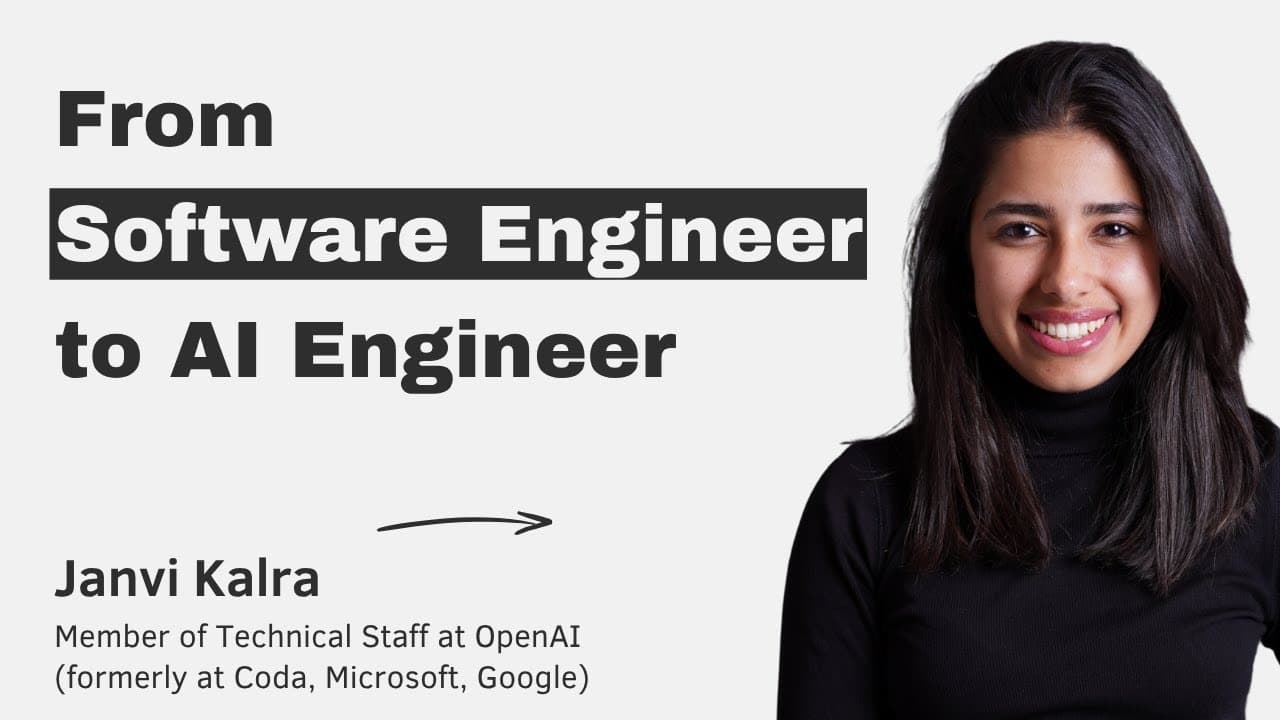
To transition from software engineer to AI engineer, focus on self-directed learning, participate in hackathons, and actively pursue AI projects. Understanding the industry’s structure and various company types can provide clarity in your job search, while cultivating a broad skill set is essential for success in this fast-evolving field.
Transcript
You interviewed at 46 companies. What did you learn about what the market is like, what interviewing is like, what the whole scene is in terms of the space. There are the product companies, infrastructure companies, and the model companies. I found it helpful to put companies in each category and figure out which segment you're most excited about t... Read More
Key Insights
- 🤩 Interviewing across multiple AI companies illuminated key segments: product companies are focused on applications, infrastructure companies provide the tools, and model companies create the underlying intelligence.
- 📽️ Jambi's proactive approach to learning about AI, such as participating in hackathons and projects, significantly impacted her transition to a role at OpenAI.
- 👨💼 To assess the long-term viability of AI companies, it is essential to evaluate their business models, revenue streams, and the competitive landscape.
- 😫 The landscape of AI engineering demands a broad skill set, blending technical competencies with business acumen, as engineers are often expected to take on roles beyond coding.
- 🐎 OpenAI’s culture emphasizes speed and trust, enabling engineers to innovate rapidly while ensuring safety and reliability in deploying AI solutions.
- 🥅 Engineers need to develop the ability to communicate clearly with AI models, enhancing their interaction and output quality to align with project goals.
- 🏑 Continuous personal development and mentorship within the AI field are vital for navigating its complexities and ensuring a successful career trajectory.
Install to Summarize YouTube Videos and Get Transcripts
Explore YouTube Video Summarizer or Get YouTube Transcript Extractor
Questions & Answers
Q: What inspired you to focus on model and infrastructure companies during your job search?
I wanted to expand my skills beyond product companies, which felt similar to my previous experience. Pursuing roles in model and infrastructure companies promised deeper learning opportunities and a chance to contribute to innovative solutions that shape the AI landscape. Although it posed challenges, I valued the potential for growth.
Q: How did you prepare for the technical interviews at AI companies?
I prepared by focusing on coding interviews, system design challenges, and projects related to AI. I utilized platforms like LeetCode for practice, studied system design principles, and engaged in project interviews to showcase my passion and ability to build relevant applications quickly.
Q: What did you learn about company viability when interviewing with AI firms?
I assessed company viability by looking at key indicators such as revenue potential, market size, and customer loyalty. By asking specific questions during interviews, I aimed to understand each company's positioning within its segment and the financial health necessary to sustain growth.
Q: Can you describe your experience transitioning to an AI engineer at KOD?
Initially, I faced resistance when trying to join KOD’s AI team. To demonstrate my commitment, I took the initiative to learn about AI technologies on my own time, participating in hackathons and building my own projects. This self-driven approach ultimately led to my acceptance onto the AI team, where I contributed significantly.
Q: What role do learning and mentorship play in advancing in AI engineering?
Continuous learning and mentorship are crucial in AI engineering, given the fast-paced evolution of the field. Networking with experienced professionals and participating in peer discussions helped me develop a clear understanding of industry trends and best practices, which accelerated my growth and effectiveness in my role.
Q: How does OpenAI's culture differ from other companies where you've worked?
OpenAI fosters a unique blend of rapid innovation and large-scale capability. The open culture encourages collaboration and knowledge sharing, creating an environment where engineers are empowered to propose ideas and implement them quickly, which keeps the work dynamic and engaging.
Q: What are some surprising aspects of AI engineering that you have realized?
One surprising aspect is that a significant portion of AI engineering involves building solutions around the model's limitations. This requires constant adaptation as models evolve, prompting engineers to retract and revise their work frequently in response to advancements in AI technologies.
Summary & Key Takeaways
-
Jambi's experience interviewing at 46 AI companies revealed key industry segments: product, infrastructure, and model companies, each presenting unique opportunities and challenges for job seekers.
-
Transitioning from a software engineer to an AI engineer involved self-study, participation in hackathons, and initiative in building AI projects, culminating in a significant role at OpenAI.
-
The AI engineering field demands adaptability and a broad skill set, emphasizing both technical proficiency and understanding of business fundamentals to thrive in a fast-evolving landscape.
Read in Other Languages (beta)
Share This Summary 📚
Summarize YouTube Videos and Get Video Transcripts with 1-Click
Try YouTube Summary with ChatGPT & Claude or YouTube Transcript Generator
Explore More Summaries from The Pragmatic Engineer 📚


Summarize YouTube Videos and Get Video Transcripts with 1-Click
Try YouTube Summary with ChatGPT & Claude or YouTube Transcript Generator