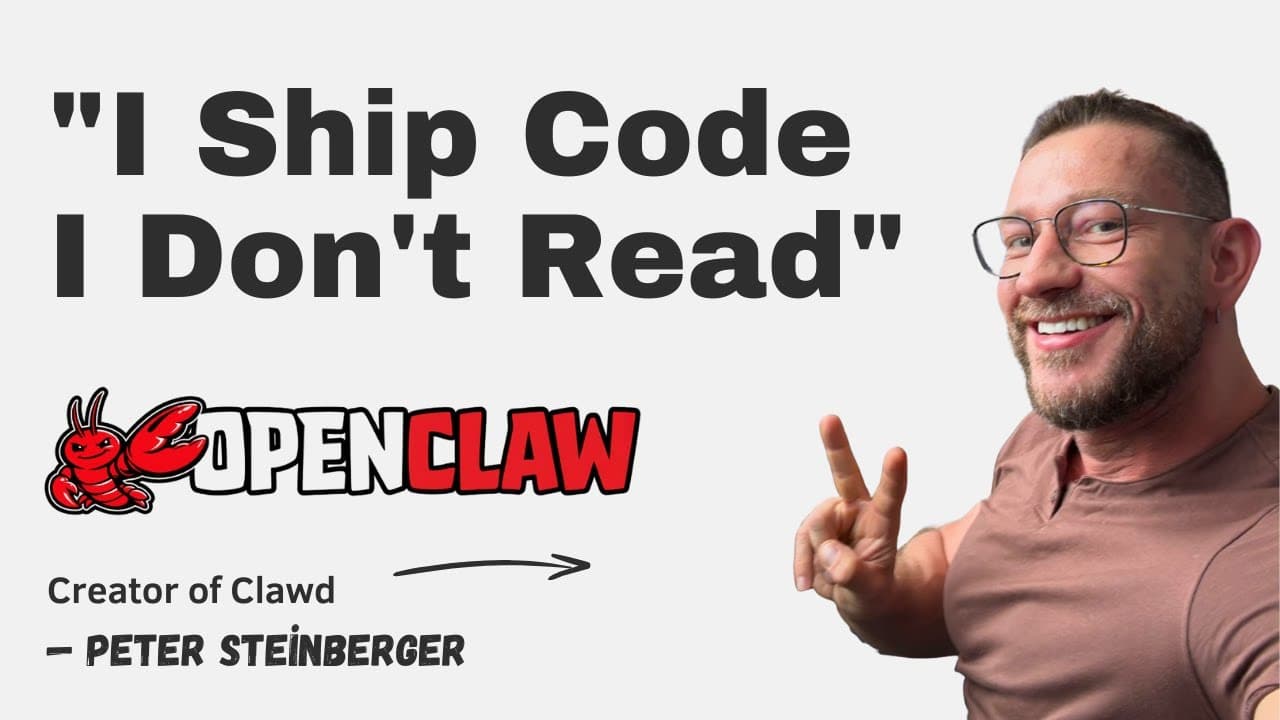
How Does Peter Steinberger Ship Code With AI?
TL;DR
Effective AI-assisted development depends on closing the loop between generated code, tests, and feedback, allowing agents to verify and improve their work. Peter Steinberger applies this approach with Claude and Codex while building OpenClaw, reaching more than 6,600 commits in January and operating with the output that might otherwise suggest a company.
Transcript
What if you could merge 600 commits on a single day [music] and none of it was slopp? This is what today's guest, Peter Stainberger, the creator of Claudebot, claims he's doing. Peter is a standout developer who built PSP PDF kit, the PDF [music] framework used on more than 1 billion devices. Then he burned out, sold his shares, [music] and disappe... Read More
Key Insights
- AI-assisted development is most effective when code generation, testing, and feedback form a closed loop. Agents need ways to evaluate their output, detect failures, and make corrections, otherwise rapid code production becomes the frustrating form of loosely directed work described as vibe coding.
- Peter Steinberger's January output exceeded 6,600 commits while he worked as one person at home. The commit history could appear to represent a company, illustrating how Claude and Codex can help an experienced developer produce software at a scale previously associated with a larger team.
- Reading every generated line is not presented as a prerequisite for shipping reliable software. Steinberger instead emphasizes engineering judgment, tests, planning, and feedback systems that help establish whether the resulting software behaves correctly, even when the developer has not manually inspected most of its implementation.
- OpenClaw is a work-in-progress personal AI assistant that Steinberger is building with AI agents at the center of his process. The project, previously called Clawdbot, is framed as an example of what a future assistant resembling a more capable Siri could feel like.
- Engineering judgment shifts when AI agents perform more implementation work. The developer's responsibility increasingly includes defining goals, structuring tasks, planning changes, building tests, and designing systems that let agents receive concrete evidence about whether their work succeeds or fails.
- Steinberger's software career began with experimentation rather than a formal long-term plan. He tinkered with computers as a teenager, learned through university and employment, and built an unofficial iPhone client after losing an emotional message when a website failed inside a subway tunnel.
- Steinberger's first iPhone application earned about 10,000 dollars during its first month at a price of five dollars. He created it by parsing website HTML because no API was available, then submitted it to the App Store despite receiving no response from the website's company.
- PSPDFKit emerged from Steinberger's work repairing an unstable magazine viewer built as a single Objective-C file containing thousands of lines. After finding that surgical fixes caused other failures, he proposed rewriting the application, beginning work in the technically challenging domain of PDF rendering.
Install to Summarize YouTube Videos and Get Transcripts
Explore YouTube Video Summarizer or Get YouTube Transcript Extractor
Questions & Answers
Q: How does Peter Steinberger ship so much code with AI?
Peter Steinberger puts tools such as Claude and Codex at the center of his development workflow and focuses on closing the loop between implementation, tests, and feedback. This lets agents generate work, receive evidence about its behavior, and make improvements. The approach helped him exceed 6,600 commits in January while working alone, producing activity that could resemble a company's output.
Q: What does closing the loop mean in AI coding?
Closing the loop means connecting generated code to tests and other feedback that can reveal whether the result works. An AI agent should not merely produce an implementation and stop. It needs concrete signals about failures and success so it can revise its work. Steinberger identifies this feedback cycle as a prerequisite for effective AI-assisted development rather than frustrating vibe coding.
Q: Why can Peter Steinberger ship code he has not read?
Steinberger's workflow does not treat manual inspection of every generated line as the only way to establish confidence. Instead, it relies on planning, testing, feedback, and engineering judgment to evaluate behavior and guide corrections. The claim is not that code quality is irrelevant. It is that reliable verification loops can carry more of the validation burden when AI produces implementation at high speed.
Q: What is OpenClaw and what was it previously called?
OpenClaw is Peter Steinberger's work-in-progress personal AI assistant project, presented as an example of what the future of Siri could feel like. It was previously called Clawdbot and was renamed OpenClaw. Steinberger develops it with large language models and AI agents at the center of his workflow, while its rapidly growing community contributes to the project's momentum.
Q: How does AI change the role of a software engineer?
AI shifts more implementation work toward agents, while the engineer concentrates on defining objectives, planning changes, applying judgment, and constructing reliable tests and feedback systems. Steinberger's workflow suggests that developers must design environments where agents can evaluate and improve their output. This can allow one experienced person to operate at a pace that looks more like a team.
Q: How did Peter Steinberger begin developing iPhone apps?
Steinberger began after a browser-based dating service lost a long, emotional message when he entered a subway tunnel. The page disabled its send button, displayed an error, and offered no copy-and-paste or screenshot option. Frustrated, he downloaded Xcode, parsed the service's HTML with regular expressions, and built an unofficial native client despite having little experience with the platform.
Q: How successful was Peter Steinberger's first iPhone app?
Steinberger placed his unofficial dating client in the App Store after the service's company did not respond to him. He charged five dollars and made about 10,000 dollars in the first month. Because he did not fully understand the business setup, he initially supplied his grandfather's bank account, prompting a surprised call when a large Apple payment arrived.
Q: How did Peter Steinberger start building PSPDFKit?
The path to PSPDFKit began when Steinberger was asked to stabilize a magazine viewer created around the arrival of the iPad. He found thousands of lines of Objective-C in a single file and described the program as a house of cards because changes caused additional failures. He proposed a rewrite, which led him deeper into PDF-viewing and rendering problems.
Summary & Key Takeaways
-
Peter Steinberger builds software with Claude and Codex at the center of his workflow. While creating OpenClaw, a work-in-progress personal AI assistant, he produced more than 6,600 commits in January. His output demonstrates how one experienced developer can use AI agents to operate at a pace that resembles an entire software company.
-
Steinberger argues that developers can ship code without reading every line when reliable feedback mechanisms evaluate the result. The essential practice is closing the loop among implementation, tests, and feedback. This shifts human effort toward planning, system design, judgment, and creating environments where agents can detect problems and improve their own work.
-
His path began with childhood computer experimentation in rural Austria, followed by university, professional development, and early iPhone applications. He later transformed a troubled magazine viewer project into the foundation for PSPDFKit, a PDF framework used on more than 1 billion devices, before burning out and leaving technology for three years.
Read in Other Languages (beta)
Share This Summary 📚
Summarize YouTube Videos and Get Video Transcripts with 1-Click
Try YouTube Summary with ChatGPT & Claude or YouTube Transcript Generator
Explore More Summaries from The Pragmatic Engineer 📚
Summarize YouTube Videos and Get Video Transcripts with 1-Click
Try YouTube Summary with ChatGPT & Claude or YouTube Transcript Generator