How to use grill me prompts to guide AI agents?
TL;DR
Grill me prompts help steer AI agents by using leading words and context. The approach emphasizes keeping agents in their smart zone, splitting context, and building fundamentals through practical, iterative workflows. It combines communication skills with strategic coding concepts to improve how we train and manage AI agents in real projects.
Transcript
It's annoying how damn it bro. >> Everyone's got a grill me story. It just has this weird emergent behavior where the models start thinking a little bit outside the box [music] and they start throwing ideas at you. >> I guess the idea of the tracer bullet is like a tracer bullet that leaves a mark. >> I just started using these phrases in my prompt... Read More
Key Insights
- Grill me is a leading word technique that nudges AI agents to act on repeating prompts.
- Effective AI agent context management relies on splitting information so agents stay in their smart zone.
- Strategic coding combines human planning with AI execution to improve software outcomes.
- Foundational software engineering concepts remain useful when teaching and using AI agents.
- Communication skills can dramatically aid career transitions into tech and AI education.
- A mixed career path can leverage non-traditional backgrounds to become successful engineers.
- Workflows with AI often involve a day shift for planning and a night shift for execution.
- Real-world adoption shows teams moving to linear tools as a context layer for agents.
Install to Summarize YouTube Videos and Get Transcripts
Explore YouTube Video Summarizer or Get YouTube Transcript Extractor
Questions & Answers
Q: What is the grill me technique and why is it effective for guiding AI agents?
Grill me is a technique where a simple, repeatable prompt acts as a leading word to steer an AI agent. By repeatedly framing tasks with this cue, the agent begins to generate responses aligned with the user’s intent. This method helps establish a predictable pattern of behavior, making it easier to guide complex AI workflows and keep agents focused on the desired objective.
Q: How does context management influence AI agent performance according to the episode?
Context management is crucial because agents need access to relevant information such as specs and history to perform well. The idea is to split context into manageable chunks so agents stay within their smart zone, avoiding overload. Proper context layering enables agents to retrieve and apply information efficiently, improving accuracy and speed in decision making.
Q: What is strategic coding and how does it relate to AI agents?
Strategic coding refers to planning and structuring code and workflows to maximize effectiveness when AI agents are involved. It combines high level strategies with hands on implementation, allowing engineers to design prompts and agent routines that delegate tasks, monitor progress, and course correct as needed. This approach helps scale AI-assisted development across teams.
Q: Why are foundational software engineering concepts still valuable when working with AI agents?
Foundational concepts remain valuable because they provide a stable framework for thinking about systems, reliability, testing, and maintainability. When teaching and using AI agents, applying classic practices such as modular design, clear interfaces, and testable components helps ensure that AI outcomes are predictable, auditable, and robust in real-world environments.
Q: How did Matt Pocock describe his career shift from voice coach to developer?
Matt described a transition from teaching voice and performance to learning to code in order to work remotely. He leveraged his communication skills to explain technical ideas, which helped him land roles in tech while gradually building technical knowledge. He emphasizes self learning, persistence, and the value of explaining complex topics clearly as part of his career progression.
Q: What role do communication skills play in tech education and career growth according to the interview?
Communication skills enable clearer explanations of technical concepts, making it easier to teach, persuade stakeholders, and collaborate with teams. In Pocock’s story, his ability to convey ideas helped compensate for initial gaps in formal CS training and accelerated his path into engineering roles and educational content creation.
Q: What is the day shift and night shift approach mentioned in the episode?
The day shift is used for planning, strategy, and structuring work with AI agents, while the night shift focuses on execution, coding, and applying the planned steps. This separation helps maintain focus, manage cognitive load, and ensure that agents stay productive by following well defined phases of work.
Q: How have real companies integrated AI agents with Linear as a context layer?
Recent discussions highlight that many enterprises now use AI agents inside Linear as a single source of truth for context. Linear provides planning and project management capabilities, and large teams have adopted it to supply agents with context, enabling more efficient collaboration and execution across complex workflows.
Summary & Key Takeaways
-
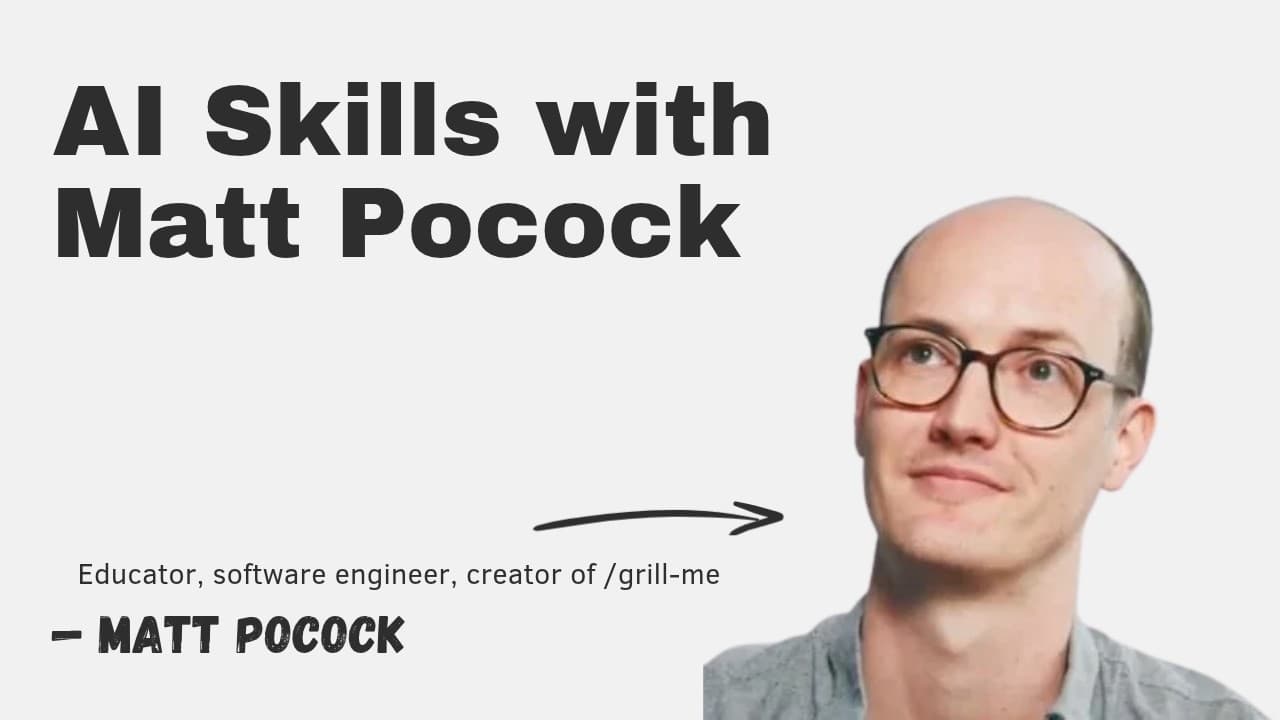
Matt Pocock emphasizes practical software fundamentals and how to teach them using AI agents, with grill me as a key technique. He explains how prompts act as leading words to guide agents and how context should be split to keep agents focused. The discussion blends teaching experience with hands-on AI tooling for engineers.
-
The episode covers strategic coding ideas and how educators like Pocock leverage workshops and courses to scale knowledge. It highlights the role of AI in translating human strategies into agent behavior, plus real-world examples like a grilled API endpoint exercise.
-
Finally, the interview dives into career shifts from voice coaching to software engineering, underlining the value of communication skills and continuous learning. It also touches on the day shift and night shift approach to manage AI-assisted workflows.
Read in Other Languages (beta)
Share This Summary 📚
Summarize YouTube Videos and Get Video Transcripts with 1-Click
Try YouTube Summary with ChatGPT & Claude or YouTube Transcript Generator
Explore More Summaries from The Pragmatic Engineer 📚
Summarize YouTube Videos and Get Video Transcripts with 1-Click
Try YouTube Summary with ChatGPT & Claude or YouTube Transcript Generator