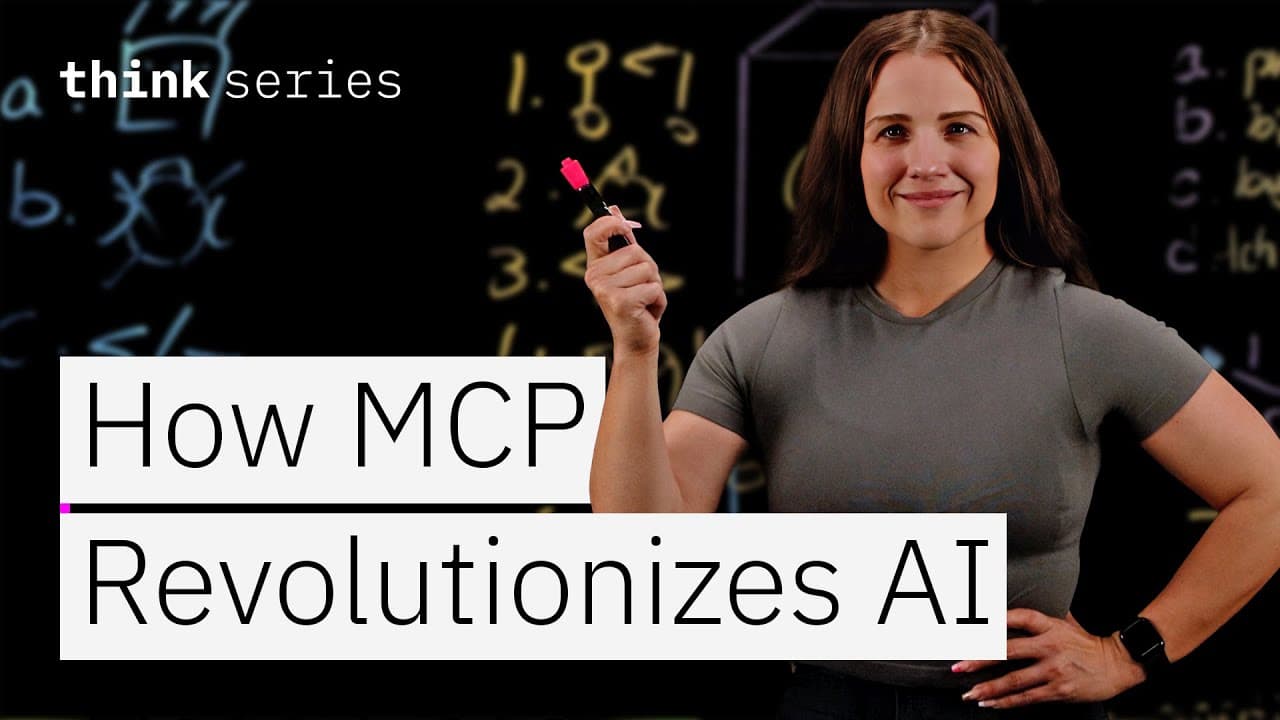
How does MCP enable AI agents to work with tools?
TL;DR
MCP provides a universal interface that lets an AI agent talk to multiple tools and data sources through a standard server and client setup. It removes bespoke adapters by routing prompts, calling the right functions, and returning results to the user. This enables automated workflows and scalable AI-driven tasks.
Transcript
In 2025 The way we build applications has fundamentally shifted. And that's thanks to Model Context Protocol, or MCP for short. MCP is the protocol that finally lets us retire a collection of duct tape, baling wire, and hand roll JSON glue code. Instead of running yet another custom integration, and every time an AI model needs to talk to an API, M... Read More
Key Insights
- MCP is a centralized protocol that unifies how AI agents connect to tools, data, and prompts.
- The MCP client acts as the middleman inside the host and communicates with MCP servers to locate the right function.
- The MCP server hosts tools, data resources, and prompts, enabling standardized access for the AI.
- GitHub is highlighted as a premier example where MCP automates PR reviews, issue triage, dependency updates, and security checks.
- MCP enables automatic authentication handling and error management, removing manual integration burdens.
- For customer support, MCP combines tools like databases, billing, logs, and knowledge bases to resolve issues automatically.
- The approach promises faster support, fewer human interventions, and scalable AI-powered workflows.
- Overall MCP democratizes AI tool orchestration by providing a plug-in like universal interface for multiple systems.
Install to Summarize YouTube Videos and Get Transcripts
Explore YouTube Video Summarizer or Get YouTube Transcript Extractor
Questions & Answers
Q: How does MCP connect an AI agent to multiple tools.
MCP connects an AI agent to multiple tools through a client inside the host and one or more MCP servers. The server offers tools, resources, and prompts, while the client determines which function to call, handles back and forth communication, and returns results to the user. This standardization eliminates bespoke adapters.
Q: What real world use case demonstrates MCP in software development.
In software development, MCP links the AI agent to the GitHub API via the MCP server. The AI can automatically manage repositories, issues, pull requests, branches, and releases, while authentication and error handling are managed by the system, freeing developers from routine maintenance.
Q: How does MCP improve customer support workflows.
MCP connects tools such as customer databases, billing systems, logs, knowledge bases, and ticketing systems to the AI agent. The AI can look up user data, verify payments, update subscriptions, retrieve help articles, and create or update tickets, enabling faster, automatic responses.
Q: What are the three components the MCP server provides.
The MCP server provides three components: tools, which are functions the AI can call; resources, which are data sources; and prompts, which guide the AI's behavior with predefined instructions.
Q: Why is MCP described as a universal interface for AI agents.
MCP is described as a universal interface because it standardizes how AI agents connect to tools, data, and prompts across diverse systems, removing the need for custom integrations for each tool and enabling plug and play interoperability.
Q: What is the role of the MCP client in the architecture.
The MCP client sits inside the host as the middleman and talks to one or more MCP servers. It figures out user intent, selects the right function from the server, and manages the back and forth communications to fetch and process results.
Q: What benefits do teams gain from using MCP for multi-repo environments.
Teams gain reduced manual integration effort, fewer maintenance tasks, and more reliable tooling across multiple repositories. MCP handles routine operations like reviews, dependency updates, and security checks, allowing teams to focus on core development and scale more efficiently.
Q: How does MCP impact developer time and error handling.
MCP reduces developer time by automating routine tasks and abstracting authentication and error handling. With a standardized protocol, teams avoid bespoke code for each tool, leading to cleaner processes, fewer errors, and faster deployment of AI-powered workflows.
Summary & Key Takeaways
-
MCP standardizes tool access by connecting a client to one or more servers that host tools, resources, and prompts. This centralizes what an AI can call and how it gets data, reducing the need for custom glue code.
-
Real world use cases show MCP linking GitHub to automate repository tasks and support systems to resolve customer issues, enabling faster, more consistent operations with less manual work.
-
The impact is a shift toward scale and reliability, where teams focus on development and customer value while MCP handles routine integrations and error handling across diverse tools.
Read in Other Languages (beta)
Share This Summary 📚
Summarize YouTube Videos and Get Video Transcripts with 1-Click
Try YouTube Summary with ChatGPT & Claude or YouTube Transcript Generator
Explore More Summaries from IBM Technology 📚



Summarize YouTube Videos and Get Video Transcripts with 1-Click
Try YouTube Summary with ChatGPT & Claude or YouTube Transcript Generator