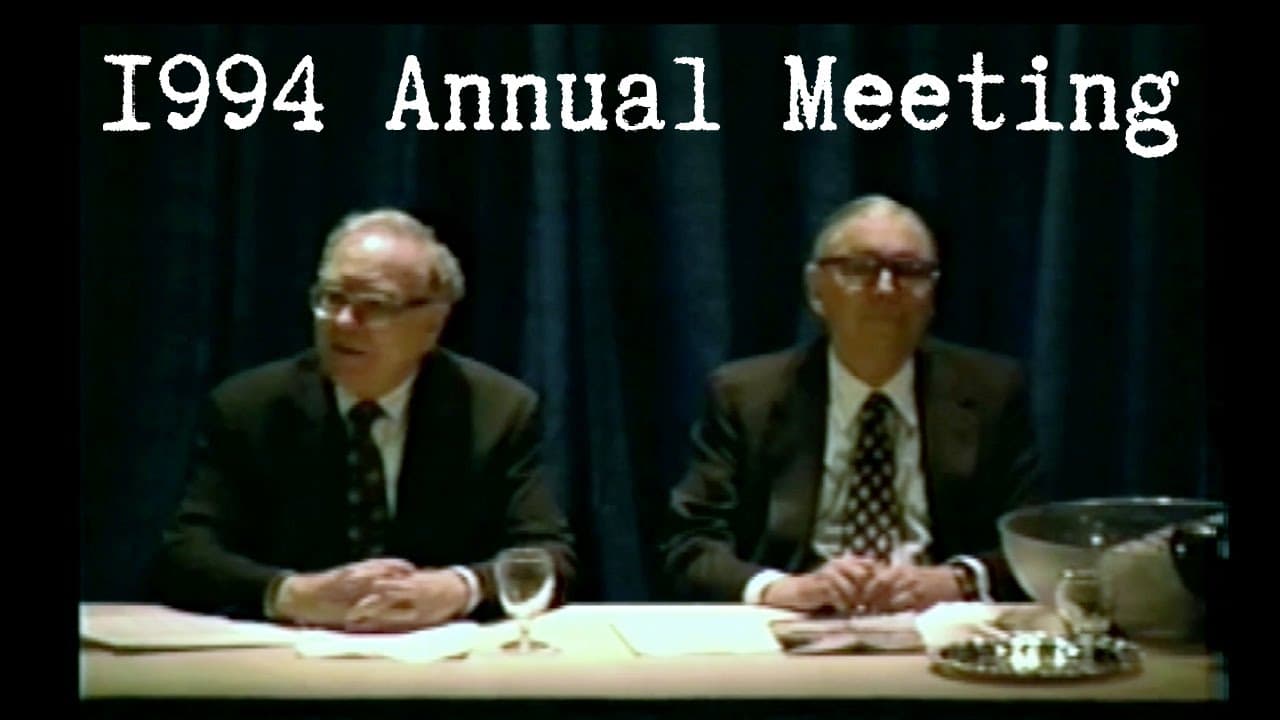
1994 Berkshire Hathaway Annual Meeting (Full Version)
TL;DR
Warren Buffett and Charlie Munger address shareholders at the 1994 Berkshire Hathaway annual meeting, discussing the company's performance, investment strategy, and the challenges faced by their businesses. Key topics include the importance of intrinsic value, the role of management, and their views on risk and market fluctuations. The meeting provides insights into their investment philosophy and operational decisions.
Transcript
put this over here right am i live yet yeah morning we were a little worried today because we uh we weren't sure from the reservations whether we could handle everybody but it looks to me like there may be a couple seats left up there but i think next year we're going to have to find a different spot because it looks to me like we're up about 600 t... Read More
Key Insights
- Intrinsic value is a core focus for Berkshire Hathaway, guiding investment decisions and business evaluations.
- Management quality is crucial; Buffett and Munger emphasize finding and retaining talented leaders.
- Risk is defined by the potential for harm or injury, not market volatility or beta, which they find irrelevant.
- Berkshire Hathaway prefers owning entire businesses but often finds better value in partial equity stakes.
- The company has a long-term investment horizon, focusing on what will happen rather than when.
- Buffett and Munger are skeptical of projections and prefer to rely on their own assessments of business value.
- They are unconcerned with short-term market fluctuations, seeing them as opportunities for strategic purchases.
- The meeting underscores the importance of understanding a business's competitive position and economic characteristics.
Install to Summarize YouTube Videos and Get Transcripts
Explore YouTube Video Summarizer or Get YouTube Transcript Extractor
Questions & Answers
Q: How does Berkshire Hathaway define risk?
Berkshire Hathaway defines risk as the possibility of harm or injury, focusing on the long-term potential for loss rather than short-term market volatility. Buffett and Munger dismiss the use of beta as a risk measure, emphasizing a business's intrinsic value and economic fundamentals over market fluctuations.
Q: Why does Berkshire Hathaway prefer owning entire businesses?
Berkshire Hathaway prefers owning entire businesses due to the tax advantages and the ability to work closely with management. However, they often find better value in the stock market, where prices can be more irrational, allowing them to acquire pieces of businesses at attractive prices.
Q: What is the importance of management quality at Berkshire Hathaway?
Management quality is crucial for Berkshire Hathaway, as Buffett and Munger focus on finding and retaining talented leaders who can effectively run their businesses. They emphasize the importance of a strong management team in driving long-term success and maintaining a business's competitive edge.
Q: How do Buffett and Munger view market fluctuations?
Buffett and Munger view market fluctuations as opportunities rather than threats. They maintain a long-term investment horizon, focusing on what will happen in the market rather than when. This perspective allows them to capitalize on market downturns to make strategic purchases.
Q: What is Berkshire Hathaway's approach to projections?
Berkshire Hathaway is skeptical of projections, preferring to rely on their own assessments of a business's value. Buffett and Munger believe that projections, especially those provided by sellers, are often unreliable and instead focus on understanding a business's economic fundamentals and competitive position.
Q: How does Berkshire Hathaway evaluate business value?
Berkshire Hathaway evaluates business value by focusing on intrinsic value, which considers a business's economic fundamentals, competitive position, and management quality. Buffett and Munger prioritize understanding the long-term prospects of a business over short-term market movements or external projections.
Q: What role does intrinsic value play in Berkshire Hathaway's investment strategy?
Intrinsic value is central to Berkshire Hathaway's investment strategy, guiding their decisions on which businesses to acquire or invest in. Buffett and Munger emphasize the importance of understanding a business's true economic worth, which allows them to make informed investment choices that align with their long-term objectives.
Q: Why is Berkshire Hathaway unconcerned with short-term market fluctuations?
Berkshire Hathaway is unconcerned with short-term market fluctuations because they focus on the long-term potential of their investments. Buffett and Munger believe that market volatility presents opportunities for strategic purchases, allowing them to acquire valuable assets at attractive prices, ultimately benefiting their long-term investment goals.
Summary
In this video, Warren Buffett addresses a variety of topics including the growth of the annual shareholders meeting, negative votes on director candidates, and the agenda of the meeting. He introduces the Berkshire Hathaway directors and auditors, and conducts the voting for directors. Buffett also discusses the use of derivatives, the stock split of Berkshire Hathaway, and the intrinsic value of the insurance business. He introduces the managers of various Berkshire Hathaway subsidiaries and highlights the upcoming non-stop air service from Midwest Express. Additionally, Buffett answers questions related to finding good management, the future of Berkshire Hathaway after him, and the potential growth of Guinness. The video ends with a question about a reverse stock split and what to do with collectible blue chip stamps.
Questions & Answers
Q: What are the implications of the growth of the annual shareholders meeting?
The growth of the annual shareholders meeting suggests that Berkshire Hathaway shareholders are increasing in number and attendance, which may require finding a larger venue in the future.
Q: What were the results of the voting for directors?
Charlie Munger received no negative votes, making him the only candidate for directors without any opposition. This humorous fact was shared with the audience.
Q: How will the meeting be conducted?
The business meeting will be conducted promptly, followed by the introduction of managers and a Q&A period. The session will be divided into two parts, allowing for a break and additional questions.
Q: How will attendees be able to leave the meeting?
Attendees can leave anytime during the meeting, but for those who prefer to leave discreetly, buses will be available at noon to transport them to various locations in Omaha.
Q: Who are the Berkshire Hathaway directors present at the meeting?
Aside from Warren Buffett, the present directors include Charlie Munger, Susan T. Buffett, Howard Buffett, Malcolm Chase III, and Walter Scott Jr.
Q: Who are the auditors of Berkshire Hathaway?
The auditors are Mr. Ron Burgess and Mr. Craig Christensen from Deloitte and Touche, who are available to answer relevant questions about the audit of Berkshire Hathaway accounts.
Q: Who is responsible for recording the proceedings of the meeting?
Mr. Forrest Carter, the secretary of Berkshire Hathaway, is responsible for making a written record of the meeting.
Q: Who is in charge of certifying the count of votes in the director election?
Mr. Robert M. Fitzsimmons has been appointed the inspector of election, and he will certify the count of votes cast in the election for directors.
Q: How many shares were represented in the election for directors?
Proxy cards representing 1,035,680 Berkshire Hathaway shares were returned as of the last Friday before the meeting, which was higher than the minimum required for a quorum.
Q: What happened during the voting for directors?
The motion to dispense with the reading of the minutes of the last meeting and the motion to elect directors were both moved and seconded without any opposition or questions. The votes cast were more than sufficient to elect Warren Buffett, Susan T. Buffett, Howard Buffett, Malcolm Chase, Charles Munger, and Walter Scott Jr. as directors.
Q: What motion was placed before the meeting by Mr. Walter Scott Jr.?
Mr. Walter Scott Jr. moved that the reading of the minutes of the last meeting be dispensed with. The motion was seconded, and after no comments or questions, it was carried through a voice vote.
Q: How many Berkshire Hathaway shares were outstanding and entitled to vote in the meeting?
According to the proxy statement, there were 1,177,750 shares of Berkshire Hathaway common stock outstanding, with each share having one voting right. Of those shares, 1,035,680 were represented at the meeting through proxy cards.
Q: What is the plan for electing directors in person or withdrawing proxies?
Shareholders who are present at the meeting and wish to withdraw a previously sent proxy and vote in person can do so. Those who haven't turned in a proxy and want to vote in person can request a ballot. Shareholders seeking a ballot must identify themselves to the meeting officials in the aisles to receive one.
Q: What is the report of the inspector of elections?
The inspector, Mr. Robert M. Fitzsimmons, reported that the ballot cast by the proxy holders received more than a million votes for each nominee, indicating their election as directors. The precise count of votes, including those cast in person, will be provided to the secretary for recording in the meeting minutes.
Q: Is there any further business to come before the meeting?
There was no further business to come before the meeting, so Mr. Walter Scott Jr. moved to adjourn the meeting. The motion was seconded and carried through a voice vote.
Q: Who are the managers introduced after the business meeting?
The managers introduced include Louis, Ron, and Irv Blumkin from the Nebraska Furniture Mart, Susan Jock from Borsheims, the Kaiser family from Central States Indemnity, Rod Eldridge from National Indemnity, Brad Kinsler from Cypress Insurance, a Jeet Jain representing a big ticket writer in the East, Mike Goldberg overseeing the real estate finance group, Gary Hellman from Fechheimer, Chuck Huggins from SEE's Candies, Stan Lipsy from the Buffalo News, Frank Rooney and Jim Eisenhower from H.H. Brown, Dave Hillstrom from Precision Steel Warehouse, Ralson Shay from Scott Fetzer, Peter Lunder from Dexter Shoe, and Harry Bauld from KNW. Harold Alphon, a partner of Harry Bauld, was absent due to his wife's illness.
Q: Who are the auditors of Berkshire Hathaway?
The auditors are Mr. Ron Burgess and Mr. Craig Christensen from Deloitte and Touche, who are available to answer relevant questions about the audit of Berkshire Hathaway accounts.
Q: Which airline will be offering non-stop air service in the near future?
Midwest Express will be launching non-stop air service from New York, Washington, and Los Angeles with flights arriving in Omaha.
Q: Will the introduction of non-stop air service affect Warren Buffett's use of the indefensible?
Warren Buffett humorously dismisses the notion, saying that his plane is being painted at the moment and that he plans to make it last a long time.
Q: What are Warren Buffett's impressions of Ajit Jain's personality and managerial skills?
Warren Buffett and Charlie Munger have a high regard for Ajit Jain, viewing him as an outstanding manager. They value their business relationship with him and appreciate his contributions.
Q: How can average investors find out what constitutes good management?
Warren Buffett suggests judging management based on their track record, how well they run the business, their allocation of capital, and their treatment of shareholders. Reading reports and proxy statements can provide insights into these factors.
Q: What are Warren Buffett's thoughts on the future of Berkshire Hathaway after him?
Warren Buffett believes that Berkshire Hathaway would still do well even if something were to happen to him. The company has a group of excellent managers and a solid ownership structure that focuses on good management and efficient capital allocation.
Q: How does Warren Buffett respond to concerns about Berkshire Hathaway's stock performance following his departure?
Warren Buffett assures shareholders that Berkshire Hathaway will continue to be a successful company, and he has confidence in the managers and the capital allocation strategy that will remain in place.
Q: How does Warren Buffett perceive the long-term growth prospects of Guinness?
Warren Buffett suggests that the growth prospects for Guinness, particularly in terms of physical volume, are not high. While Guinness is well-run, most of its money is made from distilling scotch, and the trends in scotch consumption have not been strong.
Q: What are the implications of a reverse stock split for Berkshire Hathaway?
Warren Buffett states that he does not plan on splitting the stock, as it is not efficient to divide ownership into small shares. He appreciates the current group of shareholders and believes that Berkshire Hathaway's ownership structure should not change.
Q: What should be done with collectible Blue Chip stamps?
Warren Buffett humorously suggests that his experience with the trading stamp business has been unsuccessful, as they went from doing $110 million to just $400,000 in business. He does not provide guidance on what to do with collectible Blue Chip stamps.
Summary & Key Takeaways
-
Buffett and Munger discuss the significance of intrinsic value, emphasizing its role in their investment strategy. They highlight the importance of management quality and their approach to risk, which focuses on long-term outcomes rather than short-term market volatility.
-
The meeting covers Berkshire's preference for owning entire businesses but acknowledges the value found in partial equity stakes. They express confidence in their ability to assess business value independently, without relying on external projections.
-
Buffett and Munger convey their long-term investment horizon, focusing on what will happen in the market rather than when. They view market fluctuations as opportunities and stress the importance of understanding a business's competitive position.
Read in Other Languages (beta)
Share This Summary 📚
Summarize YouTube Videos and Get Video Transcripts with 1-Click
Try YouTube Summary with ChatGPT & Claude or YouTube Transcript Generator
Explore More Summaries from Investor Archive 📚
Summarize YouTube Videos and Get Video Transcripts with 1-Click
Try YouTube Summary with ChatGPT & Claude or YouTube Transcript Generator