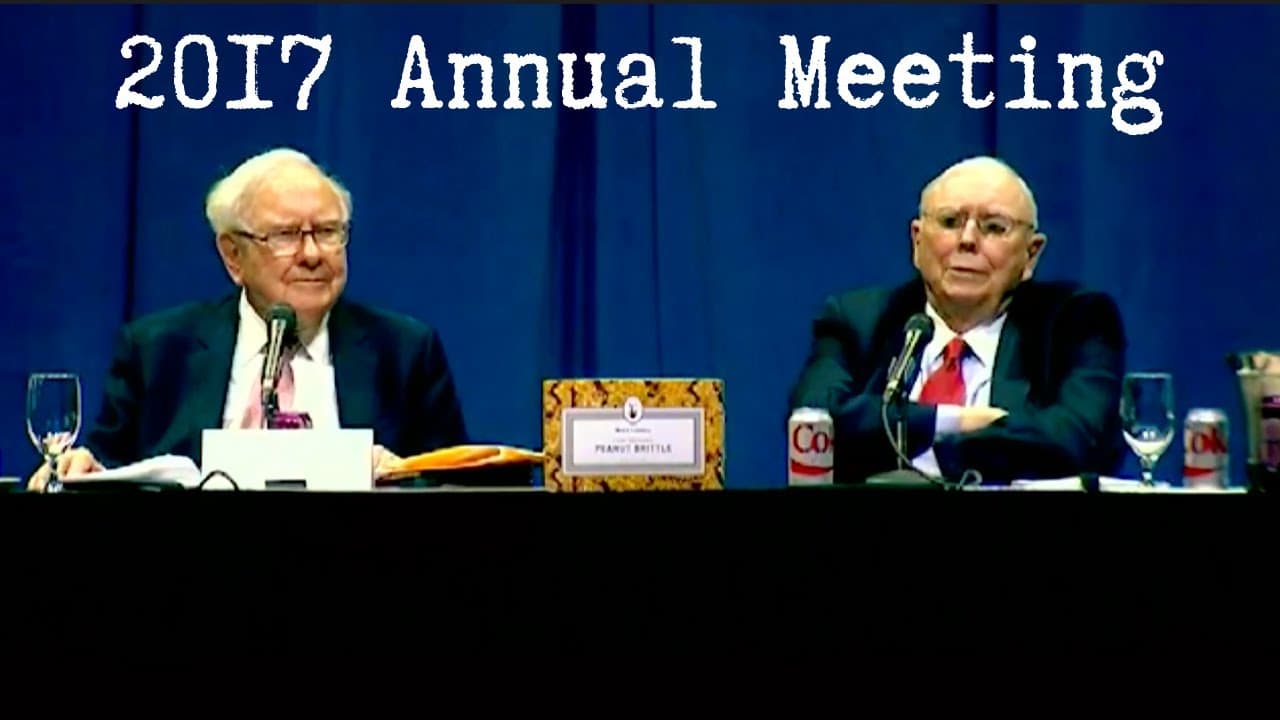
2017 Berkshire Hathaway Annual Meeting (Full Version)
TL;DR
The meeting centers on Berkshire's earnings context, insurance operations, and cash flow management. It highlights Geico growth, the growth of float, tax considerations, and the role of index funds as explained by Jack Bogle tribute. The Q and A session stimulates discussion with journalists and shareholders alike.
Transcript
thank you and good morning duh that's charlie i'm warren you can tell us apart because uh he can hear and i can see that's why we uh work together so well we usually have our specialty uh i'd like to welcome you to uh we got a lot of out-of-towners here and i'd like to welcome you to omaha it's a terrific it's a terrific city and charlie charlie's ... Read More
Key Insights
- X is that Berkshire sees intrinsic value as the main driver of value, not short term earnings forecasts, and emphasizes long term business quality over quarterly results.
- The key to Berkshire’s insurance strategy is Geico growing policyholders, while competitors reduce new business to minimize first year losses, allowing Berkshire to expand float and cash reserves.
- X is the rise in float by 14 billion in the first quarter, contributing to a larger cash position and greater financial flexibility for Berkshire.
- The 90 billion dollar level of net unrealized gains on March 31st is highlighted as the basis for potential reporting choices and tax considerations.
- Jack Bogle is recognized for creating index funds that lowered investment costs, with Berkshire highlighting the benefit to investors and noting Bogle’s 88th birthday as a milestone.
- The meeting underscores the importance of the 10-Q as a more comprehensive source for valuation compared to the quarterly summaries.
- The discussion acknowledges tax effects on gains and losses, noting a preference to realize losses in certain scenarios due to the 35 percent tax on gains.
- The overall tempo of the meeting is to educate and inform, with a structure of journalist analysts and audience Q and A to maximize understanding of Berkshire’s complex financial picture.
Install to Summarize YouTube Videos and Get Transcripts
Explore YouTube Video Summarizer or Get YouTube Transcript Extractor
Questions & Answers
Q: What is Berkshire's approach to earnings and the value of its businesses over time?
Berkshire emphasizes that real value comes from the intrinsic value of the businesses it owns rather than short term earnings forecasts. The management notes that one quarter can be volatile, but over time the focus remains on building and sustaining long term value. This approach guides decisions about when to realize gains or losses and how to interpret quarterly fluctuations in earnings.
Q: How does Geico contribute to Berkshire’s financial position in the first quarter?
Geico has grown significantly, with the first four months showing a surge in policyholders to seven hundred thousand, the highest level in memory. This growth contrasts with competitors that cut back on new business due to first year costs and higher first year loss ratios. The result strengthens Berkshire’s insurance operations and supports its float.
Q: What is meant by float and how did Berkshire change it in the first quarter?
Float refers to the funds Berkshire holds that come from insurance operations and other sources, not yet paid out as claims. In the first quarter, Berkshire increased its float by fourteen billion dollars, a sizable rise that enhances liquidity and investment capacity. This growth in float is a key driver of Berkshire’s cash and investment position.
Q: Why was Jack Bogle mentioned and what is his significance to investors?
Jack Bogle was recognized for advancing the index fund, which reduced investment costs for many investors and increased net returns over time. Berkshire notes that Bogle faced criticism initially but ultimately contributed billions in value to investors by lowering fees, making index funds widely accessible and influential in the investment world.
Q: What tax considerations are discussed in relation to gains and losses?
The discussion notes a 35 percent tax on gains, which influences Berkshire’s decision making about when to realize gains or losses. There is a slight preference described for taking losses if it is advantageous for tax reasons, and this factor may affect decisions as the year progresses toward December 31.
Q: What is the significance of the 10-Q versus the quarterly summary?
The Berkshire management points to the 10-Q as a more complete source for evaluating the business and its valuation than the quarterly summary. Investors are encouraged to consult the 10-Q for a fuller picture of intrinsic value and underlying performance.
Q: How does Berkshire view the broader meeting structure and audience participation?
The meeting includes a panel of journalists, analysts, and shareholders with a plan to rotate questions through the afternoon. After an initial set of questions, the session plans to open to the audience and overflow rooms if needed, ensuring broad participation and coverage of topics raised by attendees.
Q: What is the general outlook on the future despite short term earnings fluctuations?
The overarching message is to focus on building long term value rather than reacting to quarterly earnings noise. Berkshire expects to continue strengthening its businesses, expanding float, and maintaining liquidity and capital flexibility, with careful attention to tax considerations and the evolving investment environment.
Summary
Warren Buffett and Charlie Munger welcome attendees to Omaha and introduce Carrie Silva, who manages the annual meeting. They also introduce the directors of Berkshire Hathaway. Buffett discusses the company's earnings report, emphasizing the importance of intrinsic value over realized investment gains or losses. Munger adds that they have a slight preference for taking losses rather than gains, due to the tax effect. They then address questions about Berkshire's decentralized structure, driverless trucks and cars, their investment thesis for specific companies, and the profitability of their reinsurance deal with AIG.
Q: How does Berkshire's decentralized structure compare to Wells Fargo's decentralized corporate structure?
Berkshire operates on a more decentralized plan than any company of a similar size. They rely on principles of behavior rather than strict rules, and they believe that establishing the right culture and selecting the right managers and directors will result in better behavior and outcomes. They have a hotline and anonymous letter system in place for employees to report any issues or concerns, and they take prompt action when necessary.
Q: Are driverless trucks a threat to Berkshire's Burlington Northern railroad business?
Buffett and Munger believe that driverless trucks pose a greater threat than driverless cars to the railroad industry. They acknowledge that there are driver shortages in the trucking industry and that autonomous technology could improve truck safety and efficiency, which could narrow the cost advantage of railroads.
Q: How much time is spent reviewing Berkshire's stock holdings?
Buffett and Munger review Berkshire's stock holdings daily. They acknowledge that some of their core holdings, such as Wells Fargo, American Express, Coca-Cola, and United Airlines, have faced challenges and issues in recent years. However, they focus on the long-term competitive advantage, financial policies, and management of these companies, and they believe that their theses for holding these stocks remain intact.
Q: How confident are Buffett and Munger that Berkshire's reinsurance deal with AIG will be profitable?
Buffett and Munger express confidence in the deal, which involved Berkshire taking on liability for a portion of AIG's excess reserves in exchange for a premium. They note that every deal carries some level of risk and uncertainty, but they have a track record of successful transactions in this area. They project their payouts and expected returns conservatively, but acknowledge that their projections may be wrong.
Q: Which negotiation or business dealing stands out as notable or memorable in Buffett's career?
Buffett does not have a favorite negotiation, but he highlights the C's Candy acquisition as a significant learning experience. He emphasizes the power of a strong brand and the continuous learning that comes with making investment decisions. Munger adds that the pain of being in a lousy business can make one appreciate a good one, and that continuous learning has been crucial to Berkshire's success.
Takeaways
- Berkshire Hathaway operates on a decentralized structure, relying on principles of behavior and a hotline system to address any issues or concerns.
- Driverless trucks are seen as a greater threat to the railroad industry than driverless cars, with potential to narrow the cost advantage of railroads.
- Berkshire spends time reviewing its stock holdings daily, looking for companies with durable competitive advantages, strong financial policies, and trusted management teams.
- The reinsurance deal with AIG is viewed as a profitable opportunity, although there are uncertainties and risks involved.
- Continuous learning has been key to Berkshire's success and has informed its investment decisions.
Summary & Key Takeaways
-
The session outlines Berkshire's approach to earnings and valuation, emphasizing long term value over quarterly numbers and the importance of intrinsic value in buying or selling businesses. It notes the preference to defer gains if tax considerations favor it and explains how float contributes to financial strength.
-
Geico is highlighted as a success story with rapid growth in policyholders, while other competitors reduce new business to avoid first year losses, a dynamic Berkshire leverages to its advantage. The meeting also celebrates Jack Bogle and his impact on investors and fees.
-
The day includes introductions of key staff and directors, discussions of the 10-Q and its more comprehensive valuation metrics, and plans for the afternoon Q and A with questions from journalists and shareholders, ending with a broader participation from overflow rooms if needed.
Read in Other Languages (beta)
Share This Summary 📚
Summarize YouTube Videos and Get Video Transcripts with 1-Click
Try YouTube Summary with ChatGPT & Claude or YouTube Transcript Generator
Explore More Summaries from Investor Archive 📚
Summarize YouTube Videos and Get Video Transcripts with 1-Click
Try YouTube Summary with ChatGPT & Claude or YouTube Transcript Generator