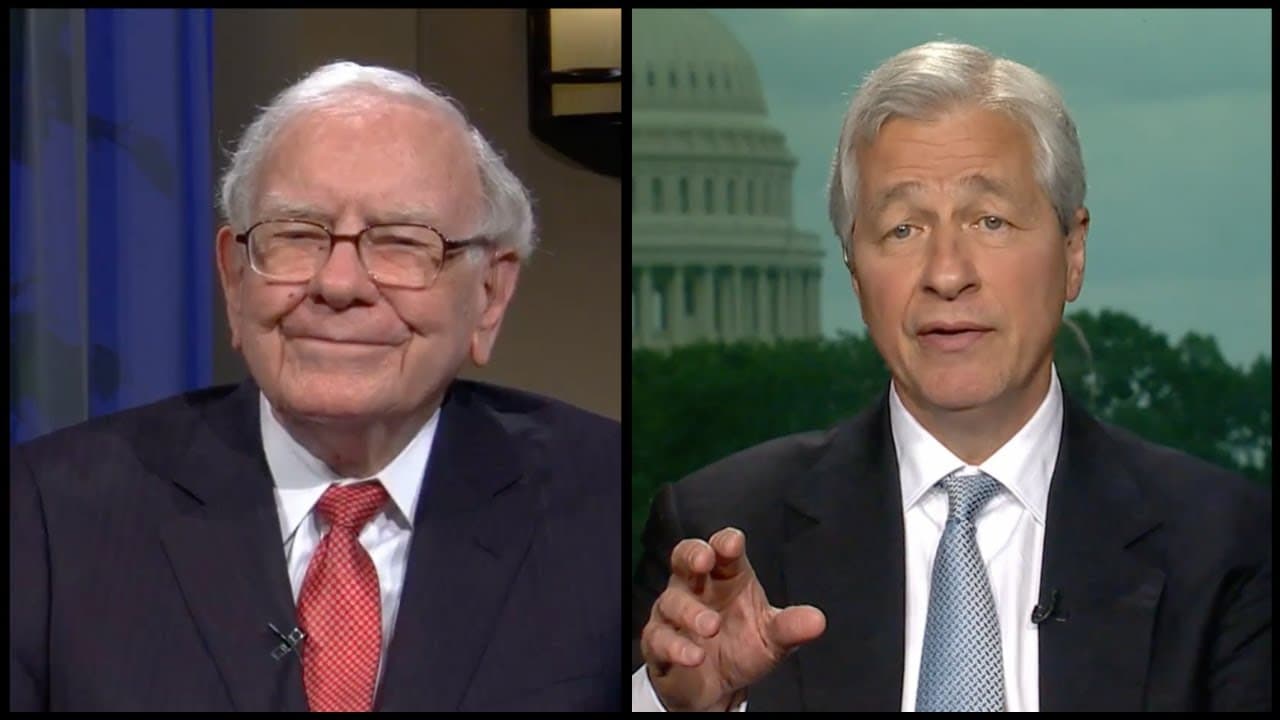
Warren Buffett | Jamie Dimon | The End Of Short-Termism | June 6, 2018
TL;DR
Companies should stop issuing quarterly earnings guidance because fixed short-term targets can pressure managers to sacrifice investments, distort operations, or even manipulate reported results. Buffett and Dimon argue that executives should instead make decisions as if they will own the business for decades, while keeping shareholders informed about important risks, opportunities, investments, and long-term performance.
Transcript
in an op-ed out this morning in the wall street journal business roundtable chairman jamie dimon announcing the group's support of companies moving away from guidance on quarterly earnings while this isn't a new idea from the jp morgan chief executive the backing of the business roundtable and big financial names like warren buffett brings a new tw... Read More
Key Insights
- Quarterly earnings guidance can create incentives that conflict with a company’s long-term interests. Managers who feel obligated to deliver a forecast may delay valuable spending, alter operations, or make decisions they would reject if they were focused on future earnings and durable business performance.
- Short-term pressure can spread throughout an organization. Dimon says expectations can reach divisional and sales levels, encouraging employees to cut marketing, postpone branch openings, sell products more cheaply, or change other activities simply to satisfy immediate revenue or profit targets.
- A long-term ownership mindset improves business decisions. Buffett tells managers to imagine that the company is the only business their family can own for 50 years and that they cannot sell it, a perspective intended to prioritize enduring value over quarterly performance.
- Published predictions can become self-reinforcing commitments. Buffett says executives may attach their reputations and egos to meeting specific numbers, while investor relations teams reinforce expectations, increasing the temptation to take foolish actions or, in some cases, make up results.
- Eliminating guidance does not mean eliminating disclosure. Dimon specifically distinguishes earnings forecasts from transparency, openness, and quarterly reporting, while Buffett asks companies to communicate the information a significant long-term partner would need about performance, risks, opportunities, and investments.
- Quarterly results are affected by variables outside management’s control. Dimon identifies weather, commodity prices, volumes, and competitor pricing as influences, arguing that leaders should make sound decisions despite temporary fluctuations and trust that strong long-term actions will ultimately serve shareholders.
- Precise short-term earnings targets can be especially dangerous in businesses involving estimates. Buffett says an insurance company can report a desired number for a while, illustrating how pressure to produce exact quarterly earnings can encourage technically accepted figures that do not reflect sound judgment.
- The Business Roundtable initiative is presented as a first step toward better corporate governance. Dimon says roughly 60 members provided annual guidance and more than 20 provided quarterly guidance, while expressing his personal preference to eventually eliminate annual earnings guidance as well.
Install to Summarize YouTube Videos and Get Transcripts
Explore YouTube Video Summarizer or Get YouTube Transcript Extractor
Questions & Answers
Q: Why should companies stop issuing quarterly earnings guidance?
Companies should stop quarterly earnings guidance because fixed forecasts can turn meeting a short-term number into management’s primary objective. Buffett and Dimon say this pressure may cause executives to cut useful spending, postpone investments, alter pricing, or distort reported performance. Removing the target gives leaders greater freedom to pursue decisions that support future earnings and long-term business strength.
Q: How can quarterly forecasts damage long-term investment?
Quarterly forecasts can make worthwhile investments appear undesirable when their immediate costs reduce current earnings. Dimon gives examples such as marketing, new branches, data centers, systems, research, and other necessary spending. A strong board should support these expenditures when they improve future prospects, even if they cost hundreds of millions of dollars during the current quarter.
Q: What long-term mindset does Buffett recommend for managers?
Buffett recommends that managers imagine the company is the only business they and their families can own for 50 years, and that they cannot sell it. Under that assumption, leaders are more likely to protect the company’s lasting economics. They become less concerned with earnings today or next week and more focused on decisions that remain sensible for decades.
Q: What information should companies provide instead of earnings forecasts?
Companies should provide the information that an operating partner would share with a significant owner who is not involved in daily management. Buffett wants updates on important developments, upside possibilities, downside risks, investments being made ahead of demand, and initiatives that may pay off several years later. Dimon also emphasizes explaining performance, future thinking, and investment priorities.
Q: Does ending quarterly guidance mean ending quarterly reporting?
Ending quarterly earnings guidance does not mean ending quarterly reporting, transparency, or openness. Dimon explicitly separates forecasts from the obligation to keep investors informed. Companies can continue reporting results and explaining strategy without promising a precise future earnings figure. The goal is to remove an artificial target while preserving useful communication between management, boards, and shareholders.
Q: How can executives change short-term profit numbers?
Executives can influence short-term numbers by cutting marketing, delaying branch openings, postponing data centers or systems, reducing compensation, changing interest-rate exposure through swaps, or selling more products at lower prices to reach a revenue target. Dimon compares some cuts to reducing airplane maintenance, because they may improve immediate figures while creating harmful consequences later.
Q: Why can repeated success at meeting forecasts become dangerous?
Repeatedly meeting or beating forecasts can create a reputation that management then feels compelled to preserve. Buffett says predictions engage executives’ egos, while investor relations departments may reinforce the expectation. Because business conditions do not develop with quarterly precision, leaders can eventually resort to foolish operating decisions or even make up numbers when ordinary performance misses the target.
Q: What economic conditions did Dimon describe in June 2018?
Dimon described consumers as financially healthy, with improving incomes and wages, low debt levels, and strong credit written since the Great Recession. He also cited high business and consumer sentiment, open markets, and a housing shortage. Although he said he disliked forecasting, he viewed several more years of growth as logically possible and believed growth was strengthening.
Summary
In an interview on CNBC, Business Roundtable Chairman Jamie Dimon and Berkshire Hathaway CEO Warren Buffett discuss their support for companies moving away from quarterly earnings guidance. They emphasize the importance of long-term corporate governance and the negative impact of short-term forecasts on decision-making. They also address topics such as the current state of the economy, trade, and their joint healthcare initiative.
Questions & Answers
Q: Why did Jamie Dimon and Warren Buffett express their support for companies moving away from quarterly earnings guidance?
Jamie Dimon explains that America's largest companies have an obligation to deliver in the long run and that short-term forecasts can often lead to counterproductive actions. He states that by eliminating the pressure to meet quarterly earnings, companies can focus on long-term strategies that benefit the business and its stakeholders.
Q: What example of negative impact from short-term forecasts does Warren Buffett provide?
Warren Buffett highlights that companies can become fixated on meeting short-term earnings predictions, which leads to making decisions that are not in the best interest of long-term growth. He argues that quarterly earnings forecasts are not only faulty in sending the wrong message, but they also encourage employees to prioritize short-term performance rather than making decisions that benefit the business in the long run.
Q: Have Jamie Dimon and Warren Buffett seen instances where short-term forecasts have gone wrong?
Both Dimon and Buffett recount instances where companies have allowed short-term forecasts to drive decision-making. They explain that this practice can lead to unethical behavior, such as inflating numbers or making poor decisions that may harm the company's long-term goals. They emphasize the importance of a strong board and sound corporate governance to prevent these issues from arising.
Q: What does Jamie Dimon believe this move away from quarterly guidance means for companies in the Business Roundtable?
Dimon suggests that companies in the Business Roundtable, which represents around 200 companies, should consider moving away from issuing quarterly guidance altogether. He believes that focusing on the long-term outlook and being transparent about investment opportunities, rather than meeting short-term forecasts, will lead to stronger corporate governance and better decision-making.
Q: According to Warren Buffett, what kind of information does he want to hear from companies?
Warren Buffett shares that he wants to hear from companies as if he were a sole partner in the business. He values updates on what is important to him as an investor and wants companies to openly discuss investment opportunities, risks, and strategies. He encourages companies to prioritize long-term thinking and make decisions that would be beneficial if they were to partner for 50 years.
Q: How does Jamie Dimon explain the concept of being free to drop quarterly guidance to CEOs?
Jamie Dimon states that being free to drop quarterly guidance means CEOs can focus on making the right long-term decisions for their company's growth, even if it affects short-term earnings. He highlights that good CEOs should communicate with their board and shareholders about investment opportunities and other factors that influence the business, without feeling obligated to meet quarterly earnings expectations.
Q: How do Jamie Dimon and Warren Buffett view the current state of the economy?
Jamie Dimon believes the current state of the economy in the U.S. is strong, with consumers in good financial shape, low debt levels, and overall positive business sentiment. He predicts possible years of growth and highlights additional stimulus from tax reform and other budgetary measures. Warren Buffett agrees that the economy is currently strong and states that America will be far ahead in the long run, but refrains from making specific predictions about short-term growth.
Q: Do Jamie Dimon and Warren Buffett believe the stock market is affordable?
Jamie Dimon believes that the time to buy stocks is when an investor believes they are getting a lot for their money. He emphasizes the importance of the long-term outlook for stocks and encourages investors not to focus solely on short-term projections. Warren Buffett agrees with Dimon's perspective and mentions that he continues to buy stocks because he believes in the long-term prospects of the American market.
Q: How does Jamie Dimon view the potential risks of trade, specifically in relation to tariffs?
Jamie Dimon points out that the Business Roundtable conducted a survey that revealed 80-90% of CEOs are concerned about the negative implications of trade tensions. He explains that while there are valid issues regarding trade, tariffs are not the best solution. He believes negotiations with countries like China should focus on fair competition, market access, and resolving other trade-related issues instead of resorting to tariffs.
Q: What is Jamie Dimon's view on the long-term outlook for the euro?
Jamie Dimon states that he believes the euro will still exist in 10 years. He emphasizes the importance of preventing any country from exiting the euro, as it currently represents catastrophic consequences for those who do. He expresses support for the European Union and the negotiated reforms being made, such as fiscal reform and regulatory adjustments, which can strengthen the union over time.
Q: Do Jamie Dimon and Warren Buffett believe that business leaders should get involved in politics?
Both Dimon and Buffett believe that business leaders should collaborate with and be involved in government affairs. They argue that business has an important role to play in addressing societal issues and supporting government activities. While they acknowledge the challenges of political leadership, they encourage business leaders to engage in politics and contribute to positive change.
Q: Are Jamie Dimon and Warren Buffett considering running for public office?
Jamie Dimon states that he has no intention of running for president, but supports business leaders getting involved in politics. Similarly, Warren Buffett insists that he is not running for any political office but acknowledges the value of business leaders participating in government activities to promote collaboration and positive outcomes.
Q: What progress has been made on the joint healthcare initiative involving Jamie Dimon, Warren Buffett, and Jeff Bezos?
Warren Buffett confirms that they have made significant progress on the joint healthcare initiative and expect to announce a new CEO for the venture within the next two weeks. Jamie Dimon credits the progress to Todd Combs and expresses confidence in the chosen CEO. They both emphasize the importance of improving healthcare outcomes and reducing costs for employees, ultimately aiming to benefit all Americans.
Q: How have Jamie Dimon and Warren Buffett addressed employee concerns about their healthcare initiative?
Jamie Dimon reassures employees that the joint healthcare initiative aims to make improvements and provide better healthcare options. He emphasizes that employees' satisfaction and wellness are essential, and the initiative intends to reduce costs while enhancing the quality of care. Warren Buffett adds that employees are interested in the topic and acknowledges the challenges of making significant changes but claims that potential CEOs recognized the opportunity for improvement and feasibility of the initiative.
Q: What is Warren Buffett's perspective on the idea of business leaders entering politics?
Warren Buffett agrees with Jamie Dimon's stance on collaboration between businesses and governments. He supports business leaders engaging in politics to address critical issues and contribute to societal progress. While Buffett acknowledges the difficulty of the political path, he believes it is essential for business and government to work together for the betterment of the nation.
Q: Do Jamie Dimon and Warren Buffett dislike Bitcoin?
Both Jamie Dimon and Warren Buffett express skepticism about Bitcoin. Warren Buffett does not consider himself an expert on the subject, but warns individuals to be cautious and points out the absence of intrinsic value in Bitcoin. Dimon indicates that he sets a high standard for disliking Bitcoin but does not explicitly state who dislikes it more.
Q: Does Warren Buffett plan to be involved with Uber following talks with Dara Khosrowshahi?
Warren Buffett reveals that while talks with Dara Khosrowshahi were held and he has great admiration for Khosrowshahi, they did not come to an agreement. Buffett does not rule out the possibility of future involvement with Uber, but deems it unlikely. He mentions that negotiations where an agreement cannot be reached are not uncommon for Berkshire Hathaway.
Summary & Key Takeaways
-
Jamie Dimon and Warren Buffett support moving companies away from quarterly earnings forecasts. They argue that precise short-term targets can pressure executives, divisions, sales teams, and investor relations departments to prioritize meeting published numbers over decisions that strengthen the business and create future earnings for long-term owners.
-
Buffett says companies should be managed as though their owners could hold only that business for 50 years and could never sell it. He wants executives to communicate as operating partners would, covering important developments, upside and downside possibilities, investments being made today, and potential payoffs several years later.
-
Dimon distinguishes eliminating earnings guidance from reducing transparency or ending quarterly reporting. Companies should still explain performance, strategy, research, capital expenditures, systems, and future investments. He says quarterly results can also reflect weather, commodity prices, volumes, and competitor pricing, factors that executives may not fully control.
Read in Other Languages (beta)
Share This Summary 📚
Summarize YouTube Videos and Get Video Transcripts with 1-Click
Try YouTube Summary with ChatGPT & Claude or YouTube Transcript Generator
Explore More Summaries from Investor Archive 📚



Summarize YouTube Videos and Get Video Transcripts with 1-Click
Try YouTube Summary with ChatGPT & Claude or YouTube Transcript Generator