Warren Buffett Celebrates 50 Years Of Berkshire Hathaway | March 2, 2015
TL;DR
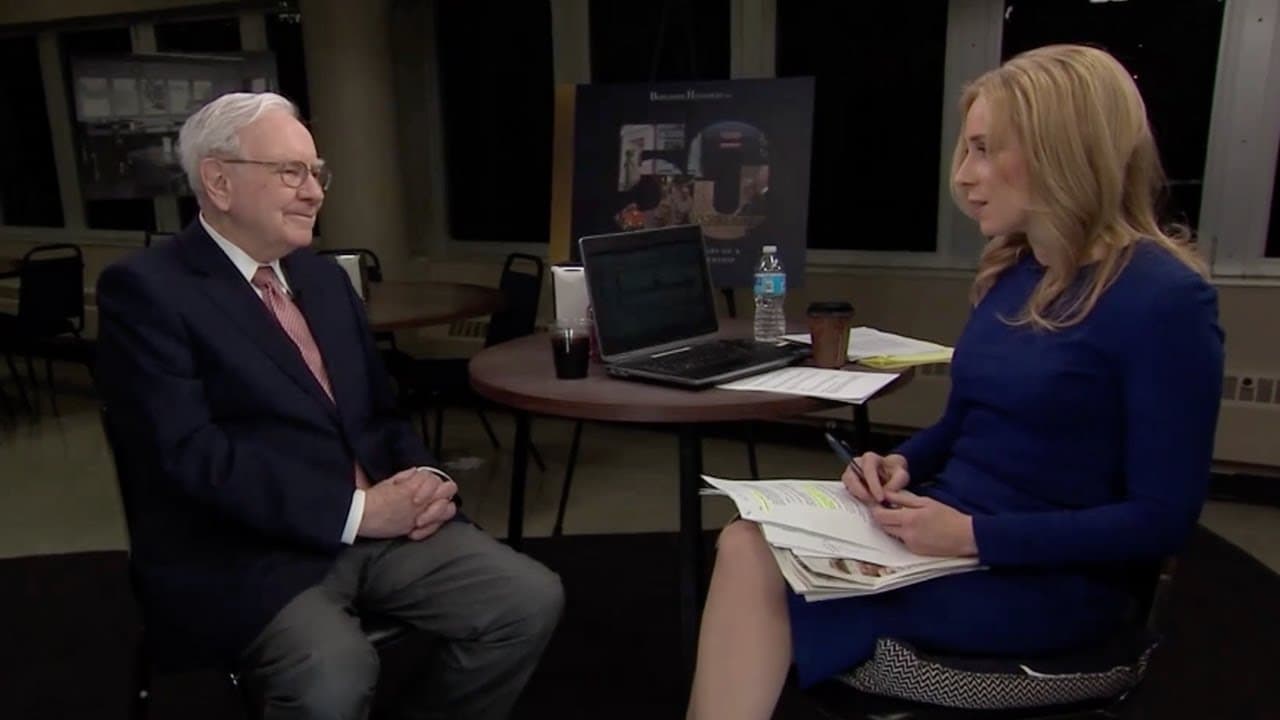
Warren Buffett built Berkshire Hathaway gradually by acquiring businesses he understood, retaining capable managers, making successful investments, and allowing compound interest to work over decades. National Indemnity, purchased for $8.6 million in 1967, reached about $111 billion in GAAP net worth. Buffett also emphasizes reasonable purchase prices and holding shares for at least five years. Read on for details about Berkshire’s growth, leadership, and investment approach.
Transcript
warren thank you so much for joining us well thanks for coming i know this is 50 years since berkshire hathaway has been under your control and we have a lot that we're going to be talking about with that this morning oh we'll do it day by day we will day by day 50 years it's coming we've got him coming up with a lot to talk about in just a moment ... Read More
Key Insights
- Berkshire's long-term growth is the result of strong operating managers, successful investments, and compound interest working together. Buffett characterizes the process as occurring one day at a time, with useful acquisitions and business additions gradually expanding the company's value and financial capacity.
- National Indemnity is one of Buffett's best transactions because the insurance company became a foundation for Berkshire's expansion. Buffett says its growth came from capable insurance professionals, investment results, compounding, and substantial additions such as a reinsurance operation and the BNSF railroad.
- Berkshire's succession plan is detailed and ready for rapid implementation if Buffett suddenly cannot continue. The board has discussed succession repeatedly, has a specific person in mind, and understands how the transition would work, although Buffett does not publicly identify that individual in the transcript.
- Ajit Jain and Greg Abel are not jockeying against each other for Berkshire's leadership, according to Buffett. Charlie Munger independently highlighted both executives as excellent managers, and Buffett says each would remain among the company's most important active participants under its future leadership structure.
- Charlie Munger influenced Buffett's management of Berkshire long before becoming its vice chairman. Buffett describes their relationship as a continuous exchange resembling communication between twin brothers, with Munger shaping decisions even before his Berkshire ownership and formal position resulted from the Blue Chip Stamps merger.
- Berkshire's annual letter and shareholder meeting function as teaching venues for Buffett and Munger. Buffett says he has enjoyed teaching since early adulthood and uses these forums to explain business and investing principles while allowing shareholders to ask questions for as long as they wish.
- Berkshire's enormous size restricts Buffett's available investment opportunities because a purchase must be very large to materially affect the company's net worth. Smaller opportunities that could once transform his personal results no longer have enough impact, making his present investment problem fundamentally different from his earlier one.
- Long-term ownership is essential because Buffett and Munger do not claim to know how Berkshire or other stocks will perform in the near term. Buffett believes that sensible activities, compound interest, a reasonable purchase price, and at least a five-year holding period allow business value to become more influential.
Install to Summarize YouTube Videos and Get Transcripts
Explore YouTube Video Summarizer or Get YouTube Transcript Extractor
Questions & Answers
Q: How did Warren Buffett build Berkshire Hathaway over 50 years?
Buffett says Berkshire grew “one day at a time” as he kept adding to businesses he liked. Capable operating managers, successful investments, acquisitions, and compound interest worked together to increase its value over decades.
Q: Why was National Indemnity important to Berkshire Hathaway’s growth?
Buffett calls National Indemnity, purchased for $8.6 million in 1967, one of his best deals. Its GAAP net worth eventually reached about $111 billion through strong insurance management, successful investments, compounding, and additions such as reinsurance operations and BNSF.
Q: How did Ajit Jain contribute to National Indemnity?
Ajit Jain joined Berkshire in the mid-1980s and developed a reinsurance operation. Buffett estimates that operation probably added $30 billion to $40 billion to National Indemnity’s net worth over time.
Q: Why is BNSF owned through National Indemnity?
National Indemnity already held a significant investment in Burlington Northern when Berkshire offered to acquire the entire railroad. Buffett decided to complete the purchase through National Indemnity, giving the insurance company additional financial strength.
Q: What succession plan did Berkshire Hathaway have for Warren Buffett?
Buffett says Berkshire’s board had discussed succession repeatedly and had one person in mind. The plan was precise, detailed, and ready to be implemented in less than 24 hours if he suddenly became unable to serve, although he did not identify the successor.
Q: Were Ajit Jain and Greg Abel competing to succeed Warren Buffett?
Buffett explicitly says there was no jockeying between Ajit Jain and Greg Abel. Charlie Munger independently identified both as excellent managers, but neither executive knew whom the board had selected.
Q: Why does Warren Buffett use Berkshire’s shareholder meeting as a teaching forum?
Buffett views the annual report and shareholder meeting as opportunities to explain business and investing principles. Even Berkshire’s earliest meetings, attended by roughly eight to twelve people in National Indemnity’s lunchroom, remained open as long as shareholders wanted to ask questions.
Q: How long did Warren Buffett say investors should hold Berkshire Hathaway shares?
Buffett says investors unwilling to hold Berkshire for at least five years should not buy the stock. He and Charlie Munger do not claim to predict near-term stock movements, so the approach depends on sensible operations, a reasonable purchase price, and time for compounding and underlying business value to emerge.
Summary
In this video, Warren Buffett discusses various topics including the 50-year anniversary of Berkshire Hathaway, the success of National Indemnity, the succession plan for Berkshire Hathaway, his long-term investing strategy, and his thoughts on specific stocks like IBM and Deere. He also talks about the importance of understanding accounting and the impact of climate change on insurance rates.
Questions & Answers
Q: How did Warren Buffett pick the location for the annual shareholders meeting?
Warren picked the location because it was larger than his office at the time and he wanted something grand to impress the shareholders. It had vending machines to supplement the income of the company.
Q: How did Warren Buffett grow the net worth of National Indemnity to $111 billion?
Warren grew the net worth of National Indemnity through a combination of adding on to the business, hiring good people in the insurance business, taking advantage of compound interest, and making successful investments. The addition of a reinsurance operation developed by Ajit Jain also contributed significantly to the growth.
Q: Why is the net worth of National Indemnity higher than reported due to the ownership of Burlington Northern?
Warren bought stock in Burlington Northern through National Indemnity, making it a significant investment for the company. By owning the railroad within National Indemnity, they carry it at a lower price compared to its actual worth, which increases the overall net worth of National Indemnity.
Q: Who is the successor of Berkshire Hathaway?
Warren Buffett and Charlie Munger have a precise plan in mind for the succession of Berkshire Hathaway. The board has discussed it at every meeting for many years. While it has not been officially announced, both Ajit Jain and Greg Abel are considered excellent managers and potential successors.
Q: Did Warren Buffett change his letter based on what Charlie Munger wrote?
Warren and Charlie each wrote their own letters about the last 50 years and the next 50 years without changing a word based on what the other had written. Charlie mentioned Ajit Jain and Greg Abel in his letter, which was news to Warren. However, they both think highly of each of them.
Q: Are both Ajit Jain and Greg Abel aware of who the next successor is?
No, neither Ajit Jain nor Greg Abel knows who the next successor is. The board has a precise plan in mind for the succession of Berkshire Hathaway, and it has been discussed at every meeting for many years.
Q: How long has Warren Buffett been working with Charlie Munger?
Warren and Charlie have been business partners since they met in 1959. Charlie officially joined Berkshire Hathaway when they merged in 1982, but they had been discussing business and shared a close relationship for many years before that.
Q: Why did Warren Buffett sell all of ExxonMobil?
Warren sold all of ExxonMobil because he believed he could better deploy the money elsewhere. While he considers ExxonMobil a wonderful company, its earning power has been significantly diminished due to the decline in oil prices.
Q: Why is Warren Buffett buying more IBM shares despite its declining revenue?
Warren likes IBM because it has been doing what he likes over the years. The company has been reducing its outstanding shares through buybacks and the stock has gone down, allowing for more shares to be purchased at a cheaper price. IBM's revenue decline was expected, and Warren believes in the company's ability to adapt and make progress over time.
Q: Is Warren Buffett a better investor in his 70s to 80s compared to his 40s to 60s?
Warren acknowledges that he has a different investment problem now compared to when he was younger. The universe of investments that can significantly impact Berkshire Hathaway's net worth is more limited now. He focuses on buying large positions in companies where the investment can have a significant effect on Berkshire's net worth over time.
Q: Why does Warren Buffett recommend a five-year time horizon for owning Berkshire shares?
Warren recommends a five-year time horizon because he believes that, over time, the value of Berkshire's businesses will increase as they continue to make sensible investments. He admits that he does not know what the stock will do in the short or intermediate term, and people should make their own decisions based on their own analysis.
Takeaways
Warren Buffett discussed various topics including his 50-year anniversary at Berkshire Hathaway, the success of National Indemnity, the succession plan for Berkshire Hathaway, his investing strategy, and specific investments like IBM and Deere. He emphasized the importance of understanding accounting and making investment decisions based on individual analysis. Warren also mentioned how climate change has not had a significant adverse effect on insurance rates in the past five years.
Summary & Key Takeaways
-
Buffett describes Berkshire Hathaway's transformation as a gradual process driven by businesses he liked, capable insurance leaders, successful investments, and compound interest. National Indemnity became especially valuable, while the addition of major operations increased its financial strength. The account emphasizes patient accumulation rather than a single decisive breakthrough.
-
Berkshire has a detailed succession plan that its board regularly discusses and could implement quickly if Buffett became unable to serve. Buffett rejects the idea that Ajit Jain and Greg Abel are competing for the position. He says both would remain exceptionally important participants in the company's future leadership and operations.
-
Buffett views Berkshire's annual report and shareholder meeting as teaching platforms. His investment challenge has changed because Berkshire now requires very large commitments for purchases to meaningfully affect its value. He therefore stresses patient ownership, reasonable purchase prices, sensible business decisions, and the long-term effect of compounding over short-term market forecasts.
Read in Other Languages (beta)
Share This Summary 📚
Summarize YouTube Videos and Get Video Transcripts with 1-Click
Try YouTube Summary with ChatGPT & Claude or YouTube Transcript Generator
Explore More Summaries from Investor Archive 📚


Summarize YouTube Videos and Get Video Transcripts with 1-Click
Try YouTube Summary with ChatGPT & Claude or YouTube Transcript Generator