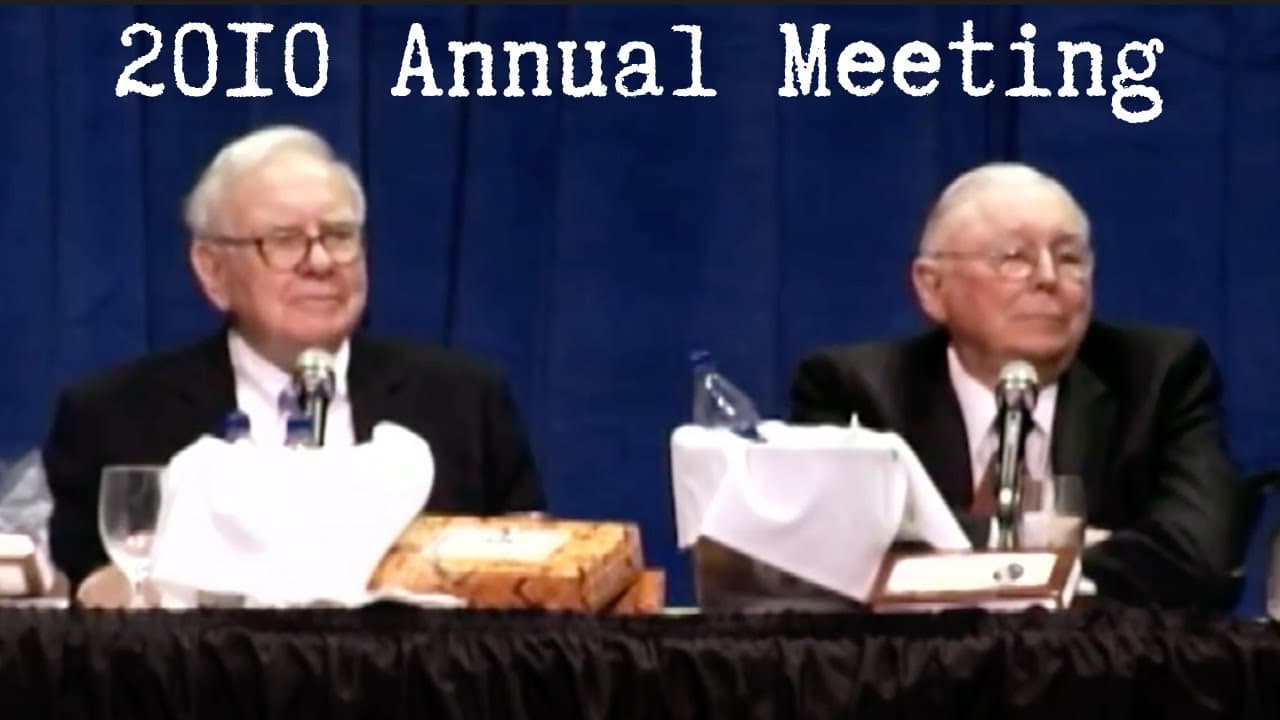
2010 Berkshire Hathaway Annual Meeting (Full Version)
TL;DR
Berkshire evaluates progress through operating earnings and the long-term buildup of enterprise value, not quarterly earnings per share or short-term investment results. Buffett also argued that ABN Amro lost money on the Abacus transaction because it accepted a paid credit-guarantee risk, while Goldman retained an unsold portion and reportedly lost money itself.
Transcript
[Applause] good morning i'm warren he's charlie he can hear i can see we work together for that reason i'd like to make one correction in the movie my fastball was filmed in slow motion they tried it the regular way and you couldn't even see it so [Applause] our uh approach today will be uh to announce a couple of things uh our earnings and uh intr... Read More
Key Insights
- Berkshire’s operating businesses showed a stronger recovery in March and April after several months of uneven improvement. Buffett specifically identified the railroad, Marmon, and Iscar as businesses serving broad industry where activity had risen, although conditions remained well below those of a couple of years earlier.
- Operating earnings are Berkshire’s preferred measure for evaluating current business performance. Buffett said quarterly investment and derivative figures can be meaningful over many years, especially as capital gains accumulate, but they reveal little when isolated within a single quarter.
- Berkshire focuses on the buildup of enterprise value rather than quarterly earnings per share. Buffett argued that concentrating excessively on a quarterly or annual figure is unhelpful for investors and potentially damaging for managers responsible for producing the reported result.
- Precise earnings targets can encourage subtle manipulation. Buffett described a study of thousands of earnings reports that found a statistically impossible shortage of results ending in four-tenths of a cent, suggesting that some accounting departments found another tenth so reported earnings could round upward.
- Reputation is treated as a critical institutional asset at Berkshire. The question about Goldman Sachs invoked Buffett’s earlier warning to Salomon employees that losing money could be tolerated, while losing even a shred of the firm’s reputation would provoke a ruthless response.
- Goldman Sachs was described as one of the losers in the Abacus transaction. Buffett said Goldman apparently could not sell one part of the transaction, retained it, and lost what he characterized as roughly 90 or 100 million dollars rather than profiting from that retained exposure.
- ABN Amro’s loss arose from guaranteeing ACA’s credit. The bank accepted about 900 million dollars of risk and received 17 basis points, or approximately 1.6 million dollars, for providing the guarantee. When ACA failed, ABN Amro had to pay under that commitment.
- Credit guarantees require independent judgment about the party being backed. Buffett compared ABN Amro’s role with Berkshire’s experience guaranteeing other insurers, noting that Berkshire had made money from such arrangements but also suffered losses in the early 1970s after guaranteeing dishonest counterparties.
Install to Summarize YouTube Videos and Get Transcripts
Explore YouTube Video Summarizer or Get YouTube Transcript Extractor
Questions & Answers
Q: Why does Berkshire focus on operating earnings?
Berkshire focuses on operating earnings because they more directly reflect the performance of its underlying businesses. Buffett said quarterly results from investments and derivatives do not mean much in isolation, even though accumulated capital gains can add substantial net worth over many years. His preferred perspective is the long-term buildup of value across the enterprise as a whole.
Q: Why does Buffett discourage quarterly earnings targets?
Buffett discourages quarterly earnings targets because they can distort managerial behavior. If managers are told to deliver an exact figure, they may be tempted to adjust decisions or accounting judgments to reach it. He cited research finding an implausibly small number of earnings results ending in four-tenths of a cent, which suggested efforts to cross the threshold for rounding upward.
Q: How was Berkshire’s business recovery progressing in 2010?
The recovery in Berkshire’s businesses had shifted from uneven improvement to stronger momentum in March and April. Buffett pointed to the railroad, Marmon, and Iscar as examples of operations serving broad industry that were seeing a meaningful uptick. He cautioned that activity was still a long way from where it had been a couple of years earlier.
Q: What happened to Goldman Sachs in the Abacus transaction?
Buffett described Goldman Sachs as one of the transaction’s losers. He said Goldman did not intend to lose money, but apparently could not sell one portion of the deal and therefore kept it. According to his account, that retained position produced a loss of roughly 90 or 100 million dollars for Goldman.
Q: Why did ABN Amro lose money on the Abacus deal?
ABN Amro lost money because it effectively guaranteed the credit of ACA. The bank accepted about 900 million dollars of exposure and received 17 basis points, approximately 1.6 million dollars, as compensation. ACA later went broke, so ABN Amro was required to honor the guarantee and pay the amount covered by its commitment.
Q: What does fronting mean in an insurance transaction?
Fronting means placing a stronger company’s guarantee behind another party’s credit or policy. Buffett explained that customers may reject the standalone credit of a particular insurer but accept its policy if Berkshire guarantees payment. The guarantor receives compensation, yet it must pay if the original party fails to meet the guaranteed obligation.
Q: What lesson did Buffett draw from credit guarantees?
A credit guarantee requires careful judgment because the guarantor becomes responsible if the original party cannot or will not pay. Buffett said Berkshire had earned substantial money from guarantees over the years, but it also lost a fair amount in the early 1970s after backing parties he described as dishonest. The guarantor must therefore evaluate the underlying credit independently.
Q: How does Berkshire evaluate long-term business success?
Berkshire evaluates success by considering the enterprise as a whole and tracking the buildup of value over time. Buffett does not regard quarterly earnings per share or short-term investment fluctuations as reliable measures by themselves. Operating performance and cumulative gains or losses matter more because they show whether the company is creating durable economic value across years.
Summary
Warren Buffett and Charlie Munger discuss earnings, introduce directors, and answer questions at the annual meeting. They address topics such as Berkshire's investment in Goldman Sachs, financial reform legislation, and collateral requirements for derivative contracts.
Questions & Answers
Q: What transaction do Buffett and Munger discuss first?
They discuss the Abacus transaction, in which Goldman Sachs and Abn Ambro were the main participants. Buffett explains the details of the transaction and the parties involved. He also emphasizes the importance of having proper knowledge and understanding when insuring bonds or guaranteeing credit.
Q: What does Buffett think about the allegation against Goldman Sachs?
Buffett does not hold the allegation against Goldman Sachs. He states that the allegation alone does not mean losing reputation. He also mentions the long-standing positive relationship between Berkshire Hathaway and Goldman Sachs, as well as the benefits of Berkshire's investment in the company's preferred stock.
Q: What are Buffett's thoughts on financial reform legislation?
Buffett acknowledges that he does not know the full impact of the pending financial reform legislation. He highlights the need for change in the regulatory system and the permissive nature of the previous system that contributed to the financial crisis. Buffett favors a more restricted and simplified mode of business for commercial banks and investment banks.
Q: How would collateral requirements affect Berkshire Hathaway?
Berkshire would not be required to post collateral for its existing derivative contracts under the current bill. Buffett believes that the chances of being deemed a danger to the system are low compared to other larger institutions. He also mentions that if collateral requirements were imposed retroactively, Berkshire would comply but would expect fair compensation for the change. Buffett and Munger express their opposition to retroactive collateral requirements and provide examples of other companies that share the same stance.
Q: How does Munger feel about collateral requirements in existing contracts?
Munger believes that it would be unfair and unconstitutional to require collateral in existing contracts, as it would be like changing the terms of a contract after it has been agreed upon. He points out that many companies, including IBM and Ford, oppose such requirements and mentions Berkshire's indifference to future collateral requirements as long as they are adequately compensated.
Summary & Key Takeaways
-
Berkshire’s preliminary first-quarter figures showed no major surprises. Buffett said a previously uneven recovery appeared stronger in March and April, particularly among businesses serving broad industry, including the railroad, Marmon, and Iscar. Activity remained far below levels from a couple of years earlier, but recent trends had improved noticeably.
-
Buffett urged shareholders to emphasize operating earnings and the long-term buildup of value. Quarterly investment and derivative results can fluctuate without revealing much about underlying performance. Berkshire also avoids emphasizing earnings per share because precise short-term targets may encourage managers and accounting departments to manipulate reported results to meet expectations.
-
Discussing the SEC complaint involving Goldman Sachs and the Abacus transaction, Buffett focused on the underlying credit decisions. He said Goldman retained an unsold portion and lost money, while ABN Amro guaranteed ACA’s credit for a small fee. When ACA failed, ABN Amro had to satisfy the guarantee.
-
Key Insights Y_n0GZCF94z7DJ3lMWaUj6w== not found in schema
-
Q_and_A Y_n0GZCF94z7DJ3lMWaUj6w== not found in schema
-
Key Insights YUo7ebD6SFXeVNULs6jRIQ== not found in schema
-
Q_and_A YUo7ebD6SFXeVNULs6jRIQ== not found in schema
Read in Other Languages (beta)
Share This Summary 📚
Summarize YouTube Videos and Get Video Transcripts with 1-Click
Try YouTube Summary with ChatGPT & Claude or YouTube Transcript Generator
Explore More Summaries from Investor Archive 📚


Summarize YouTube Videos and Get Video Transcripts with 1-Click
Try YouTube Summary with ChatGPT & Claude or YouTube Transcript Generator