How to Turn Obstacles Into Opportunities
TL;DR
Obstacles become useful when you control your perception, take deliberate action, and sustain the will to continue. Stoic thinking does not deny hardship; it separates facts from fearful interpretations, directs attention toward what remains controllable, and treats adversity as material for learning, resilience, and progress.
Transcript
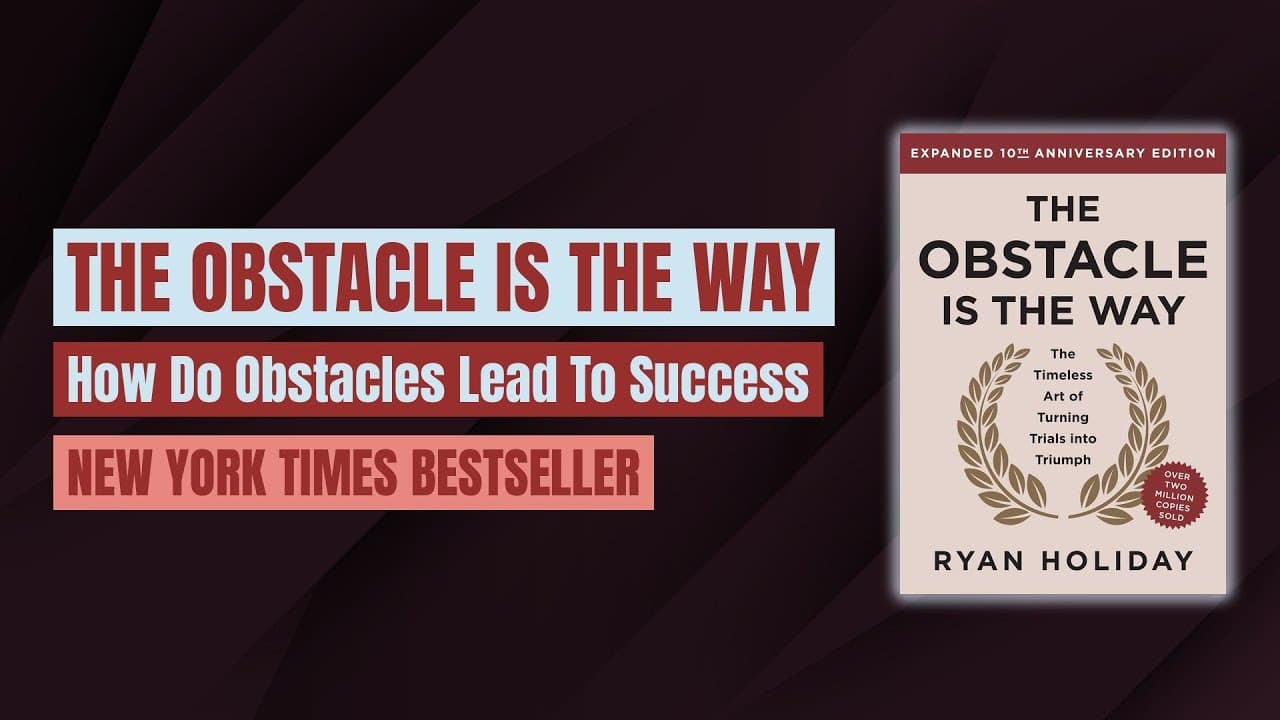
The Obstacle is the Way. This video is based on key insights from the book The Obstacle is the Way by Ryan Holiday. Introduction. Ryan Holiday begins by asking readers to consider the frustrating problems in their lives, the things that stop them from getting what they want. He suggests a different way to look at these problems. What if they weren'... Read More
Key Insights
- The central obstacle is often a person's attitude toward difficulty, not the external event itself. Fear, anger, blame, and helplessness can freeze action, while a more disciplined interpretation can reveal useful choices, lessons, or opportunities hidden within the same circumstances.
- The method for overcoming obstacles consists of perception, action, and will. Perception determines how clearly the problem is understood, action converts understanding into practical effort, and will sustains resilience when adversity continues or includes conditions that cannot be controlled.
- Stoic thinking is a practice of self-control, reason, and acceptance of what cannot be changed. It does not require pretending that everything is fine. It requires identifying what remains within personal control and using hardship as material for growth.
- Calmness preserves judgment when circumstances become chaotic. John D. Rockefeller responded to financial crises by observing rather than panicking, learning from other people's mistakes, saving his money, and waiting for opportunities that matched his disciplined judgment instead of following excitement.
- Inner freedom can remain even when external freedom is removed. Reuben Hurricane Carter refused to define himself as a victim while imprisoned, directing his attention toward his legal case, education, dignity, thoughts, beliefs, and choices rather than surrendering control of his mind.
- Training reduces fear by making stressful situations familiar. NASA repeatedly recreated parts of space missions so astronauts could follow procedures without being overwhelmed by uncertainty. Preparation built confidence and helped them keep thinking clearly when mistakes could have serious consequences.
- Objectivity begins by separating observation from interpretation. The observing eye notices what exists, while the perceiving eye adds judgments and emotional meanings. Creating space between an event and the reaction to it can prevent rushed conclusions and improve decision-making.
- Useful emotional control means managing feelings rather than denying them. A practical test is to ask whether an emotion creates more options or helps solve the problem. If it does neither, logic can challenge the reaction and redirect energy toward constructive action.
- Related book: The Obstacle Is the Way
- Export your Kindle highlights to Glasp: How to Download Highlights and Notes from Kindle
- More videos about this book:
Install to Summarize YouTube Videos and Get Transcripts
Explore YouTube Video Summarizer or Get YouTube Transcript Extractor
Questions & Answers
Q: How can obstacles be turned into opportunities?
Obstacles can be turned into opportunities by changing how they are perceived, taking practical action, and maintaining the will to continue. Instead of reacting with fear, anger, blame, or helplessness, examine the situation calmly and identify what remains controllable. The difficulty can then become material for learning, adaptation, stronger judgment, and progress toward a goal.
Q: What are the three steps for overcoming obstacles?
The three steps are perception, action, and will. Perception involves seeing the problem clearly and separating facts from fear, bias, and impulsive judgment. Action means taking concrete steps to address what can be changed. Will is the inner strength to persevere through continuing difficulty and accept conditions that cannot be controlled.
Q: How does Stoic philosophy help with modern challenges?
Stoic philosophy helps by emphasizing reason, self-control, and acceptance of what cannot be changed. It directs attention away from helpless blame and toward personal choices, interpretations, and responses. Rather than denying that hardship is real, the approach encourages people to look for constructive possibilities within adversity and use challenges to develop resilience and clarity.
Q: Why is perception important when facing adversity?
Perception shapes whether a difficult event appears to be an insurmountable barrier or a problem that can be examined and addressed. Emotions, biases, and short-term thinking can distort judgment and make circumstances harder. Clear perception separates what actually happened from the meaning assigned to it, creating room for rational decisions and constructive responses.
Q: How did John D. Rockefeller respond to financial crises?
John D. Rockefeller responded to financial crises by remaining calm, observing events, and learning from the mistakes of people who panicked. He saved money, resisted impulsive investments, and waited for opportunities that met his judgment. His example shows that greater chaos can demand greater discipline, patience, adaptability, and commitment to common sense.
Q: How can someone maintain control in a hopeless situation?
A person can maintain control by recognizing that thoughts, beliefs, interpretations, and choices may remain free even when external circumstances are severely restricted. Reuben Hurricane Carter demonstrated this by rejecting a victim identity, studying, protecting his dignity, and focusing on his legal case. His response preserved inner agency despite the loss of physical freedom.
Q: Why does preparation improve performance under pressure?
Preparation improves performance because repeated exposure makes demanding situations more familiar and reduces the fear created by uncertainty. NASA recreated mission conditions so astronauts could remember procedures and think clearly instead of panicking. Training does not remove every danger, but it builds confidence and supports steadier emotional control when plans fail or pressure increases.
Q: How can emotions be managed during a crisis?
Emotions can be managed by pausing before reacting, examining the facts, and asking whether becoming upset creates more options or helps solve the problem. Feelings do not need to be denied, but they should not control decisions. Logic can challenge catastrophic interpretations and redirect attention toward procedures, available choices, and practical solutions.
Summary & Key Takeaways
-
Ryan Holiday argues that obstacles are not the primary cause of helplessness. Our interpretations often produce fear, anger, frustration, or paralysis. Stoic philosophy offers another response: accept that difficulties are inevitable, distinguish reality from emotional judgment, and search actively for opportunities to learn, adapt, and become stronger.
-
The framework has three parts: perception, action, and will. Perception means seeing circumstances clearly without allowing fear, excitement, or bias to dictate judgment. Action means addressing the problem through practical steps. Will supplies the inner strength needed to endure difficulty and continue when solutions are slow or circumstances cannot be changed.
-
Examples involving John D. Rockefeller, Reuben Hurricane Carter, Ulysses Grant, and early American astronauts illustrate disciplined responses to pressure. Their circumstances differed, but each example emphasizes inner control. Preparation, objectivity, restraint, and calm thinking preserve the ability to make useful decisions when panic or impulsiveness would narrow the available options.
Read in Other Languages (beta)
Share This Summary 📚
Summarize YouTube Videos and Get Video Transcripts with 1-Click
Try YouTube Summary with ChatGPT & Claude or YouTube Transcript Generator