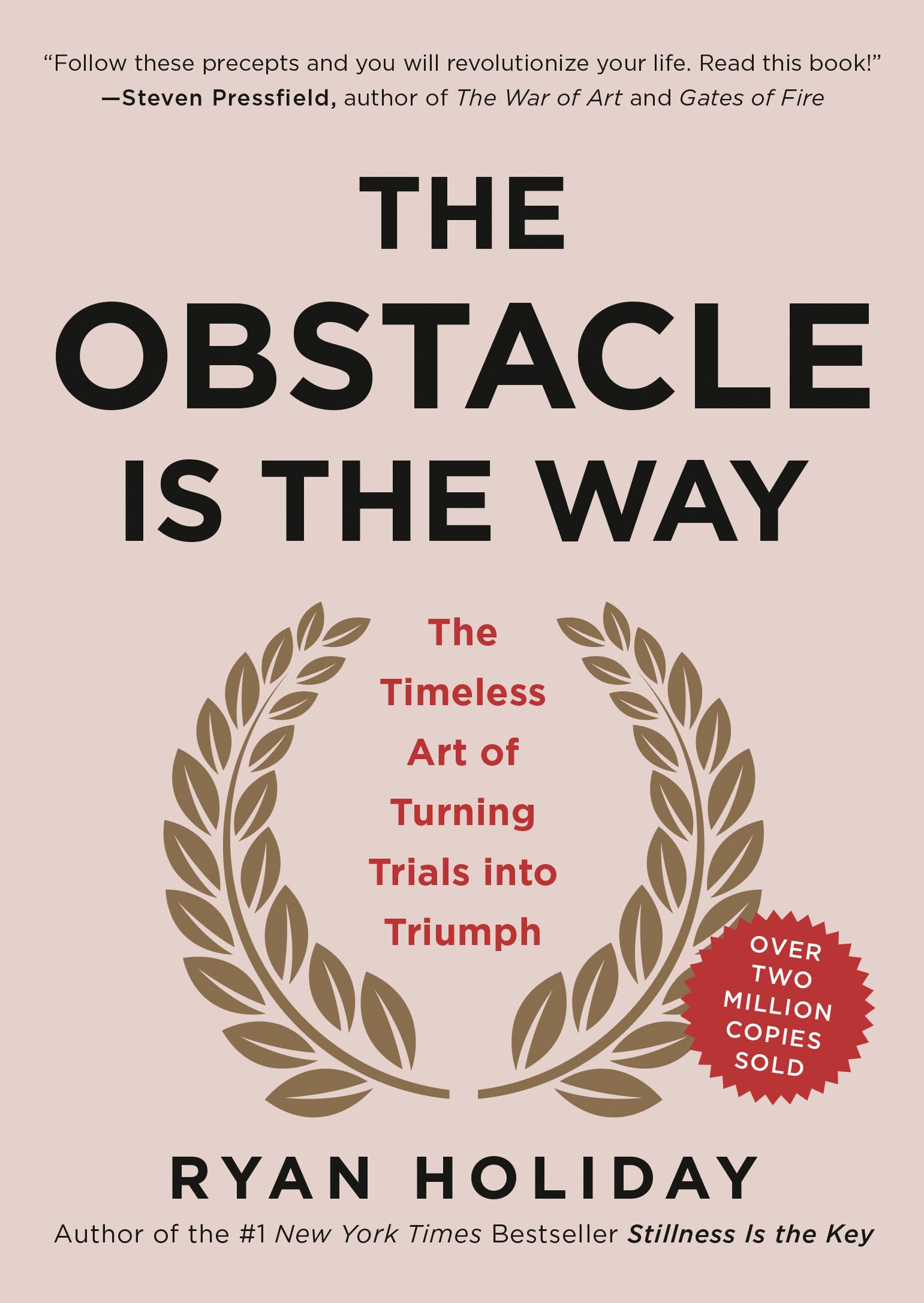
The Obstacle Is the Way: The Timeless Art of Turning Trials into Triumph
About This Book
Ryan Holiday’s The Obstacle Is the Way argues that obstacles are not merely interruptions to success; they can become the very path to it. Drawing heavily from Stoic philosophy—especially Marcus Aurelius and Epictetus—the book’s central claim is captured in its most resonant line: “The impediment to action advances action. What stands in the way becomes the way.”
The book is structured around three interlocking disciplines:
- Perception: Learn to see events objectively rather than through panic, ego, or self-pity.
- Action: Respond with persistent, creative, pragmatic effort instead of complaint or paralysis.
- Will: Endure what cannot be changed through inner steadiness, humility, and resilience.
Across the highlights, readers most often returned to Holiday’s emphasis on attitude. Obstacles are inevitable, fair and unfair alike, but what matters most is how we interpret them, whether we keep our composure, and whether we focus on what is still under our control. The book repeatedly separates the event itself from the story we tell about it, urging readers to strip away dramatization and ask what can actually be done now.
Holiday reinforces this framework with examples from history, business, sports, and public life: people who were underestimated, disadvantaged, imprisoned, injured, or blocked by circumstance but found leverage precisely there. Calmness, objectivity, and emotional regulation are presented as competitive advantages. So are persistence, process, and the refusal to waste energy on what cannot be influenced.
The overall message is practical rather than abstract: stop waiting for ideal conditions, stop blaming externals, and stop assuming difficulty is a sign to quit. Train yourself to find the upside, make the next move, and let adversity sharpen rather than diminish you. In Holiday’s Stoic framing, every obstacle contains a chance to practice courage, discipline, creativity, and self-mastery.
Key Takeaways
- 1.Your response matters more than the obstacle itself; adversity is inevitable, but interpretation and reaction shape the outcome.
- 2.There is a crucial difference between the event and the story you tell yourself about the event.
- 3.Focusing energy on what you can control increases your effectiveness, while obsessing over externals wastes power.
- 4.Calmness is not passivity; emotional regulation is a strategic advantage that makes effective action possible.
- 5.Persistent, flexible action beats complaint, perfectionism, and waiting for ideal conditions.
- 6.Failure becomes useful only if you treat it as feedback and adjust your approach.
- 7.Obstacles can become training grounds for virtue, including patience, courage, self-discipline, and creativity.
Top Highlights
The impediment to action advances action. What stands in the way becomes the way.
Highlighted by 10 people · 1 left a note
“The obstacle in the path becomes the path. Never forget, within every obstacle
Highlighted by 10 people
Will we be blocked by obstacles, or will we advance through and over them?
Highlighted by 9 people
Focusing exclusively on what is in our power magnifies and enhances our power.
Highlighted by 9 people
The impediment to action advances action. What stands in the way becomes the way.
Highlighted by 8 people
Every obstacle is unique to each of us. But the responses they elicit are the same: Fear. Frustration. Confusion. Helplessness. Depression. Anger.
Highlighted by 8 people
There is no good or bad without us, there is only perception. There is the event itself and the story we tell ourselves about what it means.
Highlighted by 8 people
There is always a countermove, always an escape or a way through, so there is no reason to get worked up.
Highlighted by 8 people
Does what happened keep you from acting with justice, generosity, self-control, sanity, prudence, honesty, humility, straightforwardness?
Highlighted by 8 people
Where the head goes, the body follows. Perception precedes action. Right action follows the right perspective.
Highlighted by 8 people
AI Review
Glasp’s AI analysis of 37 reader highlights suggests a strong consensus that this book is highly actionable and memorable. The most-highlighted passages show unusually high resonance around its Stoic framework for reframing setbacks, controlling emotion, and taking disciplined action.
Pros
- +Highly quotable core thesis that readers repeatedly highlighted
- +Clear three-part framework: perception, action, and will
- +Practical focus on controllables over excuses
- +Strong emphasis on emotional regulation under pressure
- +Memorable historical and real-world examples
- +Encourages persistence, creativity, and process thinking
Cons
- −Can feel repetitive because the same core principle is restated often
- −Leans heavily on aphorisms and examples rather than deep philosophical nuance
- −Some readers may want more concrete guidance for identifying the “right” next step
Glasp AI analysis based on highlights from 37 readers.
Who Should Read This
This book is best for entrepreneurs, managers, athletes, creators, students, and anyone facing uncertainty or frustration. It is especially useful for readers dealing with career setbacks, unfair circumstances, self-doubt, failure, or stalled momentum. No prior knowledge of Stoicism is required; Holiday makes the ideas accessible through stories and direct advice. If you tend to overthink, blame circumstances, or freeze under pressure, this book offers a simple framework for regaining agency.
Frequently Asked Questions
What is the book about?
Who is this book for?
What are the key lessons in the book?
Is it worth reading?
What does “The obstacle is the way” mean?
How does the book define what is under our control?
Why does the book focus so much on perception?
How to Apply What You Read
- 1.List one current obstacle and divide it into what is under your control and what is not.
- 2.Reframe a setback by asking, “What is the upside?” and “What opportunity is hidden here?”
- 3.Choose one concrete next step you can complete today instead of dwelling on the whole problem.
- 4.Practice objectivity by describing a stressful situation without exaggeration or self-focused storytelling.
- 5.Review a recent failure and write down what it taught you, what to change, and what to try next.
Discussion Questions
- Q1.Which of the book’s three disciplines—perception, action, or will—do you find hardest to practice in real life?
- Q2.When have you made an obstacle worse by the story you told yourself about it?
- Q3.Does focusing only on what you can control feel empowering, limiting, or both? Why?
- Q4.How do you distinguish healthy emotional expression from unhelpful emotional indulgence?
- Q5.What examples from your own life support or challenge the claim that obstacles can become advantages?
- Q6.Is the book’s advice equally useful for structural injustice and personal setbacks, or are there limits to the framework?
- Q7.What practical habits could help turn this book from inspiration into daily behavior?
Recommended Books
Revisit Your Highlights, Deepen Your Understanding
Import your Kindle highlights to review, organize, and share the ideas that matter most to you.
Get the free browser extension