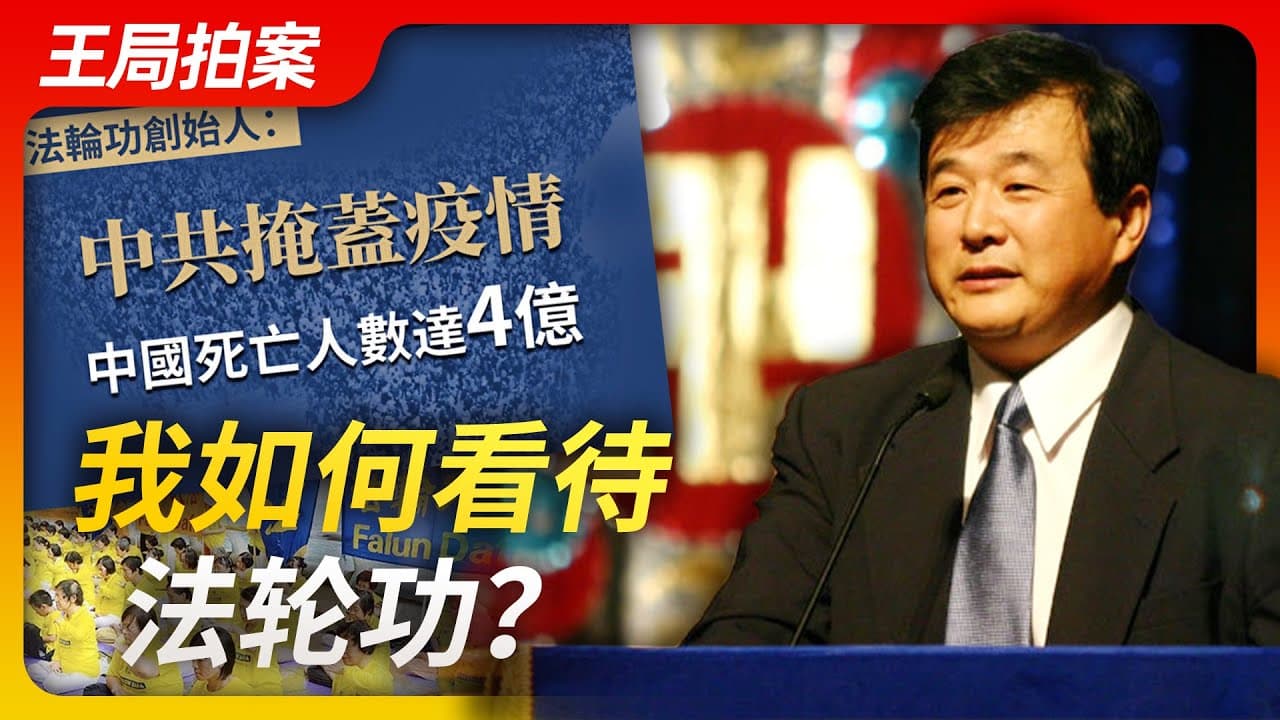
王局拍案|我如何看待法轮功及李洪志的疫情言论?20230126
TL;DR
The speaker views Falun Gong’s influence as rooted in extraordinary claims, follower loyalty, and the suggestive practices associated with China’s qigong craze. He challenges Li Hongzhi’s claim that COVID caused 400 million deaths and recalls seeing students enter what he considered a semi-hypnotic state during a university qigong event. Read on for his specific criticisms and firsthand encounters.
Transcript
Let's talk about Falun Gong today A few days ago at the Chinese New Year Falun Gong master Li Hongzhi issued a divine message He said there had been 400 million deaths due to covid in the last three years 500 million people will die when the epidemic ends This is not the first time Li has made an assertion about the number of deaths in the Chinese ... Read More
Key Insights
- Falun Gong emerged during the qigong craze in China, promoting pseudoscience and mysticism.
- Li Hongzhi, the leader of Falun Gong, made unfounded claims about COVID-19 death tolls in China.
- The organization exhibits authoritarian control over its followers, similar to political regimes.
- Falun Gong discourages modern medical treatments, advocating practices that can harm health.
- The group uses disinformation and smear campaigns against the Chinese Communist Party (CCP).
- Critics argue that Falun Gong's methods are anti-intellectual and harmful to societal values.
- Despite its anti-communism stance, Falun Gong's internal dynamics mirror authoritarianism.
- The promotion of false information by Falun Gong raises concerns about its societal influence.
Install to Summarize YouTube Videos and Get Transcripts
Explore YouTube Video Summarizer or Get YouTube Transcript Extractor
Questions & Answers
Q: How does the speaker believe Falun Gong influences its followers?
The speaker argues that Falun Gong’s influence involves followers defending Li Hongzhi’s assertions even after they provoke public controversy. He connects this loyalty with his earlier experiences of highly suggestive behavior during China’s qigong craze.
Q: What did Li Hongzhi claim about COVID deaths in China?
According to the transcript, Li Hongzhi said that COVID had caused 400 million deaths and that 500 million people would die by the epidemic’s end. The speaker questions these figures and describes the reaction to them as an uproar in public opinion circles.
Q: How did Falun Gong followers defend Li Hongzhi’s COVID claim?
The speaker says some defenders cited leaked Shanghai household-registration information and Yi Fuxian’s population model. They treated gaps between those figures and the officially announced population as evidence that the missing people had died.
Q: What earlier epidemic claim does the speaker attribute to Li Hongzhi?
The speaker says Li Hongzhi claimed during SARS that 200 million people had already died in China. He combines that assertion with the later COVID claim to illustrate why he considers Li’s epidemic figures implausible.
Q: What does the speaker say about Falun Gong’s claims that people quit Chinese political organizations?
He says Falun Gong claimed that more than 400 million people had quit the CCP, the Communist Youth League, and the Young Pioneers. He also recalls worldwide parades celebrating the claim and says he found the website’s calculation method interesting and ridiculous.
Q: How did the speaker first encounter the qigong movement?
While attending Wuhan University during China’s qigong craze, he visited a campus qigong event at the invitation of a classmate. Students on a classroom podium led the group through a practice accompanied by music and guided imagery.
Q: What happened during the university qigong event?
The speaker recalls some students running forward and kowtowing so forcefully that their heads appeared close to bleeding, while his classmate stood and danced toward the front. He interpreted their behavior afterward as probably semi-hypnotic and says he remained unaffected.
Q: What happened to the speaker’s classmate who became obsessed with qigong?
The speaker says a highly capable chemistry classmate continued practicing qigong and traveled alone to Tianshan to seek a master. He later appeared profoundly changed, lived at home, disappeared for more than ten years, and was eventually found in a small town in Guizhou or Guangxi.
Q: What happened when a Zhong Gong practitioner claimed he could diagnose the speaker’s father remotely?
The practitioner claimed that something was wrong where the speaker’s father’s esophagus joined his stomach, despite never having seen him. The speaker took his father for an X-ray with a barium meal, but the examination found nothing there.
Q: Who was Yan Xin and what qigong ability was he said to have?
Yan Xin was a qigong master known during China’s qigong craze in the 1980s. He was shown holding a broken lamp wire in one hand and touching a switch with the other, supposedly using his body to conduct electricity and turn on the lamp.
Q: What were the three major qigong schools named in the video?
The speaker names Xiang Gong as the earliest school, followed by Zhong Gong and then Falun Gong. He also calls Zhong Gong the Chinese health and education gong and says practitioners had to pay to advance through its different levels.
Summary & Key Takeaways
-
Falun Gong, rooted in the qigong craze, is criticized for pseudoscience and mysticism. It promotes anti-intellectualism, discouraging medical treatments. Li Hongzhi's baseless claims about COVID-19 death tolls exemplify its disinformation tactics. The organization exhibits authoritarian control, similar to political regimes, raising concerns about its societal impact.
-
Li Hongzhi's leadership in Falun Gong involves making unfounded claims, such as exaggerated COVID-19 death tolls. The organization maintains strong control over followers, akin to authoritarian regimes. Falun Gong's anti-intellectual stance includes discouraging medical treatments, promoting pseudoscience, and raising concerns about its influence on society.
-
Falun Gong's practices, including discouraging modern medicine and spreading disinformation, have drawn criticism for being anti-intellectual. The organization's authoritarian control over followers and use of smear campaigns against the CCP mirror political regimes. These practices raise concerns about its influence and potential societal impact.
Read in Other Languages (beta)
Share This Summary 📚
Summarize YouTube Videos and Get Video Transcripts with 1-Click
Try YouTube Summary with ChatGPT & Claude or YouTube Transcript Generator
Explore More Summaries from 王志安 📚


Summarize YouTube Videos and Get Video Transcripts with 1-Click
Try YouTube Summary with ChatGPT & Claude or YouTube Transcript Generator