How to Avoid Common Beginner Notebook Mistakes
TL;DR
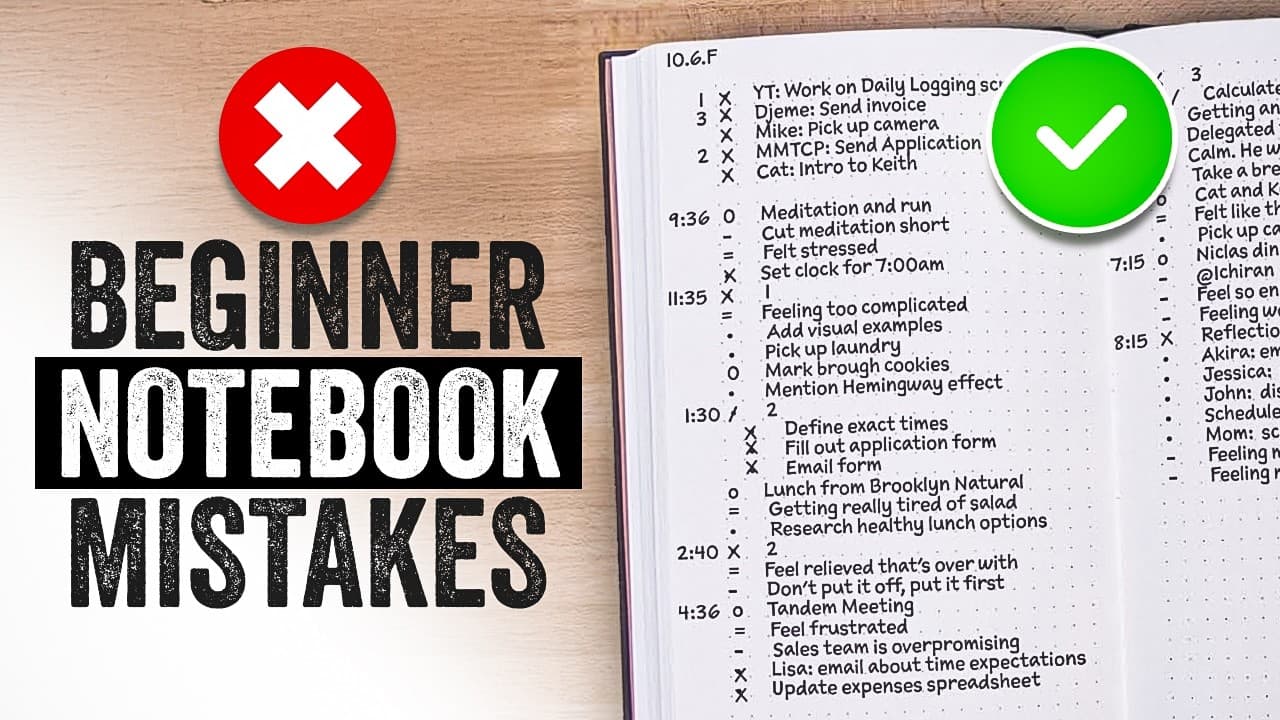
Choose a durable notebook that feels comfortable but not so precious that you fear using it, then keep one notebook for everything. Create pages as life unfolds, review past entries regularly, rank only a few important actions, and embrace handwriting and rewriting as useful constraints that clarify what deserves your time.
Transcript
In the age of screen addiction, social media burnout, and AI slop, the Humble Notebook has become a surprisingly popular alternative way to organize your life. So, I thought, why not make a video to help you avoid the biggest mistakes I've made over more than 20 years of using notebooks to organize my own. Hi, I'm Ryder, creator of the Bullet Journ... Read More
Key Insights
- A notebook's value is determined by what you put into it, not by its price or appearance. An expensive notebook can amplify fear of making mistakes, so beginners should choose something comfortable enough to use freely without repeatedly second-guessing every entry.
- An extremely cheap notebook can create practical frustration through torn pages, broken binding, and ink bleeding through the paper. Because completed notebooks can become a long-term life library, durability matters alongside affordability and ease of use.
- The best notebook is the one that distracts its user the least. It should tolerate being carried in a bag, work with whatever pen is available, and make it easy to find the current place without drawing attention away from the ideas or plans being recorded.
- One notebook for everything creates a single source of truth. Separating work, personal matters, and projects across multiple books forces users to decide where each thought belongs and can make essential information difficult to locate later.
- Flexible planning reflects life more accurately than pages prepared far in advance. Creating a daily page that morning allows available space and stated intentions to match current circumstances, rather than predictions about what a future day, week, or month will require.
- The purpose of notebook organization is clarity rather than productivity alone. Writing captures present thoughts and future plans, while reviewing those records provides context and exposes patterns of cause and effect that may otherwise remain hidden in a fast, constantly connected life.
- A priority is the one thing that comes first. A practical morning ritual is to review previous writing, list the day's most relevant actions, and rank up to three by importance, using the first item as the standard against which new demands are judged.
- Handwriting's physical limitations can improve decision-making. Digital tools make it easy to accumulate a never-ending task list, while rewriting unfinished actions in a notebook introduces effort that helps reveal whether each action is still important enough to keep.
Install to Summarize YouTube Videos and Get Transcripts
Explore YouTube Video Summarizer or Get YouTube Transcript Extractor
Questions & Answers
Q: How do I choose a notebook that I will actually use?
Choose a notebook that feels good, survives regular wear, and distracts you as little as possible. It should be comfortable enough to use without fear, durable enough to avoid torn pages or broken binding, easy to carry in a bag, compatible with whatever pen is available, and simple to navigate when you need to find your place.
Q: Why can an expensive notebook make writing more difficult?
An expensive or luxurious notebook can intensify fear of the blank page because every mark feels consequential. You may worry about ruining it, question whether an idea deserves the space, or delay writing until you have something perfect. The notebook then becomes a barrier to capturing thoughts, even though the contents, rather than the object itself, are what matter.
Q: Why should I avoid buying the cheapest available notebook?
A very cheap notebook may not withstand regular use. Pages can tear out, binding can break, and ink can bleed through the paper, turning initial savings into continuing frustration. Durability also matters because accumulated notebooks can form a life library. A fragile notebook is less likely to preserve that record well over time.
Q: Should I use separate notebooks for work and personal life?
Using one notebook for everything can be more reliable than splitting life across separate books. Thoughts do not remain inside tidy categories, so multiple notebooks create uncertainty about where to record something and where to retrieve it later. A single notebook becomes one source of truth for personal matters, work, projects, plans, ideas, and essential reference information.
Q: Why should I avoid preparing notebook layouts far in advance?
Pages prepared days or weeks ahead attempt to predict how much space future events will require, but life unfolds unpredictably. Detailed layouts may not fit what actually happens and can consume substantial setup time. Creating each daily page that morning lets the layout reflect current needs and gives you an opportunity to identify what is relevant and urgent that day.
Q: How does reviewing old notebook entries improve clarity?
Reviewing old entries supplies context that present emotions and future plans cannot provide by themselves. As daily records accumulate, they become a story of choices, experiences, thoughts, and outcomes. Reading that story regularly can reveal repeated feelings, relationships, locations, mistakes, and patterns of cause and effect, helping future decisions rely on evidence rather than guesswork.
Q: How can I identify my most important tasks each morning?
Read what you previously wrote, create a simple list of the day's most relevant and important actions, and rank them in order. The suggested limit is three. Give the most important action the first position, then rank what remains. When a new demand appears, compare it directly with the first item and ask whether it is genuinely more important.
Q: Why is rewriting unfinished tasks useful in a notebook?
Rewriting unfinished tasks, called migration in the Bullet Journal method, turns a physical limitation into a decision filter. Digital tools can make task hoarding easy because adding items requires little effort. Handwriting is slower, but that friction is useful. If an action is not worth the effort required to rewrite it, it may no longer deserve space or attention.
Summary & Key Takeaways
-
A useful notebook should be durable, comfortable, and unobtrusive. An expensive notebook can intensify fear of the blank page, while an extremely cheap one may suffer torn pages, broken binding, or ink bleed. The right choice removes friction, accepts ordinary pens, survives regular handling, and encourages consistent use without distracting from the writing.
-
Keeping separate notebooks for work, personal matters, and projects can make information difficult to capture and retrieve. A single notebook provides one source of truth. Flexible daily pages created on the day they are needed also reflect unpredictable life more accurately than elaborate layouts prepared days or weeks before their actual use.
-
Notebook organization should create clarity, not merely productivity. Regularly reading past entries reveals context, recurring patterns, and consequences that fleeting thoughts or future plans cannot provide. A daily review can also identify and rank up to three important actions, while rewriting unfinished tasks helps determine whether they remain worthy of attention.
Read in Other Languages (beta)
Share This Summary 📚
Summarize YouTube Videos and Get Video Transcripts with 1-Click
Try YouTube Summary with ChatGPT & Claude or YouTube Transcript Generator
Explore More Summaries from Bullet Journal 📚



Summarize YouTube Videos and Get Video Transcripts with 1-Click
Try YouTube Summary with ChatGPT & Claude or YouTube Transcript Generator