How to Use a Paper Notebook for Intentional Living

TL;DR
Use an unguided paper notebook with simple Bullet Journal tools to capture thoughts, reduce outside distractions, and organize information around your changing needs. Handwriting supports reflection without notifications, batteries, updates, or subscriptions, while an index, page numbers, symbols, logs, and bookmarks make flexible pages easier to navigate and turn into a practical personal operating system.
Transcript
if you've ever felt overwhelmed by your life or wish you had a way to make sense of the world both around and within you then you're not alone in this video I'll be exploring a technology that's helped us make sense of our world and our lives for hundreds of years the paper notebook hi I'm Ryder and today I'll be reviewing the paper notebook as par... Read More
Key Insights
- A paper notebook is a low-input technology that blocks notifications, feeds, inboxes, articles, and other outside information. This reduced input helps the writer focus on internal thoughts and on material previously recorded by their past self.
- Writing in a notebook is a way to externalize thoughts, feelings, behaviors, and experiences. Once these are visible on the page, the notebook can act as a paper mirror that makes previously hidden patterns easier to observe.
- An unguided notebook contains no structured prompts or predefined sections by design. Almost every meaningful input must therefore be created by hand, allowing the notebook to reflect the writer's needs rather than imposing a predetermined framework.
- Handwriting offers a direct capture process without battery life, connectivity, updates, bugs, crashes, syncing, subscription plans, or data plans. Its main physical vulnerability is losing the notebook, but otherwise the process consists simply of pen, paper, and writer.
- Dot-grid pages combine much of the flexibility of blank paper with the optional structure of a grid. Additional division marks, a grid guide, generous margins, and support for either orientation make varied layouts possible while keeping captured text clean and legible.
- Fixed notebooks provide calendars, templates, or prompts, but they require users to fit life into predetermined layouts. Skipped days can accumulate as blank pages, while irrelevant prompts and rigid structures may produce noise, pressure, and practical constraints.
- Fluid notebooks adapt to the writer's changing needs, but their limited built-in support can create uncertainty about what to write, when to write it, how to organize it, and how to retrieve it later.
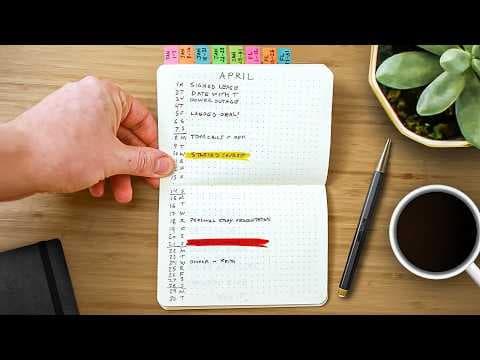
- The Bullet Journal method is presented as a personal operating system that can run on any platform. In a notebook, its symbols, intention page, index, future log, page numbers, page bullets, bookmarks, and stickers add flexible organizational support.
Install to Summarize YouTube Videos and Get Transcripts
Explore YouTube Video Summarizer or Get YouTube Transcript Extractor
Questions & Answers
Q: How can a paper notebook support intentional living?
A paper notebook supports intentional living by creating a quiet place to notice what you are thinking, feeling, and doing. It removes notifications, feeds, inboxes, and other outside inputs, then lets you bring your inner experience onto the page. Reviewing those entries can reveal patterns in thoughts, behaviors, feelings, and experiences that may otherwise remain hidden.
Q: Why can handwriting feel more focused than digital capture?
Handwriting in a notebook avoids many forms of digital friction and distraction. It does not depend on battery life, connectivity, updates, syncing, data plans, or subscription plans, and it is unaffected by software bugs or crashes. With only a pen, paper, and the writer involved, attention can remain on capturing and distilling the thought itself.
Q: What is conscious computing in the notebook review?
Conscious computing is an approach to using technology in ways that help someone live a better life. The review evaluates devices through five criteria: inputs, throughputs, stay puts, compute, and outputs. Each criterion uses a scale from 0 to 10, where lower scores indicate more manual operation and higher scores indicate more technological intervention. Neither extreme is inherently good or bad.
Q: Why does an unguided notebook have so little preprinted content?
An unguided notebook intentionally avoids structured prompts and predefined sections so the writer can focus on personally relevant material. Rather than supplying information from outside, it requires the user to create nearly every input by hand. This flexibility lets the notebook respond to changing needs and keeps irrelevant prompts from competing with thoughts, feelings, actions, and experiences.
Q: What is the difference between fixed and fluid notebooks?
Fixed notebooks use preprinted calendars, templates, prompts, or combinations of those elements. They provide structure, but users may have to fit life into predetermined layouts, and skipped days can leave blank pages. Fluid notebooks remove most imposed structure and adapt more easily, but they provide less guidance for deciding what to write, organizing entries, and finding information later.
Q: How does the Bullet Journal method organize a notebook?
The Bullet Journal method adds simple, flexible tools for capturing and organizing thoughts, feelings, behaviors, actions, events, and experiences. Symbols categorize entries in real time, an intention page anchors the notebook's purpose, an index connects topics to page numbers, and a future log stores upcoming actions and events. Page bullets and bookmarks highlight status and active sections.
Q: What notebook features make handwritten capture easier?
The reviewed notebook uses sustainably sourced 120 GSM paper designed to work with most inks while minimizing ghosting. Its 206 dot-grid pages provide optional structure, and additional dots help divide pages into halves, thirds, and other arrangements. A grid guide supports more complex layouts, while generous margins improve legibility and leave room for titles or marginal notes.
Q: How can an index improve notebook searchability?
An index works like an address book for ideas recorded throughout a notebook. The writer adds a topic and its corresponding page number, making that material easier to locate later. Numbered pages provide orientation, while modifiable page bullets can show whether a page is complete, in progress, important, or marked with multiple statuses that indicate remaining attention.
Summary & Key Takeaways
-
A paper notebook can support intentional living by removing feeds, notifications, inboxes, and other outside inputs. Writing brings thoughts, feelings, behaviors, and experiences onto the page, where they become easier to observe. Unguided pages keep the focus on information created by the writer rather than prompts supplied by the product.
-
Capturing information by hand requires no battery, connectivity, updates, syncing, subscriptions, or data plan. The reviewed notebook adds subtle features such as 120 GSM paper, 206 dot-grid pages, division marks, margins, and a grid guide. These elements support different inks, layouts, orientations, titles, and marginal notes without dominating the writing experience.
-
Notebook organization involves a tradeoff between fixed and fluid formats. Fixed layouts provide support but can create irrelevant prompts, blank dated pages, and pressure. Fluid notebooks adapt to changing needs but offer little guidance. Bullet Journal tools address this tension through symbols, intentions, an index, future planning, numbered pages, bookmarks, and page-status marks.
Read in Other Languages (beta)
Share This Summary 📚
Summarize YouTube Videos and Get Video Transcripts with 1-Click
Try YouTube Summary with ChatGPT & Claude or YouTube Transcript Generator
Explore More Summaries from Bullet Journal 📚




Summarize YouTube Videos and Get Video Transcripts with 1-Click
Try YouTube Summary with ChatGPT & Claude or YouTube Transcript Generator