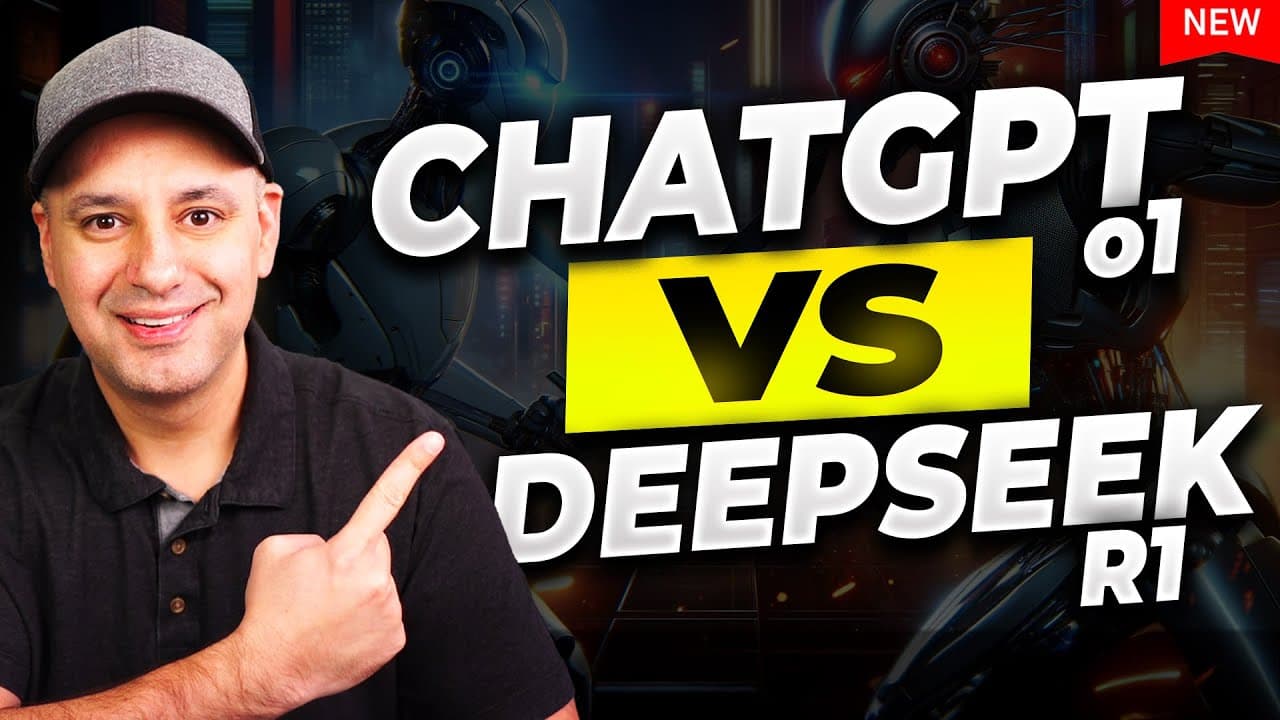
DeepSeek R1 vs ChatGPT o1: Which Reasons Better?
TL;DR
DeepSeek R1 produced more reliable answers in the demonstrated reasoning tests, while ChatGPT o1 generally responded much faster. R1 found both valid animal combinations and correctly judged 9.9 larger than 9.11, two tasks where o1 missed part or all of the answer. Both models succeeded on the light-bulb puzzle, physics problem, word counting, ambiguity, and several classic trick questions.
Transcript
I compare deep seek R1 reasoning model versus chat GPT o1 reasoning model side by side I ran it across 10 different reasoning prompts and the results were completely surprising to me now I'm going to specifically use prompts that require reasoning so you wouldn't use these type of models for every single task you would use it when it needs reasonin... Read More
Key Insights
- DeepSeek R1 is a reasoning model that must be enabled on the official DeepSeek chat website; otherwise, the site uses the V3 model. The presenter describes R1 as open source, with versions that users can download and run privately and locally.
- DeepSeek R1 was free in the comparison, while access to ChatGPT o1 required a paid plan starting at $20 per month. The presenter used a Teams plan and noted that paid ChatGPT upgrades opt users out of model-training data use by default.
- The 100-light-bulb puzzle ends with bulbs numbered by perfect squares remaining on. Both models returned 1, 4, 9, 16, 25, 36, and 49 among their answers, and the presenter judged both responses correct.
- The animal-cost problem has two valid combinations: two horses with two chickens, or one chicken with three goats. DeepSeek R1 found both combinations, while ChatGPT o1 returned only the chicken-and-goat solution, giving DeepSeek the advantage on completeness.
- The physics prompt was answered correctly by both reasoning models according to an answer key obtained from a physics specialist. DeepSeek took 137 seconds, while ChatGPT o1 took 7 seconds, illustrating the substantial response-time difference observed in several tests.
- The chicken-or-egg question produced the same scientific conclusion from both models: the egg came first because eggs existed before animals formally classified as chickens. The presenter considered DeepSeek's explanation simpler, but counted the test as a pass for both systems.
- The misleading restaurant-bill puzzle contains no missing money because all of the money is accounted for. Both DeepSeek R1 and ChatGPT o1 reached that conclusion, but the recorded times differed sharply, with DeepSeek taking 80 seconds and o1 taking 7 seconds.
- The decimal comparison exposed the clearest accuracy difference: DeepSeek correctly selected 9.9 as larger, while ChatGPT o1 incorrectly selected 9.11. Both models correctly counted three instances of R in the standard spelling and four in the deliberately misspelled version.
Install to Summarize YouTube Videos and Get Transcripts
Explore YouTube Video Summarizer or Get YouTube Transcript Extractor
Questions & Answers
Q: Which reasoning model performed better in the comparison?
DeepSeek R1 performed better on answer accuracy across the demonstrated tests because it did not fail any of the examples shown. ChatGPT o1 missed one valid solution to the animal-cost problem and incorrectly said that 9.11 is larger than 9.9. Both models passed the other discussed tasks, so DeepSeek's advantage came from greater accuracy and completeness rather than success on every test exclusively.
Q: How did DeepSeek R1 and ChatGPT o1 compare on speed?
ChatGPT o1 generally completed the reasoning prompts much faster than DeepSeek R1. The transcript reports comparisons of 137 seconds versus 7 seconds on the physics problem, 80 seconds versus 7 seconds on the restaurant-bill puzzle, and 76 seconds for DeepSeek on the animal problem. The presenter also noted that DeepSeek's website was experiencing heavy server load because it had become viral.
Q: What are the two solutions to the animal-cost problem?
The problem has two valid combinations under the stated prices and total. One solution is two horses and two chickens: the four animals cost $140 altogether. The other solution is one chicken and three goats, which also gives four animals costing $140. DeepSeek R1 identified both possibilities, while ChatGPT o1 returned only the combination containing one chicken and three goats.
Q: Which bulbs remain on after the 100-pass light-bulb puzzle?
The bulbs corresponding to perfect-square positions remain turned on. The displayed answer begins with bulbs 1, 4, 9, 16, 25, 36, and 49, and both DeepSeek R1 and ChatGPT o1 were judged correct by the presenter. Each model used its reasoning process before giving the result, although DeepSeek displayed substantially more intermediate thinking in the interface.
Q: Why is 9.9 larger than 9.11 in the decimal test?
DeepSeek R1 identified 9.9 as the larger value in the comparison presented. ChatGPT o1 instead answered that 9.11 was larger, which the presenter marked as wrong. The test was included because the answer appears obvious to people but can be difficult for large language models, making it a compact way to test whether a reasoning system handles decimal comparisons reliably.
Q: How did the models solve the restaurant-bill trick question?
Both models concluded that no money was missing and that all of the money was accounted for. The prompt tries to create confusion by saying each person ultimately paid $14, totaling $42, after the waiter kept $5 and returned $5. DeepSeek R1 and ChatGPT o1 rejected the misleading conclusion, although DeepSeek took 80 seconds and o1 took 7 seconds.
Q: Can DeepSeek R1 and ChatGPT o1 count letters correctly?
Both models correctly counted the letter R in the examples used. They found three instances in the standard spelling of strawberry. When the presenter started a new chat and deliberately used a misspelled form containing an extra R, both systems counted four. DeepSeek explicitly inspected the letters during its visible reasoning, while ChatGPT o1 reached the same conclusion more quickly.
Q: What practical differences exist between DeepSeek R1 and ChatGPT o1?
DeepSeek R1 was available free on the official DeepSeek chat site, but users had to switch on R1 or the site would use V3. ChatGPT o1 required a paid plan starting at $20 per month. DeepSeek could combine reasoning with its search option, while ChatGPT's search control was grayed out with o1 during the demonstration. DeepSeek also displayed a longer visible thinking process.
Summary & Key Takeaways
-
DeepSeek R1 and ChatGPT o1 were compared side by side using prompts designed to require reasoning rather than ordinary text generation. The tests covered logic, mathematics, physics, thought experiments, verbal ambiguity, misleading arithmetic, decimal comparison, and character counting. The presenter evaluated answer accuracy, visible reasoning behavior, response time, and practical website functionality.
-
DeepSeek R1 completed every demonstrated test successfully, including identifying two valid solutions to the animal-cost problem and recognizing that 9.9 is larger than 9.11. ChatGPT o1 supplied only one animal combination and answered the decimal comparison incorrectly. Both models solved the remaining tests shown in the transcript, including the light-bulb puzzle.
-
ChatGPT o1 usually reached answers much faster, with several comparisons showing 7 seconds for o1 against 80, 137, or 76 seconds for DeepSeek R1. DeepSeek displayed a much longer visible thinking process and provided fuller explanations in some cases. The presenter preferred waiting longer when that delay resulted in the correct answer.
Read in Other Languages (beta)
Share This Summary 📚
Summarize YouTube Videos and Get Video Transcripts with 1-Click
Try YouTube Summary with ChatGPT & Claude or YouTube Transcript Generator
Explore More Summaries from Skill Leap AI 📚





Summarize YouTube Videos and Get Video Transcripts with 1-Click
Try YouTube Summary with ChatGPT & Claude or YouTube Transcript Generator