Resistors in Electric Circuits (4 of 16): What Happens When Adding Resistors to Series Circuits? Part 1
TL;DR
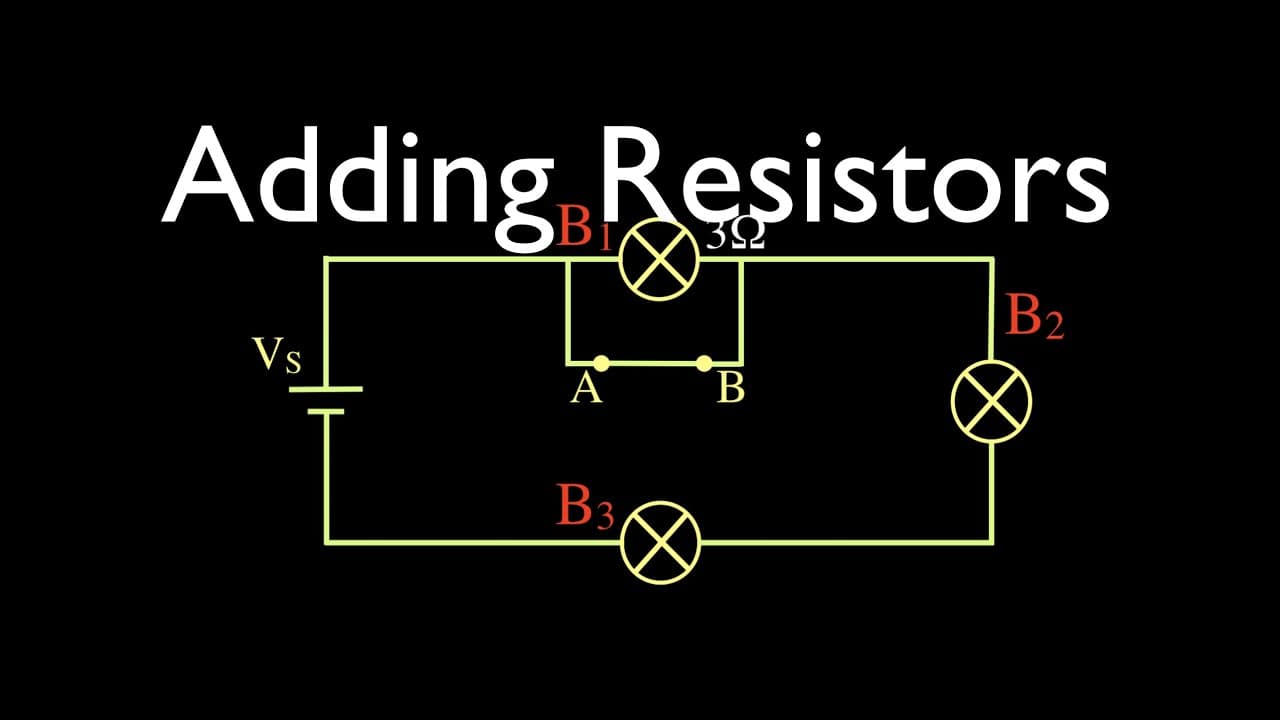
Adding an identical bulb in series increases total resistance, which decreases circuit current, voltage across the existing bulbs, and their brightness. In the example, adding a third 3-ohm bulb to a 9-volt circuit raises resistance from 6 to 9 ohms and lowers current from 1.5 to 1 ampere. Read on to see how Ohm’s law explains each change.
Transcript
okay in this video we are going to be going over what happens when we add resistors in series and we add an additional resistor to that series circuit what happens to the voltage the current and the brightness of the bulbs now I have another video I made for series resistors and also I made a video for what happens when we add resistors in parallel... Read More
Key Insights
- ❓ Total resistance increases with additional resistors in series.
- 😮 Total current decreases as resistance rises with added resistors.
- 💦 Voltage drop across individual bulbs decreases with more resistors in series.
- ✊ Brightness of bulbs decreases as power output reduces in a series circuit with added resistors.
- ❓ Understanding the impact of resistors in series is crucial for circuit analysis.
- 👮 Ohm's law is essential for calculating current, voltage, and resistance in circuit configurations.
- ✊ Power output and brightness are directly related to current and voltage in electrical circuits.
Install to Summarize YouTube Videos and Get Transcripts
Explore YouTube Video Summarizer or Get YouTube Transcript Extractor
Questions & Answers
Q: What happens when a resistor is added to a series circuit?
The circuit’s total resistance increases because series resistances are added together. With the voltage source unchanged, total current decreases, and the voltage and brightness of the existing bulbs also decrease.
Q: How does adding a third bulb change the total resistance in the example circuit?
Each identical bulb has a resistance of 3 ohms. Adding bulb one to the two bulbs already in series increases the total resistance from 6 ohms to 9 ohms.
Q: How is total resistance calculated for resistors in series?
The total resistance is the sum of the individual resistances. For three 3-ohm bulbs, the calculation is 3 plus 3 plus 3, giving 9 ohms.
Q: How does adding the third bulb affect the total current?
The total current decreases from 1.5 amperes to 1 ampere. This occurs because the total resistance rises from 6 ohms to 9 ohms while the source remains at 9 volts.
Q: How is Ohm’s law used to calculate total current in this circuit?
Using V = I times R, total current equals total voltage divided by total resistance. The 9-volt source produces 1.5 amperes with 6 ohms of resistance and 1 ampere with 9 ohms.
Q: What is the voltage drop across each bulb before the third bulb is added?
With the switch closed, current bypasses bulb one and flows through bulbs two and three at 1.5 amperes. Multiplying 1.5 amperes by each bulb’s 3-ohm resistance gives a 4.5-volt drop across each bulb.
Q: What is the voltage drop across each bulb after the third bulb is added?
Opening the switch forces current through all three bulbs and reduces the current to 1 ampere. Multiplying 1 ampere by 3 ohms gives a 3-volt drop across each bulb, and the three drops add to 9 volts.
Q: Why do the bulbs become dimmer when another bulb is added in series?
Adding the bulb increases total resistance and reduces the current through the circuit. The voltage drop across each identical bulb falls from 4.5 volts to 3 volts, reducing power output and brightness.
Summary & Key Takeaways
-
Adding resistors in series increases total resistance as it is the sum of individual resistances.
-
Total current through the circuit decreases with the addition of resistors in series.
-
Voltage drop and brightness of bulbs decrease when adding resistors in series.
Read in Other Languages (beta)
Share This Summary 📚
Summarize YouTube Videos and Get Video Transcripts with 1-Click
Try YouTube Summary with ChatGPT & Claude or YouTube Transcript Generator
Explore More Summaries from Step by Step Science 📚

Summarize YouTube Videos and Get Video Transcripts with 1-Click
Try YouTube Summary with ChatGPT & Claude or YouTube Transcript Generator