Farsighteness vs. Nearsightedness, An Explanation
TL;DR
This video explains the difference between farsightedness and nearsightedness, discussing their causes and how they are corrected with lenses.
Transcript
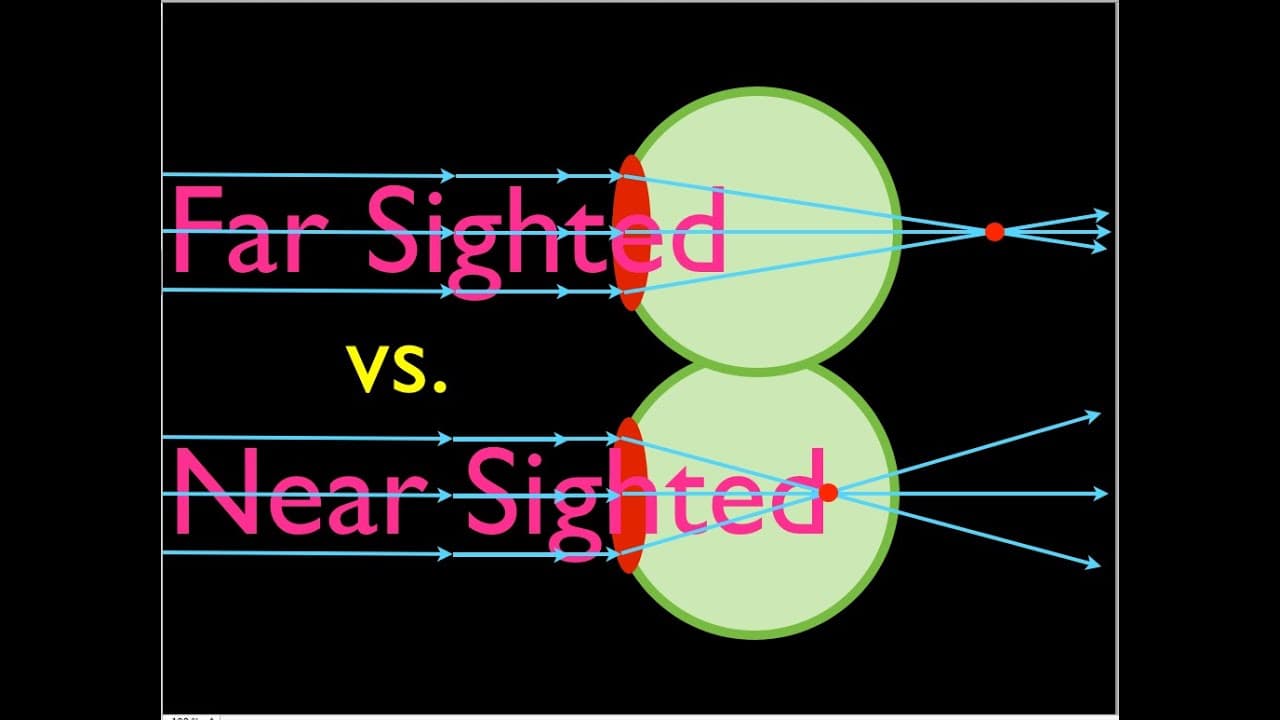
okay that's right you guessed it in today's video I'm going to go over the difference between farsighted and nearsightedness and when I do that I like to start with farsightedness what does it mean to be farsighted this is your eye this is the lens in your eye the lens in your eye is a convex lens and it is a converging lens so when farsighted ligh... Read More
Key Insights
- 🙂 Farsightedness, or hyperopia, occurs when the focal point of light is behind the retina, resulting in blurry near vision.
- 😥 Nearsightedness, or myopia, happens when the focal point is in front of the retina, causing blurry distance vision.
- ❓ Farsightedness is corrected with converging lenses, while nearsightedness is corrected with diverging lenses.
Install to Summarize YouTube Videos and Get Transcripts
Explore YouTube Video Summarizer or Get YouTube Transcript Extractor
Questions & Answers
Q: What is farsightedness and how does it differ from nearsightedness?
Farsightedness, or hyperopia, occurs when the eye's lens converges light too far away from the retina, making near objects appear blurry. Nearsightedness, or myopia, is the opposite, with the lens converging light in front of the retina, resulting in blurry distance vision.
Q: What causes farsightedness and nearsightedness?
Farsightedness can be caused by a shorter eyeball or a lens that is unable to become round enough. Nearsightedness, on the other hand, is often caused by an elongated eyeball or muscles that cannot flatten the lens properly.
Q: How are farsightedness and nearsightedness corrected?
Farsightedness is corrected with converging lenses, also known as convex lenses, that bring the focal point to the retina. Nearsightedness is corrected with diverging lenses, or concave lenses, that move the focal point back to the retina.
Q: Can farsightedness and nearsightedness be corrected with contact lenses?
Yes, both farsightedness and nearsightedness can be corrected with contact lenses. For farsightedness, converging contact lenses are used, while diverging contact lenses are used for nearsightedness.
Summary & Key Takeaways
-
Farsightedness, also known as hyperopia, occurs when the eye's lens cannot converge light properly, resulting in the focal point being behind the retina.
-
Nearsightedness, also known as myopia, happens when the lens converges light too much, causing the focal point to be in front of the retina.
-
Correcting farsightedness requires converging lenses to bring the focal point to the retina, while nearsightedness is corrected with diverging lenses to move the focal point back.
Read in Other Languages (beta)
Share This Summary 📚
Summarize YouTube Videos and Get Video Transcripts with 1-Click
Try YouTube Summary with ChatGPT & Claude or YouTube Transcript Generator
Explore More Summaries from Step by Step Science 📚
Summarize YouTube Videos and Get Video Transcripts with 1-Click
Try YouTube Summary with ChatGPT & Claude or YouTube Transcript Generator