What is a Radian? An Explanation
TL;DR
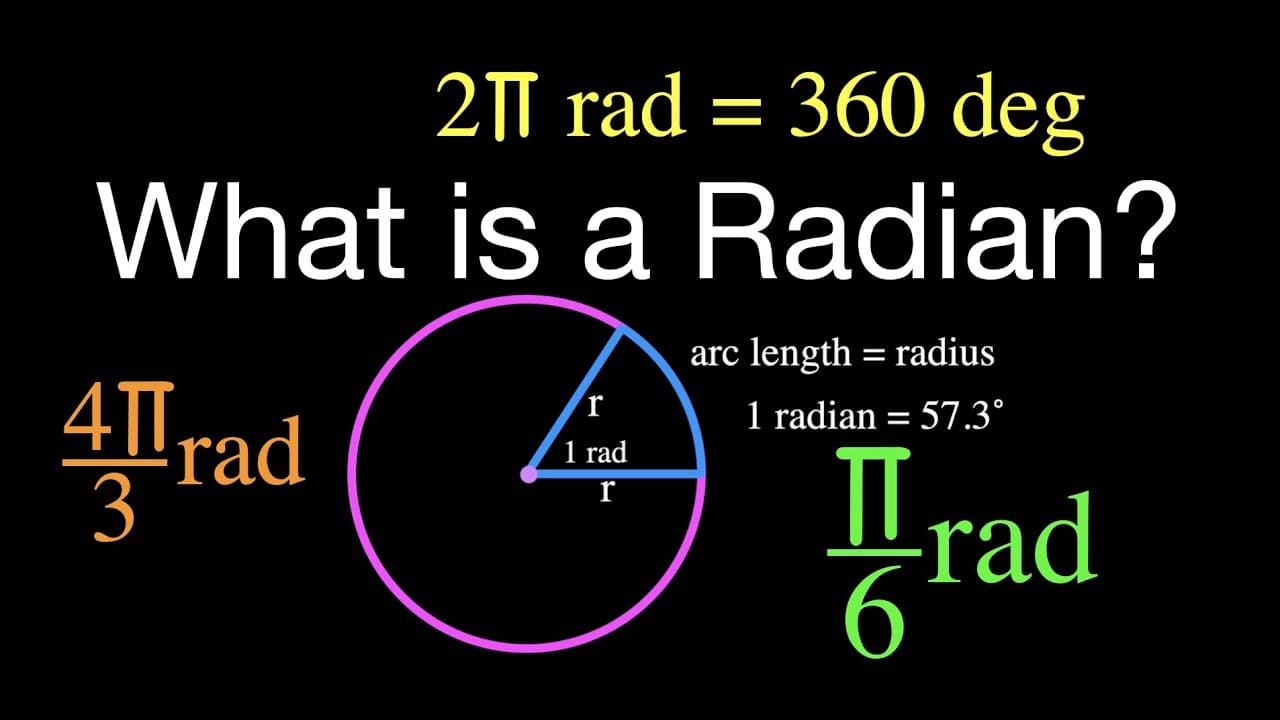
A radian is the angle formed at the center of a circle when the intercepted arc length equals one radius. A full circle contains 2π radians, so 180 degrees equals π radians, 90 degrees equals π/2, and 270 degrees equals 3π/2. One radian is also about 57.3 degrees. Read on to see how these relationships make radians easier to understand and convert.
Transcript
in today's video we're going to go over a complete introduction to what is a radian radian angle measurements before we get started please don't forget to subscribe to my channel step by step science get all my excellent physics chemistry and math videos when i look at my youtube analytics i see that more than 95 of the people who watch my videos h... Read More
Key Insights
- ⭕ Radian angle measurements provide a more natural and mathematically significant understanding of circles.
- 🔨 The unit circle is a helpful tool for understanding radian measurements for common angles.
- 🤨 Converting between degrees and radians can be simplified using the conversion factor of pi radians equals 180 degrees.
- 🈸 Understanding the relationship between degrees and radians is essential for advanced math and physics applications.
- 💦 Radian measurements offer a more precise and consistent way of working with angles in mathematical calculations.
- 🔺 By gradually transitioning from degrees to radians, individuals can develop a deeper understanding of radian angle measurements.
- 💦 The concept of radian measurements can be initially intimidating, but with practice, it becomes easier to comprehend and work with effectively.
Install to Summarize YouTube Videos and Get Transcripts
Explore YouTube Video Summarizer or Get YouTube Transcript Extractor
Questions & Answers
Q: What is a radian?
A radian is the angle subtended at the center of a circle by an arc whose length equals one radius. If two radii connect the center to the endpoints of that arc, the angle between them measures 1 radian.
Q: How many radians are in a full circle?
A full circle contains 2π radians, corresponding to 360 degrees. The transcript recommends remembering this relationship first when learning radian measurements.
Q: How are degrees and radians related?
A full turn is both 360 degrees and 2π radians. Therefore, half a turn is 180 degrees or π radians, and a quarter turn is 90 degrees or π/2 radians.
Q: How many degrees are in one radian?
One radian equals approximately 57.3 degrees. This can seem surprisingly large because 1 degree is much smaller than 1 radian.
Q: Why are radians based on circles?
Radians are defined using a circle’s radius and circumference. The measurement comes from comparing an arc length with the radius rather than dividing the circle into 360 parts.
Q: What is 90 degrees in radians?
An angle of 90 degrees equals π/2 radians. Since 180 degrees equals π radians, halving both measurements gives this result.
Q: What is 270 degrees in radians?
An angle of 270 degrees equals 3π/2 radians. It consists of three 90-degree sections, and each section measures π/2 radians.
Q: Why are radian answers usually written with π?
The transcript keeps a complete circle as 2π radians instead of replacing π with 3.14 and writing about 6.28 radians. Leaving measurements in terms of π works better when solving later problems.
Summary & Key Takeaways
-
The video begins with a plea to subscribe to the channel and support the content creator.
-
The concept of radian measurements is introduced, highlighting its relationship to degrees and circles.
-
The definition of a radian is explained as the angle subtended at the center of a circle by an arc length equal to one radius.
-
The unit circle is explored to demonstrate various radian measurements for different angles.
-
Conversion between degrees and radians is discussed, providing helpful tips for simplifying the process.
Read in Other Languages (beta)
Share This Summary 📚
Summarize YouTube Videos and Get Video Transcripts with 1-Click
Try YouTube Summary with ChatGPT & Claude or YouTube Transcript Generator
Explore More Summaries from Step by Step Science 📚

Summarize YouTube Videos and Get Video Transcripts with 1-Click
Try YouTube Summary with ChatGPT & Claude or YouTube Transcript Generator