How to Use Gas Chromatography for Sample Analysis
TL;DR
To use gas chromatography effectively, first clean your micro syringe with an organic solvent like ether, then load your sample between two air bubbles. Make the injection through the rubber septum, and after analysis, interpret the gas chromatogram by examining retention times and peak areas, before saving your results as a PDF.
Transcript
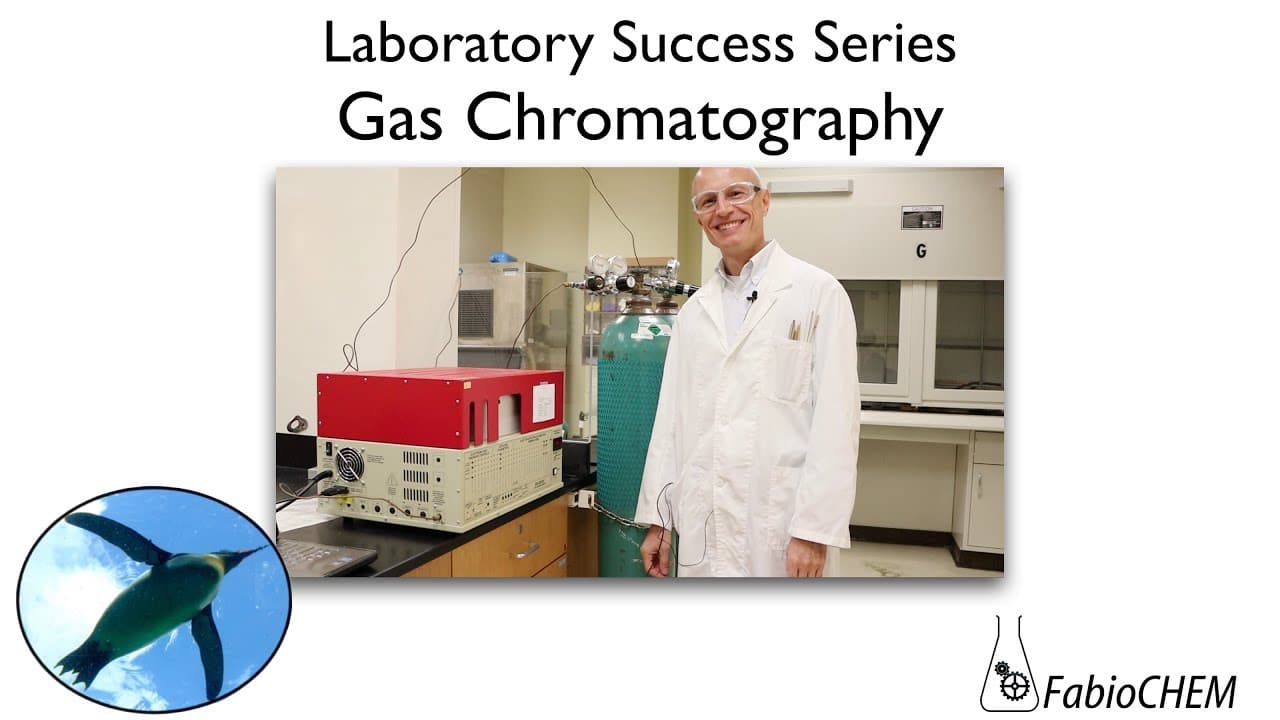
hello everybody and welcome to the organic chemistry lab series today we are talking about gas chromatography or GC for short this video is about the practical aspects of how to use a gas chromatograph the theory has already been explained in the corresponding video so a classical gas chromatography setup is like this and as you can see you have a ... Read More
Key Insights
- 🫢 Gas chromatography involves a setup with various components, including a carrier gas reservoir, pressure regulator, gas line, chromatograph, and detector.
- 👋 It is crucial to clean the syringe with an organic solvent like ether to ensure a good seal and prevent damage to the delicate plunger.
- 👁️🗨️ Loading a sample between two air bubbles helps achieve accurate results, and the injection should be made through the rubber septum.
- 🙊 Interpreting a gas chromatogram involves identifying peaks, determining their retention times, and analyzing the areas under the peaks.
- 🫢 The retention time of a compound in a gas chromatogram provides insights into its boiling point and chemical nature.
- 🫢 Results from a gas chromatography analysis can be saved as a PDF file for documentation or further analysis.
- 🫢 Gas chromatography is a technique commonly used in organic chemistry labs for separation, identification, and quantification of compounds in a sample.
Install to Summarize YouTube Videos and Get Transcripts
Explore YouTube Video Summarizer or Get YouTube Transcript Extractor
Questions & Answers
Q: What are the essential components of a gas chromatography setup?
A gas chromatography setup typically includes a carrier gas reservoir, pressure regulator, gas line, gas chromatograph, injector port, column, and detector.
Q: How should you handle the syringe to ensure accurate sample loading?
When using a syringe, it should be cleaned with an organic solvent like ether to ensure a good seal. The sample should be loaded between two air bubbles by immersing the needle in the sample and drawing up the desired amount.
Q: What does a gas chromatogram show and how do you interpret it?
A gas chromatogram displays the intensity of the detected compounds (y-axis) against their retention time (x-axis). Each peak represents a different compound, with the retention time indicating the compound's boiling point. The area under each peak corresponds to the quantity of the compound present.
Q: How can you save the gas chromatogram results?
To save the gas chromatogram as a PDF, you can use the print function and select a virtual PDF printer. Choose a file name and location, and save it for future reference or analysis.
Summary & Key Takeaways
-
The video explains the setup of a gas chromatograph, including the carrier gas reservoir, pressure regulator, and detector.
-
The instructor demonstrates how to properly load a sample using a micro syringe and discusses the importance of cleaning the syringe with an organic solvent.
-
The video also shows how to make an injection, interpret the gas chromatogram, and save the results as a PDF file.
Read in Other Languages (beta)
Share This Summary 📚
Summarize YouTube Videos and Get Video Transcripts with 1-Click
Try YouTube Summary with ChatGPT & Claude or YouTube Transcript Generator
Explore More Summaries from ThePenguinProf 📚





Summarize YouTube Videos and Get Video Transcripts with 1-Click
Try YouTube Summary with ChatGPT & Claude or YouTube Transcript Generator