How to Pack a Column (for Column Chromatography)
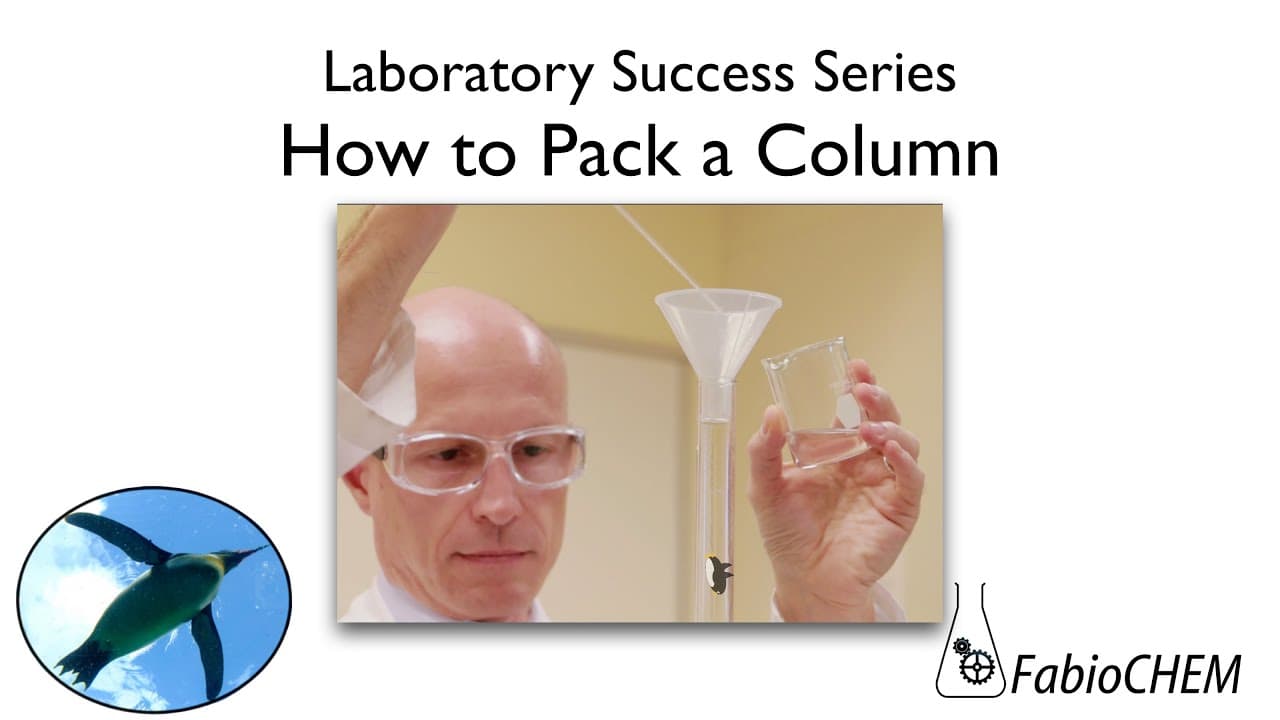
TL;DR
Pack a chromatography column by installing a cotton plug, adding and leveling sand, pouring in a well-stirred silica slurry, and running solvent through while gently tapping until the bed settles. The demonstration uses approximately 14 grams, or 28 milliliters, of silica gel and stresses that the silica must never dry out. Read on for the precise packing, loading, rinsing, and solvent-handling steps.
Transcript
[ Music ] >> Today we are talking about column chromatography. Everything I do, should be done in a hood because you are using volatile organic solvents. So, for video purposes we are doing this on the benchtop but remember always work in a hood. You are already familiar with a TLC which is a separation technique that uses silica gel chromatography... Read More
Key Insights
- 😇 Column chromatography is an analytical technique used to separate compounds using a column packed with silica gel.
- 🛌 Packing the column involves carefully preparing it with sand and adding a mixture of solvents to create a separation bed.
- 🏃 The compound to be separated is loaded onto the column, and fractions are collected as the solvents run through.
- 😇 It is important to prevent the silica gel from going dry during the experiment.
- 😇 Tapping the column helps settle the silica gel, and marking the level of the gel helps monitor its settling.
- 💾 Reusing the solvents used for packing reduces waste and saves resources.
- ❓ Proper loading of the compound ensures efficient separation on the column.
Install to Summarize YouTube Videos and Get Transcripts
Explore YouTube Video Summarizer or Get YouTube Transcript Extractor
Questions & Answers
Q: How do you pack a column for column chromatography?
Place a small cotton plug at the bottom, reinsert the stopcock, clamp the column, and add enough sand to extend past the column’s curvature. Wet and level the sand, pour in a well-stirred silica-and-solvent slurry, then open the stopcock and gently tap the column while solvent flows through so the silica settles without drying.
Q: How much silica gel is needed to pack the column?
The demonstrated column needs approximately 14 grams of silica gel. Because dry silica has a density of about 0.5, this corresponds to approximately 28 milliliters; an amount between 25 and 30 milliliters is sufficiently accurate.
Q: Which solvent should be used to pack the column?
Use the same solvent mixture that will be used to run the column. In the demonstration, this is a hexane–ethyl acetate mixture previously determined by TLC.
Q: How should the silica slurry be prepared and transferred?
Add enough solvent to the silica gel to make a very runny, fairly liquid slurry, and stir it thoroughly. Pour it into the column while continuing to stir so the silica remains suspended, then rinse the beaker with additional solvent.
Q: How do you keep the silica gel from drying out or being disturbed?
Stop the solvent flow before the liquid reaches the silica surface, because the silica gel must never go dry. Add fresh solvent slowly with a pipette at first, then increase the rate after enough liquid has accumulated to cushion the fall and protect the silica surface.
Q: How can you tell when the silica gel has finished settling?
Mark the silica level with a Sharpie and gently tap the side of the column with a plastic object while solvent passes through. In theory, solvent should continue running until the marked silica level stops moving.
Q: Can the solvent used during column packing be reused?
Yes. The solvent that passes through the column during packing is clean, so it can be collected and reused for another packing pass.
Q: How is a liquid compound loaded onto the packed column?
When about five millimeters of solvent remains above the silica, close the stopcock, add a couple of millimeters of protective sand, and drain until the sand, not the silica, is dry. Place the liquid compound in the center of the dry sand with a long Pasteur pipette, let it enter the column, then rinse the container and loading pipette with about one milliliter of solvent and apply that rinse without disturbing the silica surface.
Summary & Key Takeaways
-
Column chromatography is a separation technique that uses a column packed with silica gel to separate compounds.
-
The column must be carefully prepared by packing it with sand and adding a mixture of solvents.
-
The compound to be separated is then loaded onto the column, and fractions are collected as the solvents run through.
Read in Other Languages (beta)
Share This Summary 📚
Summarize YouTube Videos and Get Video Transcripts with 1-Click
Try YouTube Summary with ChatGPT & Claude or YouTube Transcript Generator
Explore More Summaries from ThePenguinProf 📚






Summarize YouTube Videos and Get Video Transcripts with 1-Click
Try YouTube Summary with ChatGPT & Claude or YouTube Transcript Generator