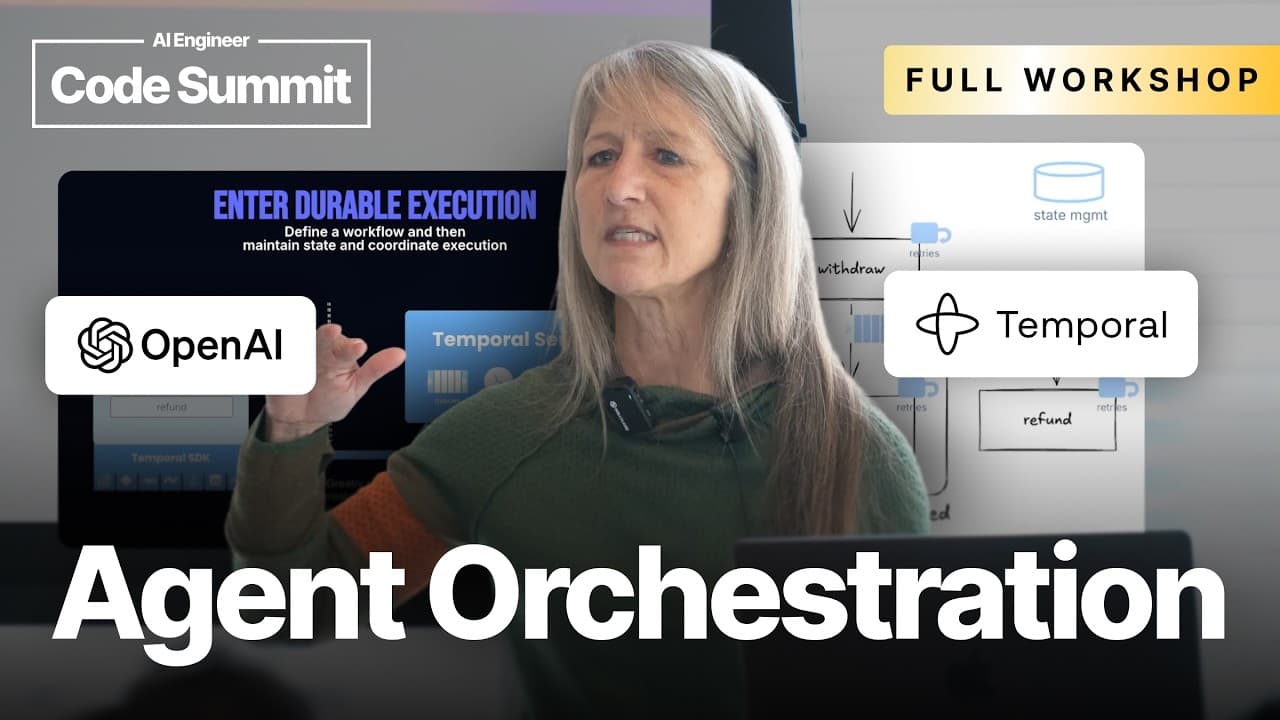
How to build durable AI agents with OpenAI + Temporal
TL;DR
OpenAI Agents SDK lets you define agents with prompts, models, and tools and run them in agentic loops. Temporal acts as a durable backing service that makes AI workflows resilient, handling retries, rate limits, and long running tasks. The talk demonstrates integration between the two and includes demos and guidance for orchestration and tooling.
Transcript
I'll introduce myself in in just a moment, but I'd like to get to know a little bit about you. So, you know, you can see that there's there's two brands up on the screen here. There's OpenAI agents SDK in particular, and there's Temporal. I work for Temporal. I'll tell you more about myself in just a second. Um, I'm curious, how many folks are usin... Read More
Key Insights
- OpenAI Agents SDK defines an agent as an entity that makes decisions and routes outputs back to the LLM through an agentic loop.
- Temporal is described as a durable execution framework that handles retries, state, and long running workflows for AI applications.
- The integration between OpenAI agents and Temporal combines the decision power of LLMs with the reliability of a durable backing service.
- Agent frameworks allow handoffs, tool use, and orchestration within and between agents to create complex workflows.
- Durability in Temporal means avoiding redoing expensive LLM calls when a process restarts after a failure.
- OpenAI and Temporal collaborate on an integration to productionize AI agents, addressing real world reliability concerns.
- The talk cites real world users of Temporal, including applications like image generation and codex, to illustrate broad adoption.
- Demos are used to show both independent OpenAI agent behavior and combined OpenAI-Temporal workflows, with attention to repeatable, branchable outcomes.
Install to Summarize YouTube Videos and Get Transcripts
Explore YouTube Video Summarizer or Get YouTube Transcript Extractor
Questions & Answers
Q: What is the core idea behind the OpenAI Agents SDK and agentic loops?
The OpenAI Agents SDK enables creating agents that manage their own flow by issuing prompts to an LLM, receiving results, and deciding what actions to take next. Each runner.run call starts an agentic loop where the agent can invoke tools, process outputs, and continue looping until it completes its task, with the LLM ultimately guiding the flow and deciding when to stop.
Q: How does Temporal complement AI agents in this workshop?
Temporal provides a durable backing service for AI workflows, ensuring persistence across failures and long running periods. It records LLM calls and tool outputs, so if a process crashes, previously executed steps are not repeated. This durability is crucial for production ready agents that must run reliably for hours, days, or weeks.
Q: What examples of real world usage are mentioned for Temporal?
The talk mentions that Temporal is used in Snapchat workflows, Airbnb bookings, and orders at Pizza Hut and Taco Bell, illustrating its applicability to high scale, reliability critical applications. It also notes that OpenAI Codex and image generation run on Temporal, underscoring its relevance to AI workloads.
Q: What is meant by handoffs in the context of agent frameworks?
Handoffs refer to points where one agent or sub-agent passes control of a task to another component or agent, enabling orchestrated micro-agents with possible micro-orchestrations. This allows complex workflows to be decomposed into smaller, manageable steps where different agents or tools handle specific pieces of the task.
Q: Why is reliability important for AI agents according to this talk?
Reliability is essential because AI workflows rely on external services like LLMs and APIs that can fail or rate limit. Temporal ensures durability by tracking state and outcomes, preventing replays of expensive calls, and letting workflows resume gracefully after interruptions, which is critical for production grade agents.
Q: What does the speaker say about model and tool configuration for agents?
The speaker notes that agents can be configured with a name, instructions, and default settings, and that frameworks allow adding tools and guard rails. The LLM decides when to call tools and how to proceed, making the agent highly autonomous while enabling developers to define boundaries and behavior.
Q: What are some practical outcomes of integrating OpenAI Agents SDK with Temporal?
The integration yields durable, production ready AI agents that can operate over long periods with scattered infrastructure. Developers can run demos and follow along with branches, see reliable orchestration of agent loops, and learn to handle issues like rate limits and partial failures without restarting entire workflows.
Q: What does the talk promise to cover beyond the basics of agents and Temporal?
Beyond basics, the talk plans to show orchestration of agents in more advanced patterns, demonstrate combining OpenAI agents with Temporal through multiple demos, and discuss how to manage long running agent workflows and handoffs, as well as how to navigate project repos and branch-based demos for hands-on learning.
Summary & Key Takeaways
-
The talk introduces the OpenAI agents SDK and how it enables agents to make decisions and invoke tools through agentic loops, with flexibility in model choice and configuration.
-
Temporal is presented as a durable, open source backstage service for distributed AI workloads, providing reliability and state tracking so long running agent workflows can survive failures.
-
A practical integration between OpenAI Agents SDK and Temporal is shown, along with demos and guidance on orchestrating agents and handling real world deployment concerns.
Read in Other Languages (beta)
Share This Summary 📚
Summarize YouTube Videos and Get Video Transcripts with 1-Click
Try YouTube Summary with ChatGPT & Claude or YouTube Transcript Generator
Explore More Summaries from AI Engineer 📚
Summarize YouTube Videos and Get Video Transcripts with 1-Click
Try YouTube Summary with ChatGPT & Claude or YouTube Transcript Generator